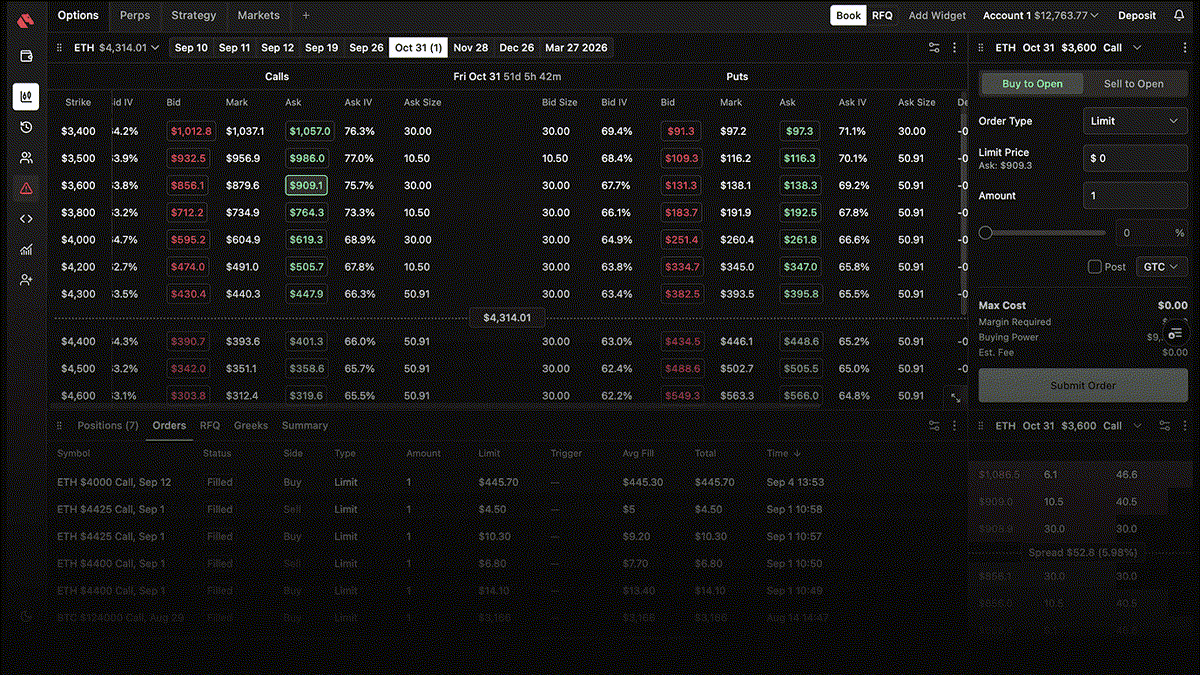


One of the most difficult problems to solve in on-chain derivatives exchanges is not about making order matching faster, but rather whether users still have sufficient information to retrieve their assets when the operator stops providing services. On October 23rd, Celestia Labs published the Derive case, which describes how this on-chain options platform continues to publish status difference data to Celestia within its V3 architecture, and coordinates this with custody and validity proofs on Ethereum. The case study also lists the platform’s scale and throughput metrics; however, since it is a supplier’s introduction to a collaborative project, not all of the commercial forecasts contained within should be taken as independent audit results.
Derive is aimed at professional traders, market makers, and funds, providing options, perpetual contracts, and inquiry-based block trades involving a variety of collateral assets. High-frequency derivatives differ from ordinary token transfers in that one account may simultaneously hold multiple positions with different directions, maturities, and collateral requirements. During periods of significant market volatility, it is necessary to maintain the ability to match trades while also ensuring that settlement and withdrawal processes are verifiable. Derive V3 is described as having a throughput capacity that has been improved by an order of magnitude compared to the previous design, and it introduces Ethereum-native hosting, proof of effectiveness, and a path for exiting the mainnet. The improvement mentioned here is a description by the project team of the architectural capabilities, and it does not imply that every actual transaction has reached this fixed multiple speed.
Why is it not enough to have just proof of effectiveness?
Proof of validity can demonstrate that a series of state changes comply with the rules, but it does not automatically provide users with all the transactional state data afterward. If the only complete transaction records are stored in the exchange's private database, and the operator becomes unreachable, users may still lack the necessary data to prove their balances and positions, even if they know that the calculations are not fraudulent. The design choice for Derive is to publish each batch of state differences to the data availability layer of Celestia, giving external participants the opportunity to reconstruct the complete ledger state. The key here is not to “add another chain,” but to move the recovery data from a single operator’s server to an infrastructure that is publicly accessible.
According to the Celestia case, user assets are located within Ethereum contracts, and the availability of this data provides the necessary status basis for withdrawal; Ethereum contracts also include a mandatory mechanism for processing withdrawals. If a withdrawal is not processed within the specified time, external participants can run the exchange program based on the data on Celestia and submit a new batch of requests. The waiting period mentioned in the text is two weeks. This mechanism may seem to imply that "withdrawals are possible even if the operator goes bankrupt," but the actual security still relies on the contract code, data integrity, the generation of proofs, and the willingness of participants to carry out takeover operations. Readers should not interpret this technical design as a guarantee of immediate withdrawals under any failure scenario.
Derive also considers lower and more predictable data publishing costs as a reason for choosing Celestia. Derivative platforms continuously generate a large number of positions and transaction statuses, and it would be difficult to provide stable quotes if they had to face fluctuating on-chain data fees with each update. According to the case study, since Derive started using Celestia in January 2024, there have been over 43,000 blob and approximately 42.52 GiB pieces of data in the relevant namespace. These numbers prove that cooperation is not just a conceptual demonstration that began on that day; at the same time, the amount of historical data does not equate to the cost of each future transaction being fixed forever, nor does it directly prove that users' funds are without risk.
The scaling indicators should be separated from the actual business performance.
Celestia pointed out that its Fibre upgrade has increased the mainnet data processing capacity to 150 MB per second, and cited higher benchmark test results from recent experiments. The available capacity of the mainnet should not be confused with the guaranteed value in a live production environment; moreover, the overall network capacity is not a throughput exclusive to any single exchange. Derive V3 claims to be able to handle more cross-margin positions, but ultimately, it still depends on factors such as order delays during severe market fluctuations, failed transactions, margin updates, and the execution of withdrawals. The more specialized an options market is, the less one can rely solely on "theoretical throughput" to represent the actual execution quality experienced by users.
The case also mentioned that Derive accounted for approximately 95% of the trading volume of options premiums on the chain at that time, with a cumulative notional trading amount exceeding 40 billion US dollars. This is the description of Celestia in the article. The statistical criteria, time window, and scope of the on-chain options market need to be verified separately; it cannot be inferred from this that it occupies the same share of the entire crypto derivatives market. The notional trading amount is not platform revenue, nor is it user profit. Confusing these different types of amounts can lead to a misinterpretation of infrastructure choices as a commitment to investment returns.
Another change brought about by the V3 architecture is more flexible integration of product releases with external wallets. If a wallet wants to provide option protection for users, it must be connected to underlying mechanisms for quoting, margin requirements, risk warnings, and settlement rules; however, the interfaces are easier to connect, but they cannot replace the review processes of these financial aspects. The volatility correlation of different collateral assets, slippage in extreme market conditions, and the transparency of settlement rules still determine whether a product is suitable for ordinary users. The scalability of the infrastructure is just one of the necessary conditions, not a proof of financial suitability.
From an industry perspective, the Derive and Celestia cases illustrate that on-chain exchanges are placing "the ability to recover" and "who holds the data required for recovery" at the center of their architecture. This choice is more noteworthy than simply pursuing a high number of transactions per second: if the data can be obtained by independent participants, then the operational party's single-point dependency can be reduced; however, if the exit strategies are only described in documents without continuous testing, they may still fail during a crisis. The most valuable verifications to come will be public failure simulations, contract audits, settlement data under real load, and records of users actually withdrawing funds, rather than the next theoretical performance chart.