Key Points
- U.S. gasoline prices have risen by about 44% since February.
- Trump defended higher fuel costs during the Iran conflict
- Despite diplomatic efforts, Brent crude oil remains above $110.
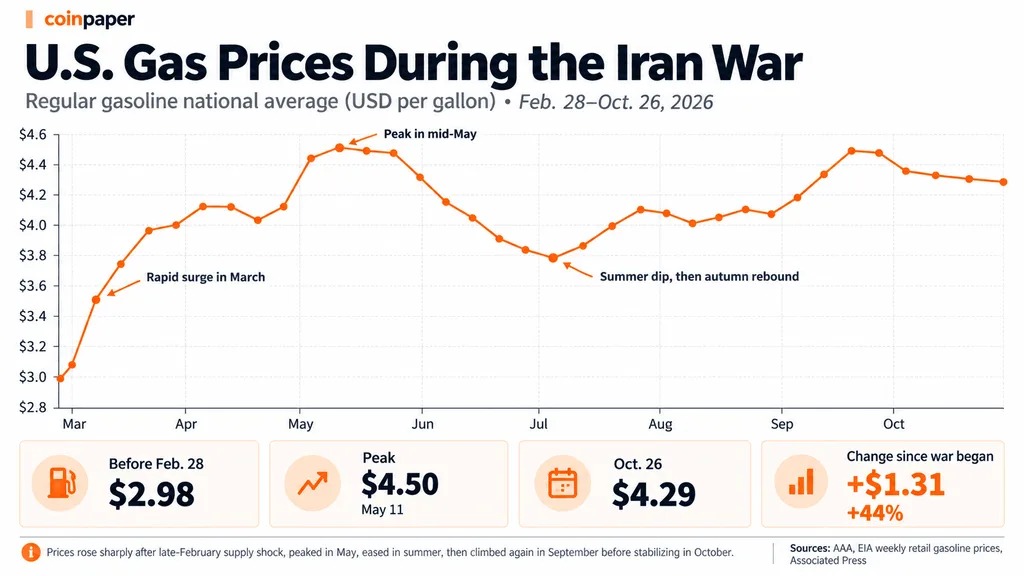
On Monday (October 26th), the average price of gasoline in the United States was still close to $4.29 per gallon. U.S. President Donald Trump defended the continuously rising fuel costs during the Iran war, stating that it was merely a "small price" to be paid in order to prevent Iran from obtaining nuclear weapons.
According to the AAA fuel price data, before the conflict began on February 28th, the national average gasoline price was about $2.98 per gallon. Based on this, gasoline prices have increased by approximately 44%, which has added nearly $20 to the cost of filling up a typical 15-gallon gas tank.
In an interview with Michigan on October 25, Trump stated that he acknowledged that war would drive up fuel costs, but believed that preventing Iran, which possesses nuclear weapons, was sufficient to justify such economic burdens. He also predicted that once the conflict ended, gasoline prices might eventually fall back to $1.85 per gallon.
These remarks come at a time when previous commitments to cheaper gasoline are once again being put to the test, due to the persistent high energy prices.
Oil Prices Today: Despite Iran's Peace Efforts, Brent Crude Remains Close to $115
After reports that Washington and Tehran are making efforts to ease tensions, crude oil prices fell on Monday. However, international benchmark oil prices remain significantly above $100 per barrel.
According to Reuters, Brent crude oil was reported at around $114.82 per barrel in morning trading, while US West Texas Intermediate crude oil was reported at around $101.19 per barrel.
On the previous trading day, Brent crude closed at $116.72 on Friday. Due to attacks on Saudi energy infrastructure, there were new concerns about supply disruptions, which led to an increase in oil prices.
The fundamental issue remains the vulnerability of the Middle East's energy supply. Attacks on Saudi facilities, as well as the shipping risks around the Strait of Hormuz, continue to support a considerable geopolitical premium in oil prices.
JPMorgan Chase recently estimated that the fundamental value of Brent crude oil is close to $94 per barrel, which means that about $20 of its market price may reflect geopolitical uncertainties rather than supply and demand fundamentals.
This estimate does not equate to a guaranteed price target. If the security situation in the region improves, the premium may fall; however, if another attack occurs, crude oil prices may continue to remain high.
Gasoline prices have risen by 44%, but the cost of diesel has a greater impact on businesses.
The rise in gasoline prices is just one part of the economic impact.
As of October 26, the price of diesel in the United States was approximately $6.35 per gallon, compared to $3.76 before the outbreak of war. The increase of about 69% has placed greater pressure on freight companies, farmers, and businesses that rely on transportation.
It is particularly important that diesel costs remain high, as higher transportation costs may ultimately be passed on to consumers through the prices of food and goods.
Recent disruptions in Saudi exports have also exposed the vulnerability of alternative routes intended to bypass the Strait of Hormuz.
Although oil exports from some Gulf regions have resumed, the shortage of refined products still exists, limiting the benefits that consumers could have gained during a brief decline in crude oil prices.
This energy shock also complicates the Fed's inflation outlook. Higher fuel and transportation costs could be transmitted to a broader range of prices, exacerbating concerns that oil price-driven inflation may keep interest rates high.
When will gasoline prices fall?
Trump has predicted multiple times that once the conflict with Iran ends, gasoline prices will drop significantly. However, the timing is still uncertain.
The oil market is simultaneously assessing the possibilities of diplomatic progress, as well as the ongoing risks faced by shipping routes, pipelines, and production facilities.
Previously, the recovery of exports in the Gulf region once pushed Brent crude oil prices below $100 per barrel, indicating that when supply conditions improve, oil prices can react very quickly.
Author: Maya Bennett
Maya Bennett is a financial journalist whose reporting covers areas including cryptocurrencies, stocks, and broader market trends. Her work focuses on Bitcoin, major digital assets, the stock market, monetary policy, as well as economic developments that influence investor sentiment. She is adept at transforming rapidly changing market news into clear and concise reports.