Key Points
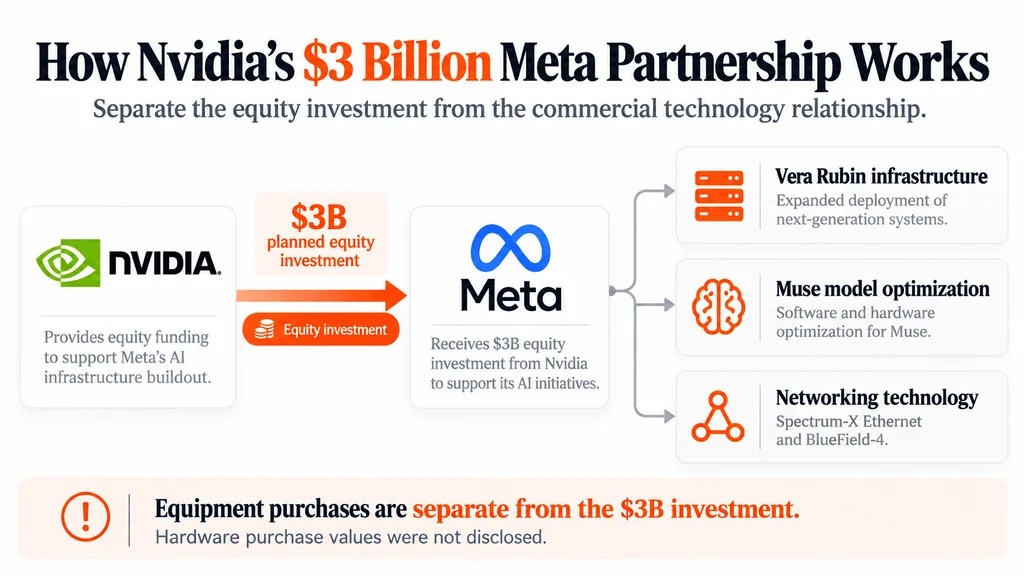
- NVIDIA commits to providing $3 billion for the equity financing of Meta
- Both parties expand cooperation on the development of Muse and the infrastructure for the next generation of AI.
- This investment has raised questions regarding the financing arrangements among the partners of AI.
On October 27th, two companies announced this agreement, which outlines plans to enhance the training and inference performance of Muse, while also expanding the deployment of Meta on NVIDIA processors and networking devices.
This investment marks another step forward for NVIDIA: it is transitioning from being a supplier of expensive AI chips to becoming a financial supporter behind the companies that purchase these chips.
NVIDIA and Meta expand cooperation around Muse AI
Muse is at the core of the development of personal AI proxies driven by Zuckerberg, and these proxies are capable of performing increasingly complex tasks in everyday applications.
This assistant was developed internally by Meta under the code name “Hatch” and can connect to services such as email, calendar, shopping, and payment. Users have the option to revoke their authorization.
Meta indicates that its Muse model has demonstrated strong benchmark test performance and a growing adoption rate among consumers. However, neither company has disclosed any new revenue data or quantifiable cost savings resulting from the expanded collaboration.
According to the agreement, NVIDIA and Meta will optimize the software and hardware that support Muse in order to improve performance and at the same time reduce the cost of running the workload of AI.
Meta also plans to increase the deployment of NVIDIA's next-generation Vera Rubin systems and Vera CPU, while adopting Spectrum-X Ethernet network devices and BlueField-4 processors.
The two companies are also considering carrying out more cooperation around the NVIDIA OpenShell architecture and Sentry monitoring technology.
These tools are designed to help developers set boundaries for autonomous AI systems. NVIDIA has previously explored this area through its AI security framework.
The AI financing of Meta brings about unusual financial relationships.
This agreement comes at a time when Meta is advancing one of its largest corporate financing plans related to artificial intelligence.
According to Reuters, the company has expanded the planned equity financing to approximately $97.5 billion, which includes funds for supporting infrastructure construction.
Coinpaper recently analyzed the financing strategy of Meta, explaining why a company with sufficient cash reserves is still seeking additional capital.
NVIDIA's participation adds another layer of significance, as Meta is already one of NVIDIA's important customers.
This chip manufacturer supplies processors and networking equipment to the data centers of Meta, and now it is also preparing to become an investor in the same business.
Such arrangements are under scrutiny because suppliers may assist in financing for customers, who then purchase their products.
Previously, NVIDIA's financing transactions raised questions from the outside world about how the AI infrastructure investments were funded, and whether the equipment would still retain sufficient value over time.
The concern is not that NVIDIA's investments will automatically lead to improper accounting practices. On the contrary, investors need to distinguish between the actual needs of end-users and the financing arrangements within the AI supply chain.
What does this $3 billion transaction pair AI mean for the industry?
For Meta, a closer integration with NVIDIA may help to improve computational efficiency as Muse reaches more users.
For NVIDIA, this arrangement strengthens the existing relationship between the two parties. Moreover, if the AI investment of Meta is successful, NVIDIA may also receive equity returns.
This collaboration is built on a broader trend: chip manufacturers, cloud service providers, and AI developers are increasingly financing each other.
Coinpaper Previously, an analysis of AI expenditure flows indicated that equipment suppliers often receive payments before the AI platform generates corresponding profits.
Recent financing arrangements by GPU indicate that expensive computing infrastructure is being funded through increasingly complex structures.
This agreement also follows previous warnings regarding the exposure of off-balance-sheet AI. In these arrangements, guarantees and special-purpose financing structures may make it more difficult to assess infrastructure risks.
Maya Bennett
Maya Bennett is a financial journalist with experience reporting on cryptocurrencies, stocks, and broader market trends. Her areas of focus include Bitcoin, major digital assets, the stock market, monetary policy, as well as economic developments that influence investor sentiment. She is adept at transforming rapidly changing market news into clear and concise reports.