

Jupiter holds 53% of the weekly lending and deposit market, while Kamino attempts to regain market share by expanding wallet integration, recruiting senior management personnel, and developing institutional credit products.
Jupiter Lend has become the leading lending protocol among Solana, ranking first in five key indicators: total deposits, total loans, utilization rate, stablecoin deposits, and stablecoin loans. Blockworks data shows that Jupiter has total deposits of $2.78 billion and outstanding loans of $1.12 billion; in contrast, Kamino has deposits of $2.17 billion and loans of $855 million. The utilization rate of Jupiter also reaches 40.34%, slightly higher than Kamino's 39.31%.
In terms of stablecoin lending, the gap is even more pronounced. Jupiter has $1.33 billion in stablecoin deposits and $907 million in stablecoin loans. Kamino has $652 million in stablecoin deposits and $532 million in stablecoin loans.
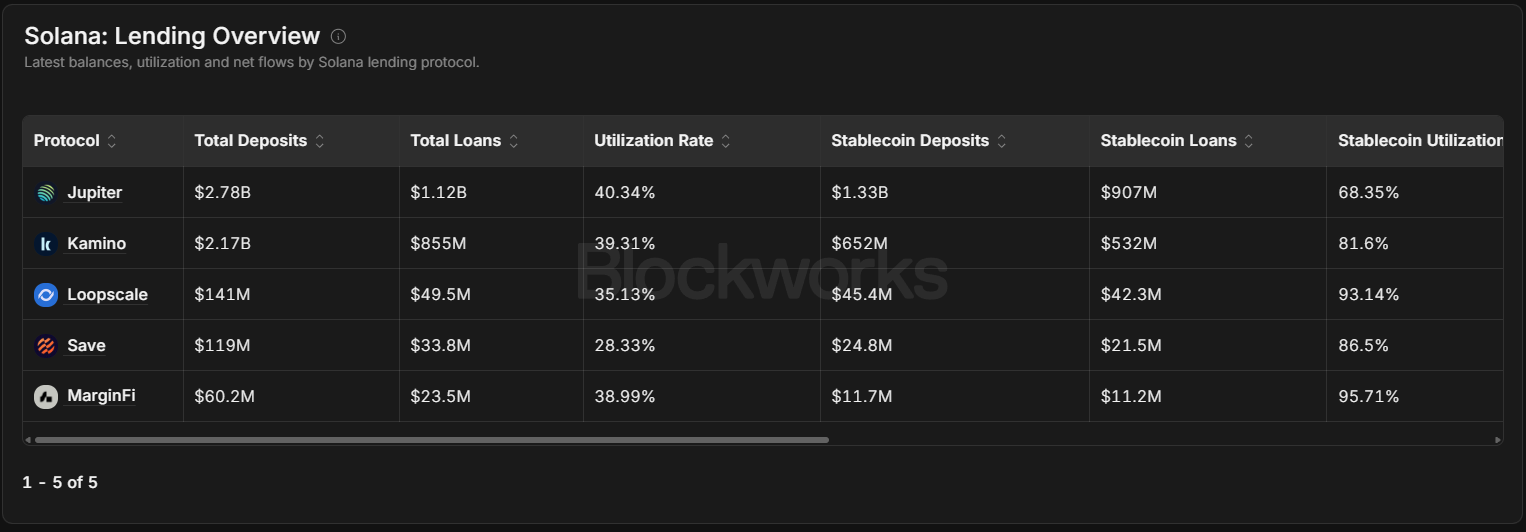
These data indicate significant changes in the Solana lending market. Previously, Kamino had established itself as the major credit platform in that market.
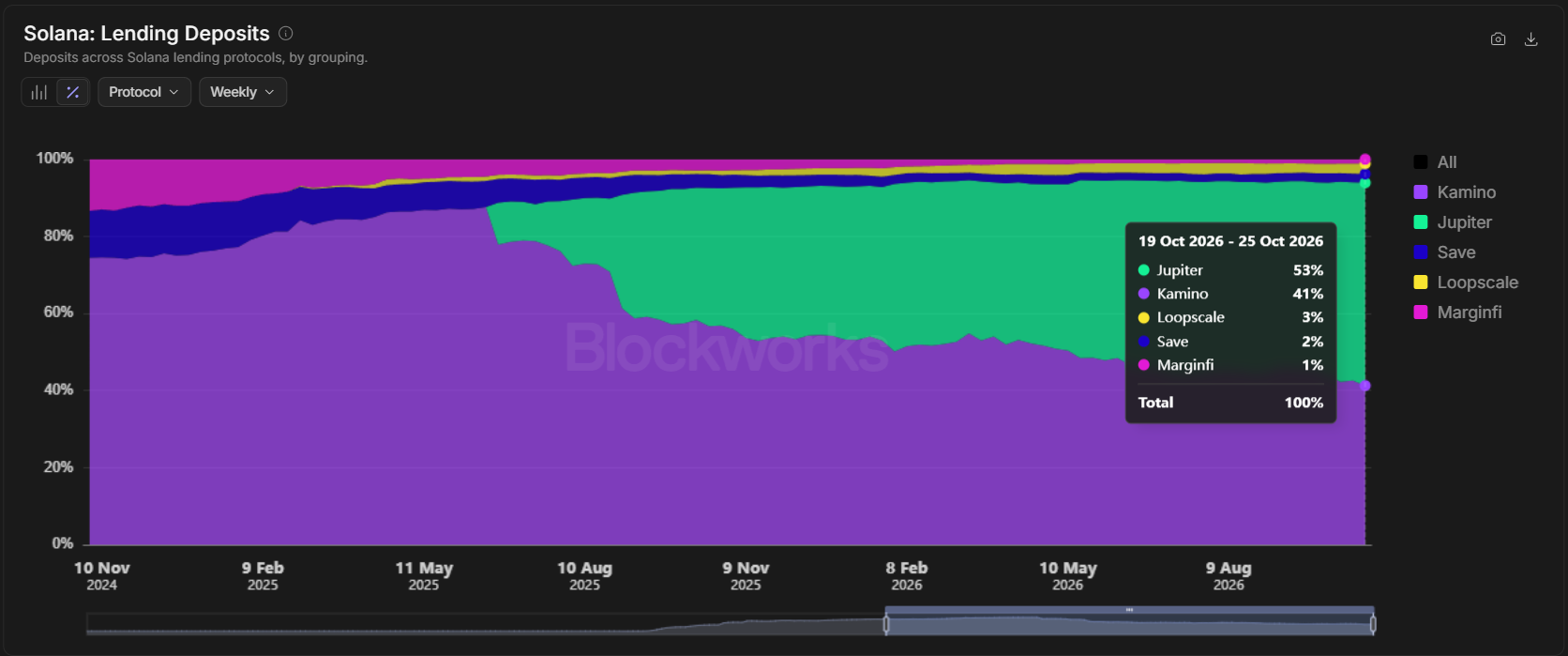
Although the lead of Jupiter is expanding, Kamino continues to gain integrations with well-known products in the Solana ecosystem. In August this year, Solana Mobile launched a USDC Earn Vault within the Seeker smartphones. This product allows users to deposit USDC into the lending infrastructure of Kamino and earn profits without leaving their wallets, with no lock-up period and no withdrawal fees charged.
Earlier today, Solflare launched a new product, Earn, which allows users to deposit USDC into the lending market of Kamino and earn interest directly from their wallets.
Jupiter continues to expand its DeFi product stack
After securing a leading position in the lending market, Jupiter has not slowed down its expansion efforts. Earlier today, this trading platform launched a beta version of its "super app" Jupiter Bridge. This cross-chain bridge aggregator will compare the fees of Relay, Mayan, Circle CCTP, NEAR, and other providers, helping users find more competitive routes when transferring assets in and out of Solana.
This release adds another service to the continuously expanding DeFi ecosystem of Jupiter, which previously already covered a variety of different businesses in its product portfolio.
As Jupiter has expanded from its core DEX aggregator business to include lending, wallets, and other products, some observers have questioned whether the team has spread itself too thin, potentially facing the risk of losing focus. Its current dominant position in the lending sector has challenged these doubts. However, its once absolute advantage in the DEX aggregator field is beginning to weaken. Blockworks data shows that its trading volume share has dropped from a high of 94% in February 2026 to around 60% at present. In the perpetual contract market, Jupiter is also facing fierce competition from platforms such as GMTrade and Pacifica.
Solana Whether this "super app" will be able to maintain its leading position in the lending field and regain its advantages as a seasoned DEX aggregator, or whether its continuously expanding product line will overstretch its competitive edge remains to be seen.