Key Points
- BNY Added institutional hosting support for XRP and RLUSD
- Ripple Expands Cooperation to Stablecoin Issuance and Redemption
- Both parties are exploring tokenized trade financing with C2FO.
BNY has incorporated the stablecoins of XRP and Ripple into its institutional digital asset custody platform, expanding this Wall Street partnership. In the future, this collaboration may support the issuance of stablecoins, tokenized investments, as well as trade financing on XRP Ledger.
The two parties announced this expansion during the Ripple Swell 2026 event held in New York on October 27th. BNY is one of the largest financial custodian institutions in the world, with assets under custody or management amounting to 63.4 trillion US dollars as of September 30th.
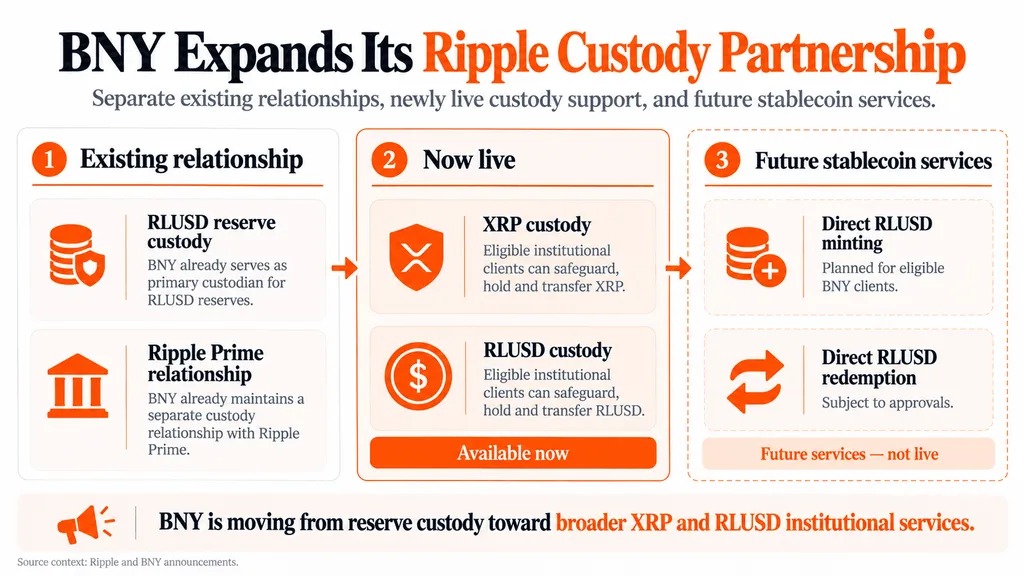
According to the official announcement of BNY, eligible institutional clients can now safely store, hold, and transfer XRP and RLUSD through the bank's digital asset custody platform.
BNY extends the custody of XRP beyond the reserves of RLUSD.
This announcement marks a significant expansion of the existing cooperative relationship between the two parties.
This distinction is very important, as holding assets that support stablecoins is not the same as providing blockchain token custody for institutions.
Coinpaper previously reported that as Ripple expands its stablecoin infrastructure, BNY provides custody services for its reserves.
The new services of BNY also enable institutional investors to access XRP – the native cryptocurrency of XRP Ledger – rather than focusing solely on the US dollar-pegged tokens of Ripple.
The scale of this entity is quite considerable. It manages and oversees assets totaling 63.4 trillion US dollars, with an additional 2.2 trillion US dollars in assets under its management.
However, these figures reflect the overall business scale of BNY, and do not represent the asset scale held by XRP or transferred to XRP Ledger.
Ripple and BNY plan to directly mint RLUSD and advance tokenized finance
Both parties plan to allow eligible BNY customers to directly mint and redeem RLUSD through this channel.
They are still exploring providing broader custody support for tokenized investment products issued on XRPL.
Both of the above plans still require final approval from BNY and regulatory authorities, and the launch dates have not yet been disclosed.
Ripple indicates that the market value of RLUSD has reached approximately $2.5 billion, while XRP Ledger has processed over 4.6 billion transactions since its launch.
These developments come shortly after Ripple recently received approval from the federal bank, which adds another layer to the infrastructure of its regulated institutions.
Ripple has also expanded its institutional tokenization business through Franklin Templeton and Aviva Investors.
These measures indicate that the interest of the financial industry in XRPL infrastructure is on the rise, but it does not mean that there will be a similar scale of purchases for XRP.
C2FO Collaborates to Focus on Blockchain-Based Trade Financing
BNY and Ripple are still exploring supply chain financing projects with C2FO – an operating capital platform that connects enterprises with financing providers.
The proposed system will use XRPL to digitally represent approved accounts receivable, which may make it easier for institutional investors to finance and manage them.
Unlike direct token purchases, trade financing involves providing funds for real business obligations, including invoices owed to suppliers.
This plan is built upon the broader institutional hosting strategy of Ripple, which increasingly integrates asset custody with tokenization and settlement infrastructure.
This also continues the company's agenda on Swell 2026, where institutional finance has become a core theme.
Marcus Hale
Marcus Hale is a cryptocurrency and financial markets contributor who reports on Bitcoin, Ethereum, digital assets, regulation, ETF, and institutional adoption. His work focuses on driving market-changing developments, investor trends, and the broader forces shaping the crypto economy.