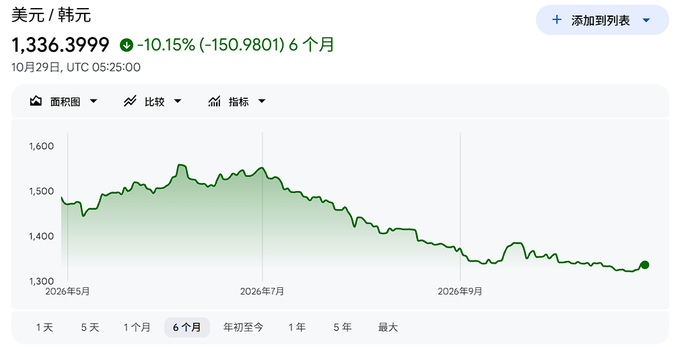
The Korean won appreciated significantly by about 13% against the US dollar in the third quarter of this year, recording the largest single-quarter increase since the fourth quarter of 1998. Hwang Kunil, who is regarded by the market as the most dovish member of South Korea's central bank's monetary policy committee, has publicly warned that the recent appreciation rate of the won has exceeded expectations, and that close attention needs to be paid to the risks of exchange rate fluctuations.
Hwang Kunil states: 'When evaluating exchange rates, what should be focused on is volatility and the speed of change, rather than the absolute level. The recent appreciation of the Korean won has exceeded expectations to some extent, and we are closely monitoring the volatility.' He also pointed out that once the effects of the huge current account surplus and the rebalancing of foreign capital are fully absorbed, downward pressure on the exchange rate will continue to exist. This is the first time Hwang Kunil has publicly expressed his views on the trade-offs of monetary policy since joining the central bank committee in February 2024.
At the time of this warning, the Bank of Korea chose to remain inactive after raising interest rates twice in a row this month, keeping the benchmark interest rate at 3.00%. However, it did not close the door to further tightening measures. While the strong Korean wone has helped to curb inflation, it has also impacted the export-oriented economic structure and exacerbated the operational difficulties of small and medium-sized enterprises, putting monetary policy in a dilemma.
Korean won quarterly increase reaches its highest in nearly thirty years, AI chip demand is the main reason
The Korean won appreciated by about 13% against the US dollar in the third quarter, marking the largest single-quarter increase since the fourth quarter of 1998. Hwang Kunil attributes the main driving force behind this appreciation to the large-scale inflow of US dollars brought about by the global boom in artificial intelligence infrastructure construction – the strong demand for AI computing power has driven a surge in demand for specialized memory chips produced by South Korea's top chip manufacturers, SK Hynix and Samsung Electronics, thereby attracting a large amount of US dollar funds into South Korea.
Hwang has previously served as the Deputy Minister of Finance of South Korea and an Executive Director of the World Bank, and is a senior financial diplomat from South Korea. During Trump's first term in office, he was in charge of South Korea's exchange rate policy and faced significant external pressure when he criticized Seoul for deliberately creating a large current account surplus in Washington.
Hwang predicts that this year's current account surplus in South Korea may be raised from the central bank's forecast of $450 billion in August to nearly $500 billion. He also pointed out that if global AI spending slows down and the surplus shrinks by about $50 billion (about one-tenth of the total surplus), "of course" it will hit export-led growth – but he also stated, "This period of prosperity may continue for even longer."
Export competitiveness under pressure; the impact of a strong Korean won does not benefit everyone equally.
Although strong currencies usually help to reduce import costs, Hwang Kunil clearly states that exports remain the cornerstone of South Korea's macroeconomic structure. "The importance of exports is not what it used to be, but they are still a pillar of our economic structure," he said.
The rapid appreciation of the Korean won directly weakens the price competitiveness of South Korea's export goods, putting pressure on manufacturing enterprises that rely on overseas markets. Hwang indicates that despite strong export momentum, the positive effects of economic growth have not been evenly distributed. The recovery of private consumption is still slow, and the benefits of economic prosperity are highly concentrated among specific groups.
"The positive effects are limited to specific groups, while high interest rates and high prices affect everyone," he said, "The ultimate outcome depends on which side has more power."
The default rate of small and medium-sized enterprises is rising, and the real economy is suffering from asymmetric impacts.
Hwang Kunil expressed clear concerns about the situation of small and medium-sized enterprises.
He pointed out that the default rate among small and medium-sized enterprises continues to rise, domestic demand is weak, and operational pressures are significant. What is even more concerning is that the borrowing activities of these enterprises are not used for capital investment but are mainly used to cover immediate operating costs such as salaries and raw materials. This phenomenon reflects deep-seated hidden dangers in the quality of the enterprises' balance sheets.
Reports indicate that, against this backdrop, the strong Korean won has had an asymmetric impact: large export enterprises are still able to absorb the exchange rate pressure thanks to the demand for AI chips, while small and medium-sized enterprises (SMEs) are unable to benefit from the booming exports and face the dual pressures of high financing costs and tight operating capital in a context of high interest rates.
Inflationary pressures are under strain, leaving monetary policy in a dilemma.
Regarding the inflation outlook, Hwang Kunil provided a clear timeline: it is expected that overall consumer price inflation will begin to approach the central bank's target of 2% by the end of the first half of 2027 and will be fully stabilized at that target level by the end of 2027 or the beginning of 2028. He emphasized, "Of course, what needs the most attention at present is the trajectory of inflation."
The appreciation of the Korean won objectively exerts a restraining effect on the inflationary path—lower prices of imported goods help to curb prices, which may, to some extent, accelerate the process of inflation returning to target levels. However, this also complicates the policy decisions of the central bank:
- On one hand, energy price risks and economic resilience support the necessity for further tightening;
- On the other hand, rapid appreciation of exchange rates, pressure on small and medium-sized enterprises (SMEs), and weak consumer recovery pose constraints on excessive tightening measures.
The South Korean central bank maintained its interest rate at 3.00% this month, pausing after two consecutive rate hikes, but clearly retained the option to raise rates further.
As one of the most cautious members of the committee, Hwang voted against the interest rate hike decision in August. His recent public warning about the speed of exchange rate appreciation further highlights the divisions within the central bank regarding policy orientation, as well as the difficult situation of seeking a balance between exchange rates, inflation, and the real economy.