Multiple studies have shown that trust is the real obstacle to the large-scale deployment of proxy AI; 58% of respondents indicated that the industry still lacks clear and responsible AI standards.
Toronto and New York, October 29, 2026 / PRNewswire / -- According to the report " Responsible AI in Life Sciences ( RAIL ) 2026", life science companies are establishing governance mechanisms to deploy agent-based AI on a large scale in commercial, medical, and patient-related activities. This new industry study is based on roundtable discussions and surveys of executives from pharmaceutical, biotechnology, and medical device companies. Two-thirds (64%) of the respondents indicated that their organizations have already established relatively mature AI governance processes or are in the process of developing them.
This research, conducted by ACTO, shows that the life sciences industry is ready to adopt AI, but is still working to build trust. Governance is the most frequently mentioned issue related to AI by executives, and it is also one of the aspects that they admit is most easily overlooked in practice. More than a third of the respondents still do not have a clear governance mechanism, or rely only on one-time IT approvals.
Trust is an obstacle to large-scale adoption.
These results indicate that in the future, the speed and scope of deployment of AI in the life sciences industry will depend on trust, rather than being primarily limited by technology. Executives believe that regulatory, legal, or compliance concerns (21%) are the biggest internal obstacles to the large-scale adoption of AI, while technical readiness is ranked lower (9%). When asked about the most important indicators for evaluating AI pilot projects, executives listed trust and adoption rate (24%) ahead of efficiency (23%), indicating that the criteria for measurement are changing.
Executives feel more confident when they personally use AI than when it is deployed at the company level. Over two-thirds of executives (68%) have participated in their organization's AI projects, and 69% consider themselves to have a high personal comfort level with AI. However, more than half (54%) are still concerned about the way AI is being used within their companies. 58% of respondents stated that the life sciences industry lacks clear, responsible AI industry standards.
Arctic Therapeutics, the Chief Legal Officer and Operations Director, and Lisa DeMarco, the host of the RAIL roundtable discussion organized by ACTO, stated: "The discussion reflected a wide range of views and experiences across the industry in terms of understanding, adopting, and supervising AI. An important topic during the discussion was the need for practical guidance to help organizations assess the credibility of AI, while always putting patient safety first."
Governance is the foundation of trust.
Executives describe governance as a continuous operational model that far exceeds the scope of initial approval. This requires designating business owners, clear escalation processes, and standard operating procedures ( SOP ), as well as the ability to deploy and revoke AI proxies and implement governance at both proxy and sub-proxy levels. The issue is that ownership is still not clear. As for who should ultimately be responsible for the actions of the AI proxies, executives cited different answers: end-users (34%), legal and compliance departments (28%), third-party AI suppliers (22%), and IT departments (16%).
Data shows that the responsibility may lie more with end-users, as a considerable portion of AI usage occurs outside of approved systems. Nearly a quarter of organizations (23%) do not monitor or discuss employees' use of unauthorized AI proxies, and executives participating in roundtable discussions also mentioned that employees have built their own proxies without any governance mechanisms in place. The gap between the adoption of AI and supervision seems to be becoming a point of breakdown for trust throughout the industry.
The industry is rapidly shifting from its initial priorities to future development.
Executives hope that AI can improve its performance, and that the evaluation method should be fair. Four-fifths (79%) agree that the risks and return on investment of AI should be measured based on the current human-led work methods and their own error rates. Improving results and effectiveness (29%) is listed as the most important expected benefit, significantly higher than budget savings (10%) and risk reduction (8%).
In the view of executives with the most mature experience in AI, each use case should be ranked according to value and governance difficulty. Most organizations start with easier-to-manage tasks, such as review and approval processes, call preparation, information recording, triage, and coaching. Although two-thirds of the respondents are already advancing with the AI project, the focus is shifting to more complex tasks: system interconnection, full product launch support, and coordination between multiple agents. Whether it's agents supporting frontline sales representatives or those supporting medical liaison personnel, they must work collaboratively with multiple systems as well as the AI agents embedded within these systems. This also brings new issues: which results can be trusted, and who is responsible for those results.
Human factors remain the main bottleneck. Change management is a challenge that arises repeatedly in every roundtable discussion. When asked about the most essential abilities that humans need to retain, 45% of respondents chose judgment, followed by interpersonal skills (31%) and strategic capabilities (24%). The report recommends redefining job responsibilities more meticulously to clarify which tasks should be handled by AI, and which should still be performed by humans.
Introduce a unified standard of trust: RAIL rating
To provide a common reference for the industry, RAIL offers an evaluation framework for any AI systems, scoring them across six responsible AI dimensions: governance, security, testing and certification, people-oriented approach, value creation, and orchestration. Each dimension is rated as "high" – reliable enough to be used in the life sciences industry; "medium" – with specific gaps that need to be addressed prioritarily; or "low" – not usable. The report also comes with a variety of tools, including self-assessment forms, supplier evaluation checklists, AI proxy role description templates, and a 90-day go-live checklist.
ACTO, Co-Founder and CEO, stated: "The industry no longer debates whether proxy AI should be used. Executives now want to know which systems are trustworthy enough for large-scale deployment, but there is currently no unified standard to answer this question. Any proxy AI system must establish appropriate security and governance. The RAIL rating provides a consistent method for evaluating systems according to the standards required by regulated industries, allowing trust to be based on evidence rather than on vendor propaganda."
Methodology
The " Responsible AI in Life Sciences ( RAIL )2026" report is based on 8 offline executive roundtable discussions involving 80 executives from North America and Europe, conducted from February to April 2026. It is also based on an online survey that targeted 135 executives from pharmaceutical, biotechnology, and medical device companies between June 8 and July 17, 2026. Nearly all respondents (97%) held positions at the director level or above, covering areas such as business, medical affairs, legal and compliance, learning and development, and marketing.
The free RAIL 2026 report and related tools are now available at acto.com / RAIL.
For further information on the results, you can sign up for the upcoming webinar "Responsible AI in Life Sciences: Executives' Views on the Large-Scale Development of Proxy AI", which will take place on Wednesday, November 4th, at 11:00 a.m. Eastern Time in the United States.
About ACTO
ACTO helps life science companies bring treatment options to patients after obtaining regulatory approval. Its first-line excellence platform based on AI and its AI super agents can accelerate product launch, strengthen frontline execution, and deepen customer interaction with both business and medical teams. ACTO can improve training and coaching efficiency, and automate up to 30% of the work in customer-facing roles. This enables sales representatives, medical liaison personnel, and their managers to focus more on interpersonal relationships, judgment, and strategic execution. Fourteen of the world's top 50 pharmaceutical companies are using ACTO, in addition to rapidly growing biotechnology companies and leading medical technology enterprises. ACTO has passed the 21st part of verification through FDA, obtained SOC 2 Type II certification, and is a Veeva Gold product partner. For more information, please visit www.acto.com.
Research Highlights: The 2026 "Responsible AI in the Field of Life Sciences" Report
The 2026 report RAIL is based on 8 executive roundtable discussions involving 80 senior managers from North America and Europe, as well as an online survey of 135 executives from pharmaceutical, biotechnology, and medical device companies. Nearly all respondents (97%) held positions at the director level or above. The study examined how life science organizations assess, govern, and deploy proxy AI on a large scale during the commercialization process.
Governance is a decisive issue.
Nearly two-thirds (64%) indicated that their institutions have established relatively mature AI governance processes (22%) or are in the process of formulating them (42%).
More than one-third (36%) do not have a clear governance mechanism (21%), or rely solely on a single approval process (15%).
Governance is the most frequently mentioned AI issue in roundtable discussions, and executives also describe it as the aspect of practice that is most easily overlooked.
Responsibility for this still remains unclear. There is disagreement among senior executives regarding who should be responsible for the proxy actions of AI: end-users (34%), legal and compliance departments (28%), AI suppliers (22%), and IT departments (16%).
Nearly a quarter (23%) did not monitor or discuss employees' use of unauthorized AI proxies. 37% of respondents considered this to be a serious security violation.
Trust may actually be the real obstacle to growth.
More than half (58%) indicated that the life sciences industry lacks clear and responsible AI standards.
More than half (54%) are concerned about the way AI is used within their organizations, even though 69% of people claim to be very familiar with AI.
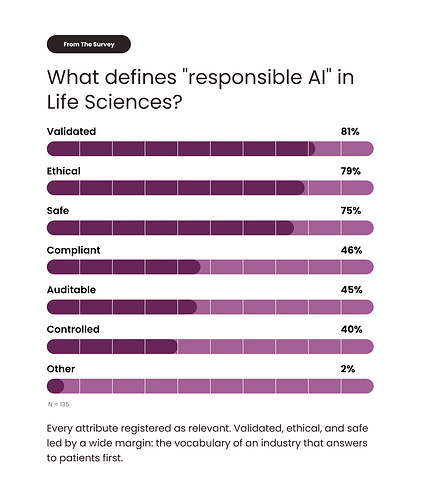
Executives define AI as verified (81%), ethical (79%), and secure (75%). A relatively smaller number choose compliance (46%), audibility (45%), or controllability (40%).
Four-fifths (79%) agree that AI risk and return on investment should be measured based on the current human-led approach to work.
Trust and adoption rate (24%) are slightly higher than efficiency (23%), risk (21%), and return on investment (18%), making them the most critical indicators for measuring the success of the pilot program.
From current priorities to future development
Two-thirds (68%) of people have already participated in the AI project of their respective institutions.
Get started now (high value, easy to manage): review and approval processes, preparation before calls, information recording, triage, coaching.
Subsequently, advancing to higher value areas (where governance is more challenging): system interconnection, support for the launch of complete products, and coordination among multiple agents.
Delay or restriction: Any content that may reach patients or regulatory authorities directly without human intervention.
Improving results and performance (29%) is considered the most important expected benefit, ahead of efficiency (25%) and productivity (24%). Budget savings (10%) rank lower, while risk reduction comes at the bottom of the listed benefits (8%).
The main obstacles come from the organizational level.
The main obstacles to development are regulatory, legal, or compliance concerns (21%) and the lack of comparable measures for investment return (20%). Technological readiness ranks lower (9%).
Executives mentioned three major pressure factors driving the adoption of AI: accelerated commercialization, tighter budgets, and the pressure to accelerate the adoption of AI even in the absence of a clear strategy.
Personnel reorganization is the real bottleneck to growth. Executives stated that the key abilities that humans must retain are judgment (45%), interpersonal skills (31%), and strategic capabilities (24%).
RAIL Rating
RAIL Ratings evaluate any proxy AI systems from six dimensions: governance, security, testing and certification, people-oriented approach, value creation, and orchestration.
Each dimension is scored from 1 to 3, with a total score of 18 points: high (16–18 points), medium (12–15 points), or low (12 points or below).
Security and governance are the fundamental pillars. If either of these aspects scores less than 3 points, the system can only be classified as low-level.
The free RAIL 2026 report and related tools are now available at acto.com / RAIL.
For further information on the results, you can sign up for the upcoming webinar "Responsible AI in Life Sciences: Executives' Views on the Large-Scale Development of Proxy AI", which will take place on Wednesday, November 4th, at 11:00 a.m. Eastern Time.