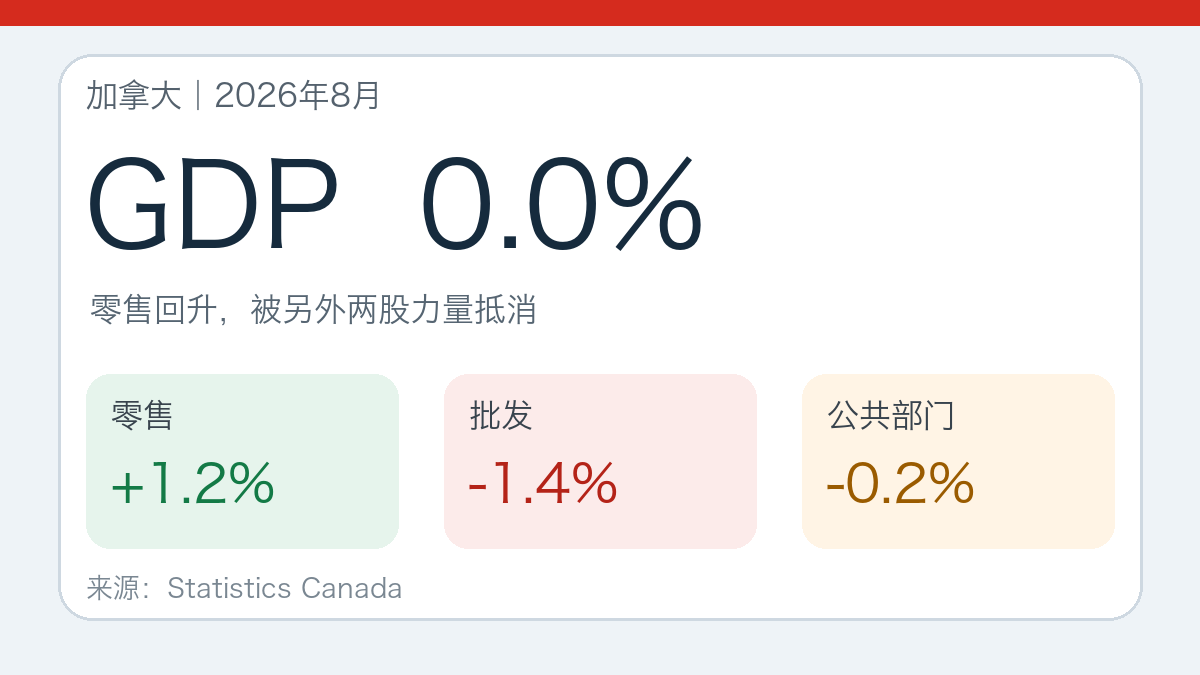


In August, Canada's real gross domestic product (GDP) showed almost no change, remaining stagnant for the second consecutive month. On October 30th, Statistics Canada announced that out of 20 industries, 9 experienced expansion: retail trade grew by 1.2%, and manufacturing by 0.3%; however, wholesale trade declined by 1.4%, as did the public sector. This "zero growth" in the overall figure is the result of several opposing industry trends canceling each other out.
If one only looks at the national GDP figure, which is close to zero, it's easy to assume that all activities weakened in August. However, sub-items show that consumer activity in stores has clearly rebounded, and some manufacturing and transportation sectors are also growing; the drag comes from different areas such as wholesale, public administration, automobile manufacturing, and oil and gas extraction. The economy has not uniformly hit the brakes, but rather, momentum is being reallocated among different industries.
The store side is back, but the car chains are one hot and one cold.
Retail trade grew by 1.2% in August, offsetting the decline in July. Automobile and parts dealers saw a rise of 1.8%, food and beverage retail increased by 1.3%, general merchandise retail grew by 1.5%, and health and personal care retail also increased by 1.3%. Gas stations and fuel sellers experienced a decline of 0.6%, which lowered the overall growth rate of retail trade.
Automotive-related data shows contrasts at different stages of the industrial chain. While there is growth on the dealer side, the manufacturing of transportation equipment has declined by 3.1%, with the production of automobiles and parts falling by 5.8%. The statistical bureau links this decline in manufacturing to a large automobile assembly plant extending its summer shutdown period. An improvement in end-sales does not necessarily mean that local production also increases during the same month; inventory levels, imports, and production arrangements can result in different trajectories for these two sectors.
The manufacturing sector as a whole still saw a 0.3% increase, marking the fifth growth in seven months. Machinery manufacturing grew by 3.8%, and oil refining increased by 4.2%, with some refineries resuming production after unplanned maintenance in July. This combination indicates that the positive growth in manufacturing does not come from the automotive industry, but rather other sectors have filled the gap.
Wholesale and public management have become the biggest burdens.
Wholesale trade declined by 1.4%, which was the largest negative contributor in August. Wholesale of automobiles and auto parts fell by 4.4%, marking the first contraction in seven months, and this coincided with a decrease in imports of passenger cars and light trucks, as well as weaker automobile manufacturing. Wholesale of building materials and supplies rose by 0.5%, but this could only partially offset the decline.
The total in the public sector decreased by 0.2%, marking the first decline in six months. Federal public management (excluding defense) saw a decrease of 2.1%, mainly due to the ongoing finalization of the 2026 census work. This change is clearly influenced by temporary projects and cannot be directly equated with a comprehensive reduction in public services.
The resources department also did not provide any increment. Overall, mining, quarrying, and oil and gas extraction remained almost unchanged; the mining sector rebounded after previous production disruptions, with potash mining increasing by 12.0%, and the extraction of other metal ores significantly recovered. However, oil and gas extraction decreased by 1.2% for the third consecutive month. Oil sands extraction fell by 2.1%, with facility maintenance being the main reason for this decline.
The initial value at the beginning of September showed a slight decline, but it may still be revised.
The September forecast from Statistics Canada indicates that the actual GDP is likely to decline by 0.1%. The declines in manufacturing, as well as mining, quarrying, and oil and gas extraction, may be partially offset by growth in utilities and wholesale trade. Since this is a preliminary estimate, the official data will be updated when it is released on November 30th.
Based on the initial figures at the beginning of September, information compiled by industry statistics indicates that the economy may grow by 0.3% in the third quarter. The official quarterly GDP figures, calculated based on income and expenditure, will not be released until November 30th. Since the monthly data compiled by the Industry Department and the quarterly expenditure data use different methodologies, the current figures are suitable for indicating the general trend but cannot replace the official quarterly conclusions in advance.
For ordinary families and businesses, this set of data also highlights a common misconception: a stagnation in the overall macroeconomic figures does not mean that everyone is facing the same circumstances. Retail businesses that have seen a recovery may feel an improvement in customer flow, while the automotive assembly, wholesale, and oil and gas industries are still dealing with shutdowns, imports, and maintenance schedules. To determine whether demand has truly strengthened, it will be necessary to see whether the production side can keep up with the consumption side after these short-term disruptions subside.
The truly noteworthy scenes of August were not a flat line, but rather retail, manufacturing, wholesale, and the public sector all moving in different directions simultaneously. The rebound in consumer activity did not boost the overall volume, as car production, the wholesale sector, and the end of temporary public jobs offset it. The Canadian economy did not experience significant expansion that month, nor did it contract in every corner; the shift of growth momentum from one set of industries to another determined that the overall volume ultimately stayed near zero.