Five years ago, I did something that seemed rather absurd at the time: I bought an electric mini-truck worth $2,000 from China, shipped it across the ocean to the United States, and made it work on my parents' property in Florida.
This white small electric truck later became unexpectedly popular online. My initial unboxing and testing videos quickly gained over 10 million views, and subsequent videos brought in millions of more views.
It has also attracted many skeptics who firmly believe that a Chinese electric truck costing $2,000 will fall apart or rust to the point of being unusable within a few months, or that it will prove to be a complete fiasco in some other way. A common joke is, "Fortunately, it has a cargo bed, so the parts that fall off on the road can at least be put back on again."
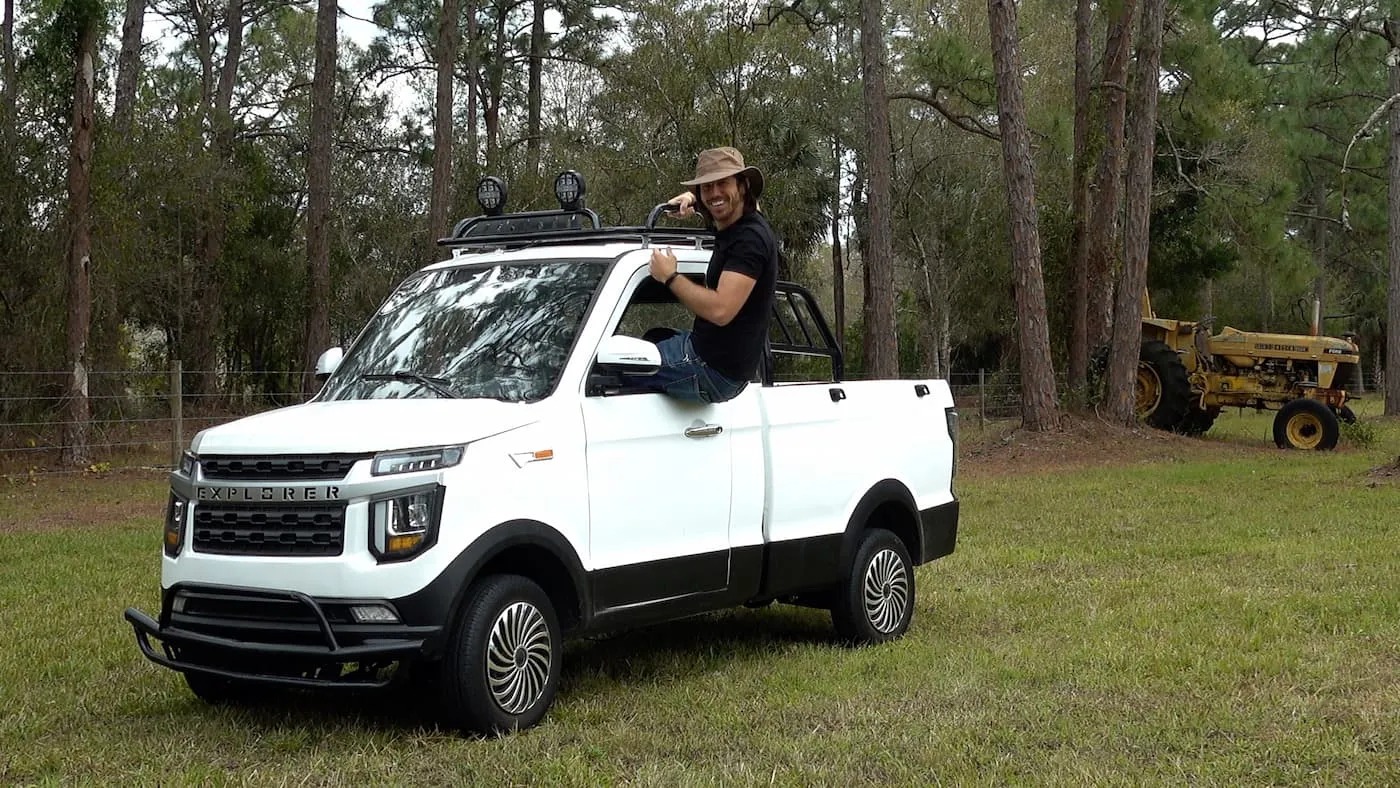
I made an update after the first year, and at that time, it showed that the car was in very good condition. But to be fair, one year doesn’t really tell us much.
It's been over five years now, and I recently returned to Florida to see how this little truck had performed after being used on my parents' property for that time. I have to say, the results were quite surprising.
This is the real condition of this car five years later. Oh, by the way, if you want to see how it actually works, you can watch my update videos. Trust me, you'll want to.
Five years of genuine labor
First and foremost, it's important to understand that this car hasn't just sat idle in the garage for five years, serving merely as some kind of novelty toy. It has always been the real “workhorse” on my parents’ 10-acre property.
Over the years, we have used it to transport coverings, sand, wood, branches, logs, yard waste, and all sorts of other materials.
Its hydraulic dump bucket is particularly useful, suitable for transporting bulk materials within a residential area, such as delivering mulch, and then directly dumping it into elevated planting beds.
My father even used it as a mobile irrigation vehicle during the dry season in Florida. I built a solar water pump system for him, which could pump water from the pond into the storage bags in the truck bed, allowing him to drive around watering the trees and plants.
So far, this vehicle has been involved in almost all of my parents' major gardening and construction projects.
Over the years, we have also made some modifications. In the early stages, my father and I replaced the factory-installed suspension springs, which were incredibly stiff, with softer springs, which significantly improved the riding comfort. We also added a custom trailer hook and switched from the original road tires to more aggressive off-road tires, which performed much better on the sandy and muddy terrain of our backyard.
However, the suspension upgrade also reduces the weight we can comfortably carry. If more than about 500 pounds (220 kilograms) of sand or other bulk materials are loaded into the cargo bed, the rear of the vehicle will sink significantly, to the point where our homemade trailer hook is almost touching the ground.
But for most of our work, it has always been an excellent small multi-purpose vehicle.
Before anyone asks, let me clarify: no, this is not a truck that can be legally used on public roads. It was never designed for American roads in the first place, and we almost exclusively use it on private property. Although it’s common to see tractors and other vehicles that are not legally permitted on public roads in remote areas and on country lanes, it’s certainly not ideal to drive it on paved roads at a speed of 25 miles per hour (40 kilometers per hour) over long distances.
So, what exactly went wrong after five years?
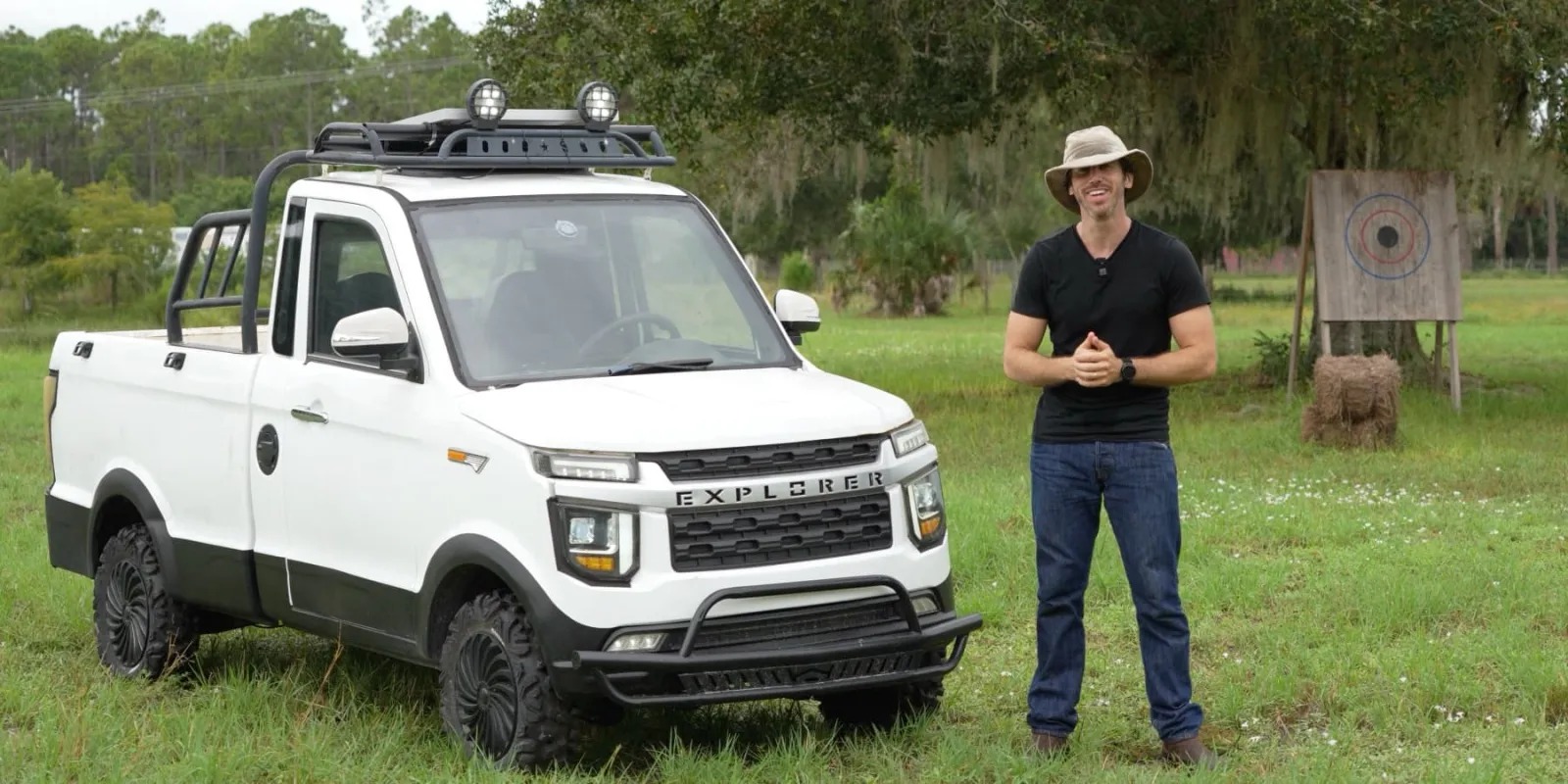
What surprised me the most was that almost everything was still working normally.
The electric windows still rise and fall as quickly as a guillotine. The electric door lock works. The headlights work. The reverse camera works. Even the air from the air conditioner is still surprisingly cold.
Of course, not everything is perfect either.
The wipers are still functional, but their range of motion has significantly decreased. Now they stop near the middle of the driver's field of vision, which is clearly not ideal when the famous afternoon thunderstorms in Florida hit.
The rearview mirror has also developed an annoying problem: it always falls off. We’ve stuck it back on several times already, and it seems like we’re about to go through another “glue surgery” soon.
On the inside of the vehicle, there is some minor damage to the interior of the driver's seat, including several small cracks and areas where the cheap imitation leather material has torn due to stress. These can be seen in the video.
The passenger seats, due to being used much less frequently, still look almost new. In a few more years, I might swap the two seats around in order to get another half a decade of use before it’s necessary to repair the interior.
A piece of decorative plastic around the driver's door handle has come off, but I still have that part saved. With a bit of effort, I should be able to fit it back in place. It's just a cosmetic issue, so it hasn't been a priority for repairs.
Basically, that's all the mechanical and electrical problems we've encountered.
There were no major faults with the power system, and the hydraulic dump bucket was still able to function. The reliability of this vehicle in starting and driving is also similar to that of a new car.
It is still often used for various types of bulk transportation and material delivery, and sometimes it is simply used for casual commuting within residential areas.
So what about the so-called claim that "Chinese steel will rust and deteriorate"?
Five years ago, one of the most common predictions from critics was that this cheap Chinese truck would quickly rust into a pile of scrap metal.
To be fair, there is indeed some rust, but it's not as severe as you might imagine.
Most of the corrosion is concentrated in the areas where the paint has been scratched or chipped off, especially around the tailgate and the cargo bed.
The most severely rusted area is definitely on the upper edge of the tailgate, because we often extend long objects such as shovels, ladders, and wood out of the cargo hatch. The paint on that edge has worn through, and rust inevitably starts to appear from those areas.
This car is usually parked under a makeshift shelter I built between two containers, but there's a skid loader parked in front of it, so the rear of the truck is exposed to the weather. As a result, it gets rained on several times a week, and even several times a day during the summer.
In the first year of using this vehicle, we applied a coating-type cargo bed liner to the cargo bed, which helped to protect the metal for a considerable period of time.
However, after four years of handling soil, stones, branches, and other abrasive materials, this coating has begun to wear through in some areas.
Every time I use a shovel to scoop out the covering material from the cargo bucket and hear the sound of metal rubbing against metal, my heart skips a beat. Then I remember that this car only cost me $2,000, and in that regard, it has already gone above and beyond in fulfilling its purpose.
When it comes to vehicles that are parked outdoors for long periods with the rear exposed to sunlight, it's obvious that the wear and tear on the vehicle is also affected.
You can definitely tell the difference between the painted surfaces and the plastic parts. The front headlight covers are still clear and bright, while the rear taillight covers have become noticeably foggy due to exposure to ultraviolet rays.
Nevertheless, the basic structure of this vehicle is still quite sturdy, and the rust is mainly limited to the exterior areas that are repeatedly subjected to impact and prone to scratches. For a tool vehicle that is truly used for work, this is actually quite normal.
Considering that Florida has high humidity, frequent rainfall, and strong sunlight, and yet the price of this vehicle is even lower than that of many electric bicycles, I think this is already a quite impressive result.
The real test: What will my father say?
Since this car has always been parked on my parents' property, in fact, my father uses it far more often than I do.
When I asked him how he viewed that purchase five years later, his attitude was surprisingly positive.
He described this car as a highly functional device that has become an indispensable part of maintaining this property.
In fact, he pointed out that this vehicle has been involved in nearly every important project they have completed over the past five years.
These days, there is more than just one electric multi-purpose vehicle on this property. My parents also have an Kandi electric UTV. Due to its better suspension and more convenient cargo bed operation (the cargo bed can also be lowered electronically), it has taken on some smaller daily chores, such as helping my father lift trash cans and recycling bins, and then transporting them along the long private road to the roadside to wait for collection.
My father also mentioned one point that is often overlooked in discussions about cheap Chinese electric vehicles: their operating costs are so low as to be virtually negligible.
The cost of a full charge is just slightly over $1, and the maintenance required for this car over the years has been astonishingly minimal.
Even in the fifth year, he said that he still smiled every time he drove it.
Does it really just cost $2,000? Is it worth it?
Yes, this car cost me $2,000. To be precise, the price was $2,080.00, which is what I paid to the factory. From that point on, it became mine.
Of course, at that time it was still in China, so I also had to pay the fees to an international freight company to ship it to the United States by cargo ship (if I remember correctly, that alone cost nearly $2,000).
Then I also have to pay a large sum of tariffs to the US Treasury Department to ensure that American automobile companies do not have to compete with such vehicles.
In addition, I also hired a customs broker to help me with import documents and other matters.
So, in addition to the car price, there are several thousand dollars in additional costs, but considering the tremendous value it has brought us over the years, I still think it's well worth it.
Of course, for anyone considering purchasing such vehicles, there is an important prerequisite here.
Please keep in mind that this is a very basic low-speed electric tool vehicle, which does not come with the safety equipment, collision protection, or regulatory certifications that modern full-size pickups are required to have.
For us, this is a work vehicle. It is responsible for transporting materials, towing trailers and boats, and taking out the trash cans along a quarter-mile route to the roadside every week, and so on. In this sense, as a work truck used on private property, it performs very well.
I also have to attribute some of the credit to the modifications we made in the early stages, especially the suspension and tire upgrades, which turned what was somewhat of a quirky small imported car into a practical tool more suited for off-road activities.
The biggest unknown is how much longer it can be used. Unfortunately, this vehicle doesn’t have a proper odometer, so I can’t even tell you how many miles it has accumulated over these five years on our private property.
I also can't tell you about the battery degradation, because we don't know how far it has actually traveled (since there's no odometer), and even on a 10-acre plot of land, it's unlikely that you would be too far from a power outlet. We usually charge this 6-kilowatt-hour battery every few weeks just to keep it fully charged, but range has never been an issue, at least not for our usage scenarios. If you needed to use it every day to travel to the neighboring town, then that might be a completely different story.
Overall, there are no signs that this mini-truck has approached the end of its service life.
My father believes that it would be no problem for it to continue serving for another five or even ten years without any issues. After seeing its performance in the first five years, I tend to agree as well: it clearly still has a lot of life left.
When I bought this thing back then, many people said it was a bad idea. Five years later, this vehicle is still being used for hauling soil, transporting branches, and continues to perform its functions effectively. I feel quite satisfied with my initial decision. In those five years, it has probably done more work than many “real” pickups could do in a lifetime.
For a small electric truck from China that looks a bit funny, this is already quite good.
FTC: We use car alliance marketing links that can generate revenue.