


U.S. stocks experienced a typical repricing of risks, but BTIG believes that this is more like the beginning of a sell-off, rather than the confirmation of a low point.
During this round of declines, all sectors of the S&P 500 closed lower, with an estimated loss of about $2.8 trillion in market value in a single day. The VIX index rose to its highest level since April, while the Philadelphia Semiconductor Index fell by 12%, recording its worst single-day performance since 2020.
BTIG Chief Technical Strategist Jonathan Krinsky stated in the latest report that there are early signs of a "surrender-style selling" in the market, but we are still far from a full-scale clearance in the true sense. His core judgment is that it is difficult for the market to form an important bottom when breadth indicators are still at high levels.
For investors, the risks are not limited to the already plummeting AI and the semiconductor sector. BTIG warns that what is more crucial next is whether sectors such as healthcare and essential consumer goods, which were previously seen as safe havens, will start to experience a catch-up decline. Once selling pressure spreads from high-weight technology stocks to a wider range of individual stocks, the S&P 500 could see further declines.
Selling off assets with "surrender" characteristics, but not yet fully completed
From the market outlook, this round of decline has triggered several typical panic signals.
According to statistics from Jonathan Krinsky, the trading volume of declines on the New York Stock Exchange accounted for about 86%, marking the first time in nearly a year that the trading volume of declines exceeded 80%. All sectors of the S&P 500 fell, with 10 out of 11 sectors experiencing a decline of more than 1%. VIX rose by about 10 points, and the ratio of put/call options increased. The trading volume of SPY may reach its highest level since the low point in March.
These signals are usually considered as indications of approaching a bottom. A high proportion of declining trading volume means that selling is no longer limited to a few individual stocks, while a surge in volatility indicates that the market is rapidly reducing its risk exposure.
However, Krinsky believes that the problem is that these signals only indicate that panic has emerged in the market, and do not mean that the risks have been completely released.
The breadth is still at a high level, but the bottom signals lack a crucial element.
BTIG is not most concerned about the single-day decline, but rather the breadth of the market.
Krinsky pointed out that before this round of decline, nearly a quarter of the constituents in the S&P 500 were in an overbought state, and about 70% of the constituents were still above their 200-day moving averages. This proportion is near the top ten percent of readings over the past two years.
In other words, most stocks had not truly entered a state of oversold conditions before. The decline was mainly concentrated in high-weight sectors such as AI and semiconductors, while many individual stocks in indices representing healthcare, essential consumer goods, and other sectors were still near their highs.
BTIG data shows that the proportion of S&P 500 constituents above the 200-day moving average was previously around 69.5%, near a one-year high, and significantly higher than the 40% to 45% range at the lows in March and late September.
The question raised by Krinsky to investors trying to determine a bottom is whether it is possible to identify an important bottom when this ratio exceeds 60%. He acknowledges that there was a similar situation in July, but the rebound at that time only lasted for a few days, and no subsequent effective upward movement occurred.
The 200-day moving average has been temporarily held; BTIG is looking towards 7000 points.
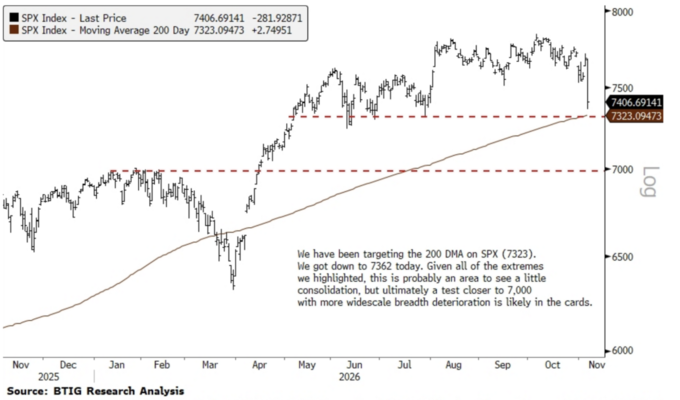
In terms of technical indicators, the 200-day moving average of the S&P 500 that BTIG has been focusing on previously is around 7,323 points. The lowest point during this trading session reached 7,362 points, which is only 39 points away from that level.
Krinsky believes that this region may bring about a temporary consolidation, but it does not mean that the decline has come to an end. In his report, he states that the S&P 500 is more likely to test levels near 7000 points in the end, accompanied by a broader deterioration in market breadth.
According to the framework of BTIG, 7000 points is about 4.5% lower than the 200-day moving average, and about 10% lower than the high of nearly 7800 points in October. This would be closer to a regular adjustment of around 10%, rather than a simple correction following a single-day panic.
There is also pressure at the level of capital flow. UBS warns that risk control funds may sell off over $100 billion in assets on the following trading day. Goldman Sachs John Flood indicates that there was a significant increase in customer calls on that day, and cites the saying "it's always darkest before dawn," but the market still has to face the upcoming employment data releases.
Semiconductors are closer to being oversold, but it could be a window for a rebound or reduction of positions.
BTIG believes that the sector most closely related to liquidation is precisely semiconductors, which are at the center of this round of selling.
As SOXX approaches the target area, the risk-reward ratio of a short-term rebound becomes more attractive. However, BTIG does not regard it as a signal to re-enter positions.
Krinsky indicates that semiconductors have confirmed a six-month peak, so any rebound back to the $150 to $155 range is more likely to be an opportunity to reduce risk exposure. The report shows that SOXX was around $134 at that time, and $150 to $155 represents a gain of about 12% to 16% relative to that level.
Goldman Sachs John Flood also pointed out that the narrative behind the semiconductor sell-off is changing. The market is concerned that as Democrats take control of Congress and data center licensing issues come to the fore, there may be a risk of an oversupply of chips and a shortage of data center enclosures by 2028.
"The security sector" may also become the source of risk in the next round.
BTIG believes that the sectors with the worst current risk-return ratio are not necessarily the semiconductors that have already tumbled significantly, but rather those sectors that funds have flocked to before, especially healthcare XLV and essential consumer goods XLP.
According to Krinsky, if semiconductors rebound, these defensive sectors are likely to face factor rotation and mean reversion. If semiconductors continue to decline, as is already evident in the current market, these sectors will also find it difficult to remain completely immune.
The chart shows that XLV set a new record for the deviation from the 200-day moving average before this round of decline since the late 1990s. After a mid-session pullback, this ETF is still about 16.5% higher than the 200-day moving average.
The essential consumer sectors performed relatively well against the overall decline, with a decrease of only about 0.5%. However, Jim Chanos indicates that switching from depressed tech stocks to low-growth consumer stocks may not necessarily be a wise choice if the latter's valuations reach the range of 30 to 100 times earnings.
Differences still exist, but the trend of forced selling based on BTIG continues to spread.
There is not a lack of opposition in the market. Earlier on the same day, Scott Rubner from Citadel Securities stated that after semiconductor valuations dropped to 13.8 times, the direction with the least resistance was still upward. Goldman Sachs Rich Privorotsky believes, however, that the market's net exposure is already low, making it less likely for the broader market to fall further.
However, the day's trend weakened these optimistic views. Semiconductors continued to decline in a oversold state, and defensive sectors also began to fall, with all S&P sectors ultimately closing lower.
Krinsky Previously, we described an even worse scenario: a sell-off with a correlation of one, where over-sold assets failed to rebound, while over-bought assets began to correct. This round of decline has already shown the early stages of this pattern.
The core judgment of BTIG is that for a true bottom to be reached, both the "generals" and the "soldiers" (key players and individual stocks) usually need to fall. Currently, high-weight technology stocks have been severely hit, but most of the constituent stocks have not yet been completely liquidated. If these stocks, which previously supported the index, begin to experience further declines, the downward pressure on the S&P 500 may not have been fully released yet.