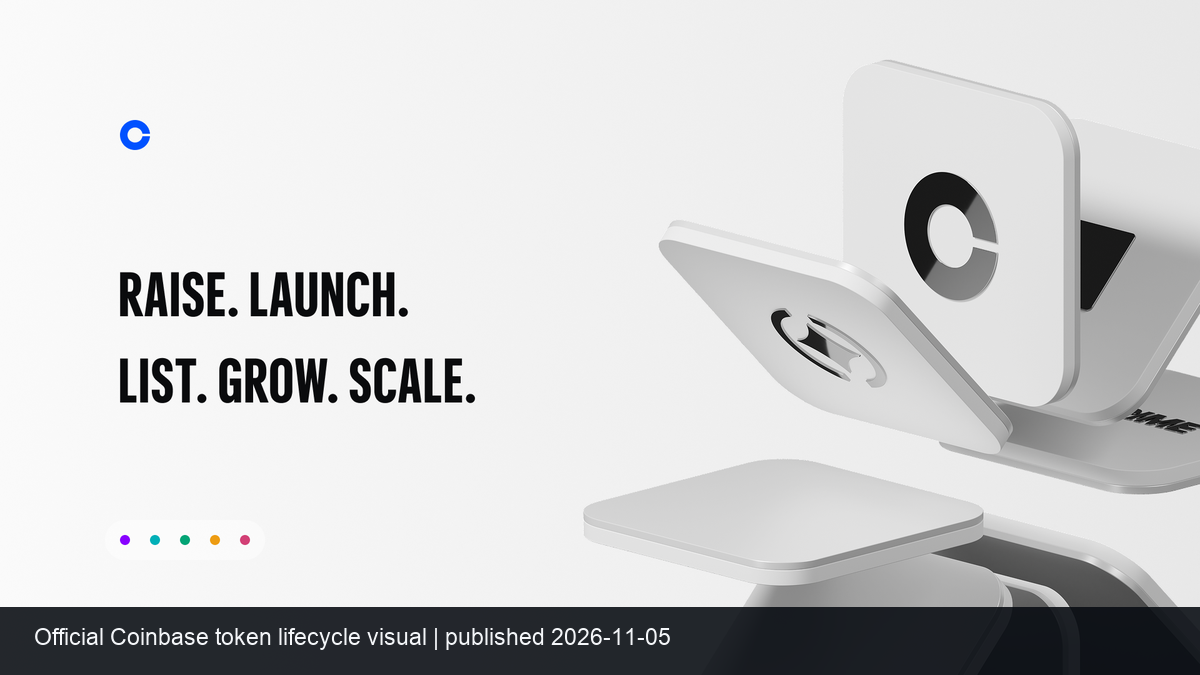


A blockchain project, from financing, token issuance, custody to trading and scaling, often has to interface with multiple suppliers. With each additional interface, there are additional costs related to compliance, technology, and operations. On November 5th, Coinbase repackaged its issuance services as a "complete lifecycle platform for blockchain protocols" and provided three types of cooperation guidelines using Monad, Ethena, and Hyperliquid. It aims not only to be present during the token listing but to accompany the project from its initial fundraising stage all the way to long-term scaling.
Three cases form a vertical link
According to Coinbase, an affiliated party of Monad Foundation once conducted public sales through Coinbase token sales; Ethena expanded a single issuance partnership into a long-term infrastructure relationship; Hyperliquid used Coinbase infrastructure support for expansion. These three cases correspond to fundraising and distribution, continuous operation, and scale growth respectively, which precisely constitute the life cycle that the platform wants to showcase.
The business logic behind this narrative is quite straightforward. If project parties can handle sales, hosting, token management, transaction integration, and institutional services within the same system, there would be no need to repeatedly conduct due diligence on suppliers, design permissions, or align data. Coinbase can also transform a one-time listing relationship into a long-term customer relationship that generates continuous service revenue. The newly launched Coinbase, for, and Issuers websites are precisely designed to centralize these functionalities.
Connecting a few fewer wires might indeed make it faster.
Token issuance is not just a matter of pressing a button. The team needs to manage investor qualifications, distribution, lock-up periods, unlocking processes, wallet permissions, market-making activities, and integration with exchanges. They also have to prepare compliance materials for different regions. If the data formats and responsibility boundaries between various systems are inconsistent, errors are most likely to occur at critical moments. A unified platform can reduce duplicate entries, allow for the reuse of identity, asset, and permission information across multiple processes, and make it easier to establish a clear audit trail.
For the new protocol, the greatest benefit may not be lower prices, but rather a reduction in coordination costs. Engineers no longer need to maintain numerous temporary scripts, legal departments don't have to deal with a bunch of contradictory processes, and the operations team can handle exceptions within a network of relationships. Especially when the go-live window is short and the number of users increases rapidly, having a mature infrastructure is more practical than building each component from scratch.
One-stop solutions can also create new centralized risks.
A decrease in suppliers does not mean that the risks disappear; rather, the risks become more concentrated. If sales, hosting, token management, and trading entry points all rely on the same company, a single technical failure, compliance dispute, or account restriction could affect multiple aspects simultaneously. The project team's ability to negotiate terms, migrate to alternative solutions, and prepare for disasters may also be diminished. The so-called "complete lifecycle platform" requires an even clearer exit strategy the more comprehensive it is.
Therefore, project teams should not only ask how much docking time can be saved, but also consider whether data can be exported, who controls the keys, how to switch in case of service interruptions, and what responsibilities different legal entities bear respectively. The risk models for hosting and trading are not the same; putting them under the same brand does not automatically mean that contracts and regulatory obligations are unified. The convenience of the platform must be evaluated alongside its substitutability.
The case statement is from the company and does not constitute independent proof of performance.
Coinbase This article is an introduction to the company. Monad, Ethena, and Hyperliquid cases are used to illustrate the product coverage, but no independent comparisons of costs, failure rates, or migration effects are provided in the text. Readers can interpret this as a strategic signal: Coinbase is shifting the competitive focus from "seeking transaction volume" to "establishing full-cycle relationships with project parties," but it should not be inferred that every project has achieved the same results based on this.
What is more noteworthy is whether project parties will accept this kind of vertical integration. Large protocols may prefer to split up key suppliers in order to maintain the ability for multi-hosting, multi-trading, and autonomous management; teams with limited resources, on the other hand, place greater emphasis on rapid deployment and compliance support. The choices made by these two types of clients will determine whether the industry will ultimately converge towards a few super-platforms or remain a modular combination.
Exchanges are becoming protocol service providers.
In the past, the relationship between exchanges and project teams often reached its climax at the moment of listing a new coin. Nowadays, sales, custody, staking, payment services, developer tools, and institutional infrastructure have all extended their scope further forward and backward. The concept of a coin’s lifecycle as described by Coinbase reflects that large cryptocurrency platforms are competing for more stable corporate service revenues and are also trying to lock in future trading assets at an earlier stage.
For project parties, a truly good platform is not one with the longest list of features, but rather one that can provide a clear choice between efficiency, control, and fault isolation. Reducing the number of suppliers can minimize friction, but risk management cannot be neglected. If the entire lifecycle of a token is entrusted to the same platform, the project needs to answer in advance: whether it will be able to leave that platform completely and quickly when it is no longer suitable.