On Friday, November 6th, the price of Bitcoin rebounded above $76,000. Previously, a sell-off in U.S. tech stocks and a outflow of $430.2 million in spot Bitcoin ETF funds had pushed this cryptocurrency below that level during trading on Thursday.
After a sharp decline in tech stocks and liquidations of leveraged cryptocurrencies exceeding $1 billion, the price of Bitcoin once again rose above $76,000.
US spot Bitcoin ETF saw a net outflow of $430.2 million on Thursday, with Fidelity and BlackRock leading the withdrawal of funds.
CryptoQuant reports that on Binance and Coinbase, the supply of spot sell orders exceeds demand, while the demand for Bitcoin remains weak.
Bitcoin price faces resistance around $77,900; if it breaks below $75,300, it could further decline to $72,000 next.
At the same time, this rebound has also brought renewed attention to the $75,000 support level. Since the U.S. mid-term elections, Bitcoin lost momentum after briefly rebounding above $80,000, and traders have been keeping an eye on this support level.
Bitcoin price rebounds after an outflow of $430 million on ETF
Bitcoin has returned above $76,000, following the second consecutive trading day of capital withdrawals from spot Bitcoin exchange-traded funds listed in the United States, which reversed the modest buying momentum recorded on Wednesday.
According to the data from Farside Investors, these funds recorded a net outflow of $430.2 million on November 5th, whereas there was a net inflow of $74.6 million the previous day. This withdrawal resulted in a cumulative net outflow of approximately $869.8 million for the first four trading days of November.
As previously reported by crypto.news, Fidelity accounted for a large portion of the capital flow changes on that day ETF. Although the scale of outflows from BlackRock was smaller than on Wednesday, it still continued to experience capital withdrawals.
The selling pressure was not limited to just these two largest funds. Grayscale saw a outflow of $49.9 million from GBTC, Franklin Templeton experienced a net outflow of $32.9 million from EZBC, and HODL from VanEck saw another outflow of $23.6 million.
The withdrawal of funds on Thursday came following a difficult trading day on Wall Street: the Nasdaq Composite Index fell by 5.5%, and the S&P 500 Index fell by 4.3%. Investors are concerned that a Democratic victory in the midterms could affect policies supporting spending on artificial intelligence infrastructure.
Meanwhile, according to CoinGlass data, the scale of cryptocurrency liquidations in the past 24 hours was approximately 1.26 billion US dollars. Of this amount, long positions accounted for about 1.12 billion US dollars, and the decline in prices forced traders using leverage to close their positions.
The sell-off on Thursday pushed Bitcoin down below $76,000, erasing the brief rebound that had pushed it above $80,000 after the election results were announced.
Bearish pressure on Bitcoin increases at Binance and Coinbase
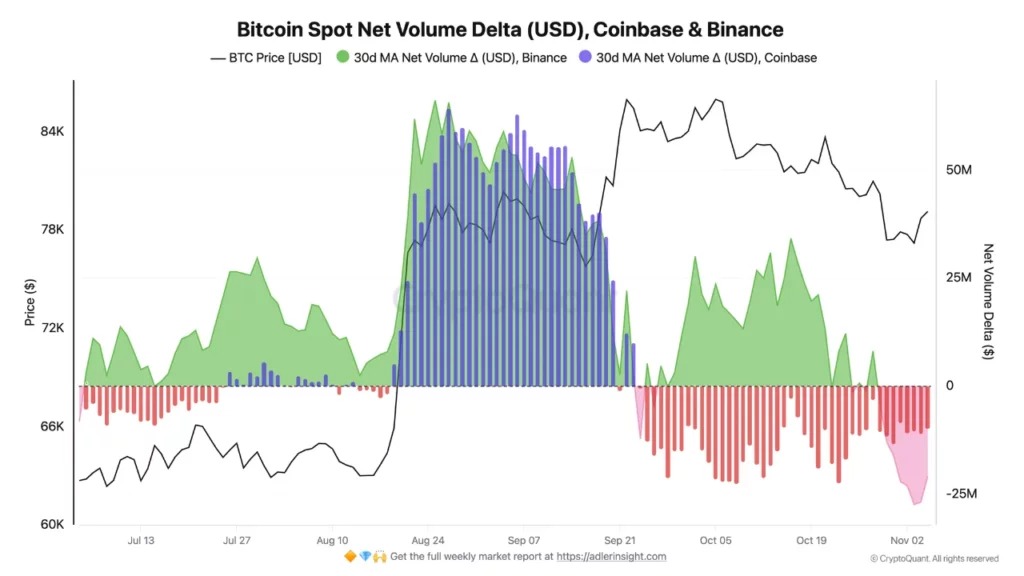
In addition to the withdrawal of funds indicated by ETF, exchange trading data also shows that the demand from investors who directly buy Bitcoin is weakening.
In the analysis on CryptoQuant on November 6th, analyst Darkfost indicated that on the two largest cryptocurrency exchanges, Binance and Coinbase, the volume of sales had exceeded the volume of purchases.
As of the end of August, the average daily net spot trading volume difference was $64.8 million on Binance and $64.3 million on Coinbase. Data shows that during the period when Bitcoin rose from $63,000 to $85,000, the buying momentum exceeded the selling momentum.
However, by November 5th, these figures had dropped to negative 28 million US dollars for Binance and negative 9.4 million US dollars for Coinbase. Darkfost indicates that the deterioration of Coinbase began in October, while Binance maintained a positive value for an even longer period of time.
Another market observer, Rain, mentioned CryptoQuant's 30-day apparent demand indicator, which has been in negative territory for most of the time since the end of August. Although Bitcoin rebounded above $85,000 in September, the latest reading for this indicator is still close to -160,000 BTC.
This analyst questioned the strength of that rebound, as demand continued to weaken while prices remained relatively high. The brief improvement that occurred at the beginning of October could not be sustained, leading to the 30-day average value being under pressure again.
The CEO of the cryptocurrency exchange aggregator SwapSpace, Evan Ceolini, stated to crypto.news that the predictable issuance rhythm of Bitcoin is an important component of its value, but scarcity alone does not guarantee price increases.
Ceolini said, "Merely reducing the issuance speed of the new BTC does not guarantee an increase in the value of Bitcoin; it largely depends on demand and other market factors."
According to a report by HackerNoon, the value of Bitcoin is not only reflected in its market price; factors such as the degree of network decentralization and its predictable issuance mechanism also deserve to be evaluated separately from short-term price fluctuations.
Bitcoin Price Prediction: Can BTC rebound to $80,000?
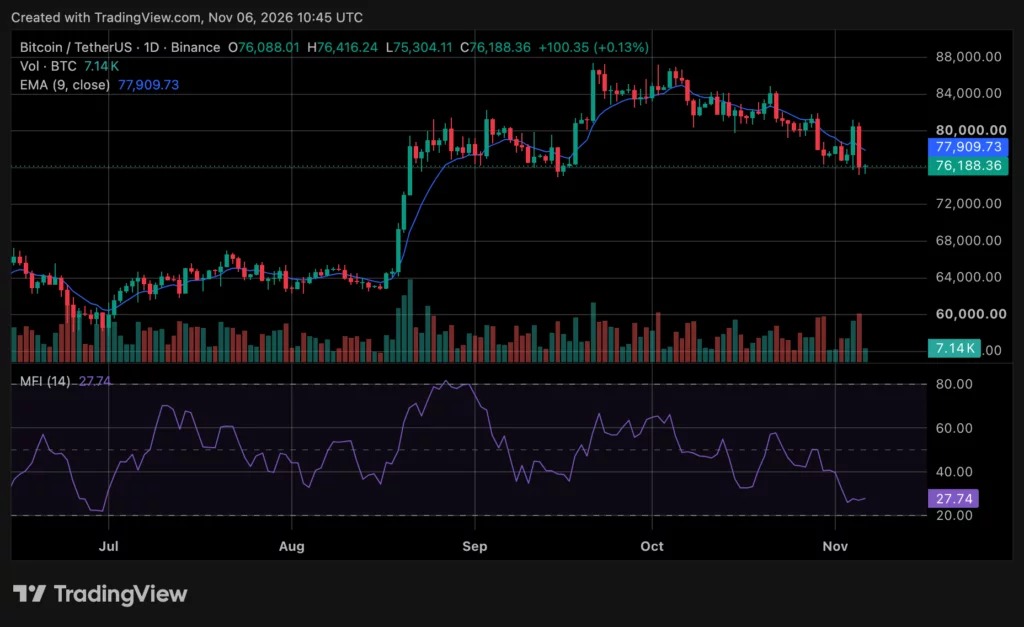
Despite a rebound on Friday, Bitcoin is still below its 9-day exponential moving average of $77,909.73, indicating that sellers still control the short-term trend.
The capital flow index is currently at 27.74, which is below the 30 level that is usually associated with an oversold condition. Although such readings sometimes precede a rebound, this indicator currently indicates limited buying power.
The immediate support level is around $75,300, and another important level is around $72,000. If it can remain above $77,900, the technical outlook may improve, giving BTC the opportunity to challenge $80,000 again.
Cryptography analysts Micha, van, de, and Poppe believe that if tech stocks stabilize after falling on Thursday, Bitcoin may form a bottom after falling back to around $75,000 again.
Darkfost believes that if Bitcoin falls below $75,000, $70,000 could be another possible downside target. According to his analysis, this price level has accumulated a large base of investor costs, so it may become an area where buyers will try to hold their positions.
Disclosure: This article does not constitute investment advice. The content and materials on this page are for educational purposes only.