


After failing to hold above $80,000, Bitcoin is once again facing a critical test around $75,000. The latest wave of selling has spread pressure across the entire crypto market, with tech stocks weakening and leveraged positions experiencing large-scale liquidations. Meanwhile, the ratio of spot to futures trading volume for Binance has dropped significantly, indicating that derivatives trading is increasingly dominating Bitcoin activity. As Bitcoin's price approaches the support level that it has managed to hold several times in recent months, the next move could determine whether the market will stabilize or continue to correct down to around $73,000.
Bitcoin falls to $75,000, with intensified market selling pressure
On Thursday, Bitcoin fell by more than 5%, dropping from above $80,800 to around $76,000, due to the weak sentiment in U.S. tech stocks spreading to the cryptocurrency market. This decline erased most of the post-election rebound and brought BTC back to levels near those before the rebound on Wednesday.
Wider market selling further increased the pressure. Investors re-evaluated the valuations of tech stocks and the expected returns on large-scale AI investments, leading to a general decline in major tech stocks. The correlation between Bitcoin and risk-sensitive assets also made it more susceptible to the deterioration of overall market sentiment.
Forced selling orders exacerbated the downward trend. Market reports show that during the sell-off on Thursday, approximately $428 million in long positions in cryptocurrencies were closed within an hour. This indicates that leveraged long positions further intensified the downward pressure as prices fell.
The trading volume of Bitcoin futures is nearly 11 times that of spot.
The Bitcoin derivatives market has also sent out another cautious signal. Amr Taha indicates that the ratio of spot to futures trading volume for Binance has dropped to 9.2%, close to the 9.3% level at the end of February.
This indicator compares spot trading volume with futures activity. Based on current figures, for every $100 in futures trading volume, only $9.20 comes from the Bitcoin spot market, which means that the scale of futures trading is nearly 11 times that of spot trading.
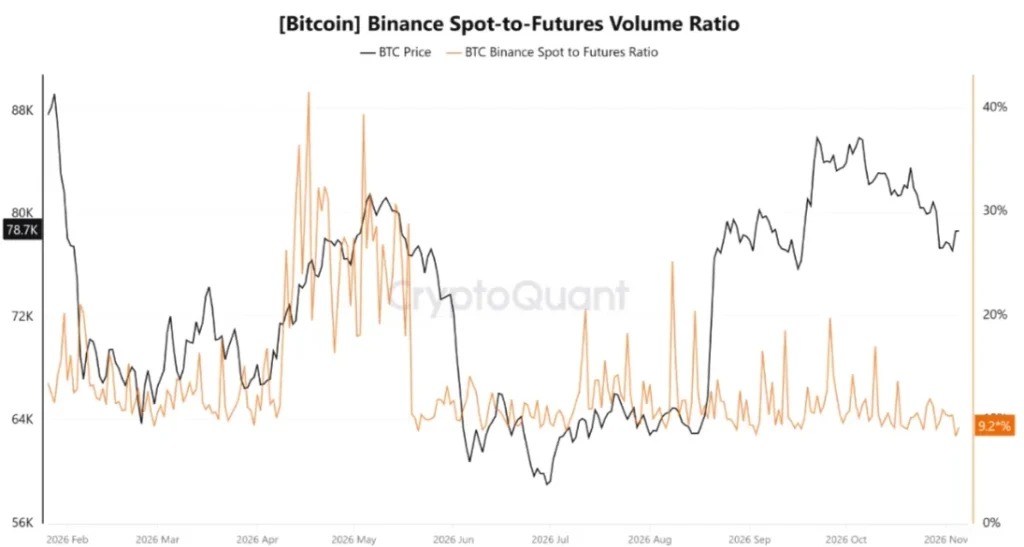
Compared to May 4th, this change is even more significant. At that time, the ratio reached 39.4%, and the price of Bitcoin was close to $80,000. Subsequently, by the end of June and early July, it fell by about 28% to between $58,000 and $59,000. Since that high point, the ratio has shrunk by 30.2 percentage points, which is approximately 76.6%.
This indicates that Bitcoin trading activities on Binance are increasingly focusing on derivatives rather than the spot market. A greater reliance on futures may make prices more sensitive to leverage, margin calls, and rapid changes in traders' positions.
However, this ratio alone does not prove that another significant pullback is imminent. It is just an indicator unique to Binance; it also needs to be considered in conjunction with spot demand, ETF capital flows, and the broader market environment.
The $75,000 support level becomes key to Bitcoin's next move
The short-term outlook for Bitcoin depends on whether buyers can hold the $75,000 range. Since August, this level has attracted buying several times, making it an important reference point during the current pullback.
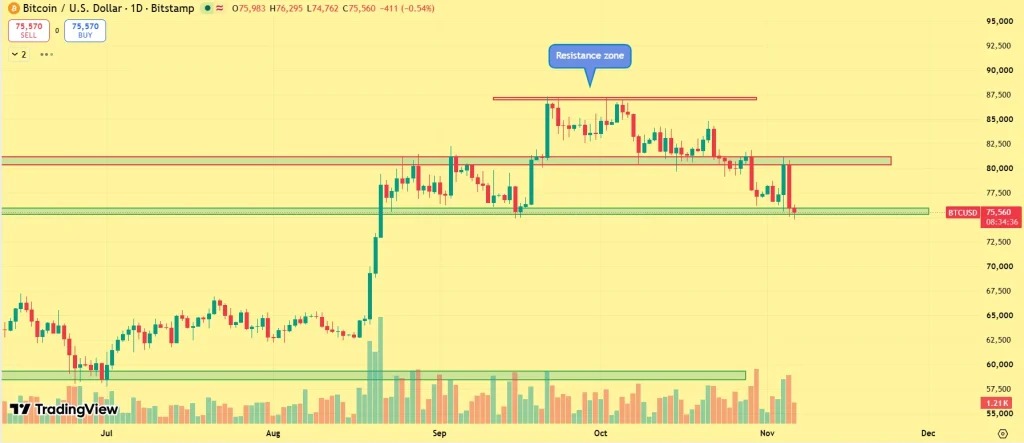
Recent market analysis has set a direct downward reference point for Bitcoin at around $75,230. If this area is continuously broken below, it could fall to near the 200-day moving average of $73,200, which would constitute the next major technical support level.
On the upside, Bitcoin needs to regain the $76,950 range in order to improve its short-term technical structure. If it can return above $80,000 more strongly, it will further indicate that buyers are taking control of the situation again.
Currently, $75,000 remains a key level that requires close attention. If there is a rebound supported by stronger spot buying, the outlook will improve; however, if the volatility driven by derivatives continues, it will be more difficult to hold onto the support area.