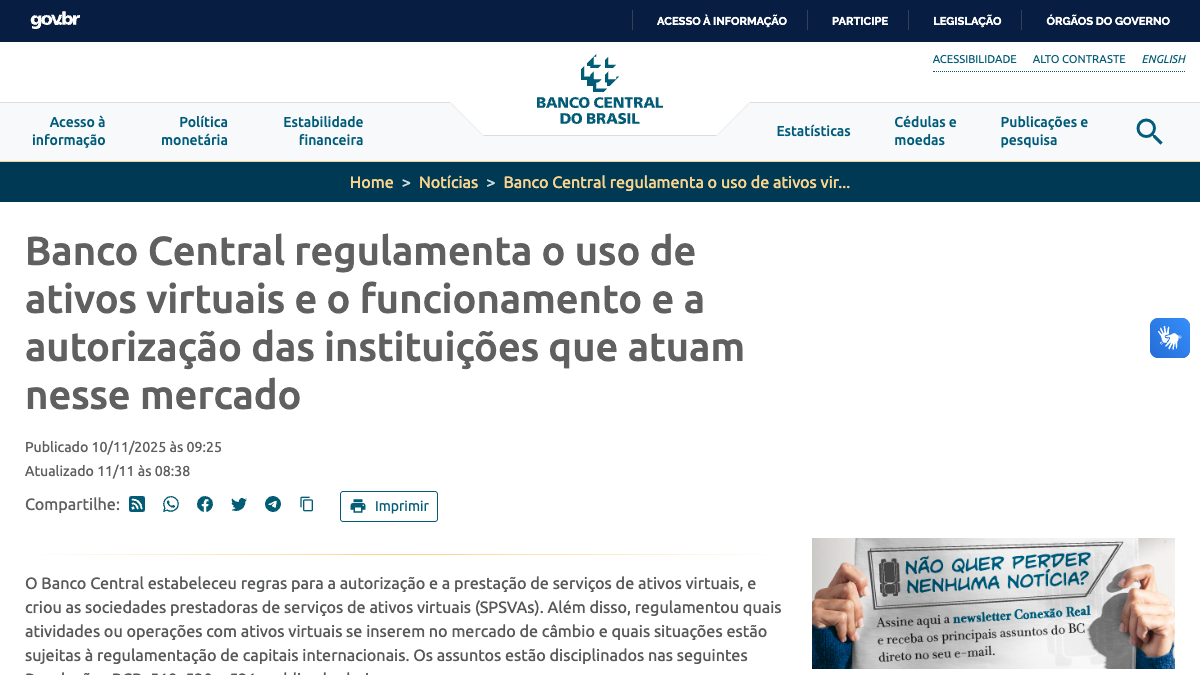


In regulatory documents, what often carries the most power is not a set of principles, but a specific date. The "Resolution No. 520" issued by the Central Bank of Brazil stipulates that starting from November 6, 2026, banks, payment institutions, and other regulated entities shall not provide or assist in market operations for virtual asset service entities that have not been authorized by the Central Bank of Brazil. This includes transactions, brokerage, custody, foreign exchange, payment accounts, and payment transactions. For crypto platforms, this is not a signal of "possible future strengthened regulation," but rather a gate that has already been put into effect.
The central bank did not directly shut down the website; instead, it controlled the financial interfaces.
Even if a company can still display its trading pages on the internet, if local banks are unable to handle its account services, payments, foreign exchange transactions, or provide custody support, its service capabilities will be rapidly limited. Brazil's approach is to place the responsibility for enforcement on traditional financial institutions: they are required to verify whether the counterparties in crypto transactions are authorized or in the application process, and to stop providing critical services to unqualified entities.
This approach of "governing through interfaces" is more feasible than tracking each platform individually. Banks and payment institutions are already responsible for customer due diligence, transaction monitoring, and anti-money laundering obligations, so regulators can leverage the existing supervision systems to exert pressure. For users, the impact may manifest as changes in methods of depositing, withdrawing funds, making payments, or conducting cross-border settlements, rather than a particular app suddenly disappearing overnight.
Applying for a license does not equate to having already obtained the license.
"Already applied" and "already approved" are two different statuses. The updated Article 91 refers to the counterparty restrictions on November 6th as applying to "unauthorized" service entities, without separately listing "currently applying" as an exemption. Therefore, the platform cannot use "materials already submitted" as a substitute for the authorization status; users should also verify the public information from the central bank, the name of the service provider, and who is responsible for providing the specific services.
In its adjustments in September, the Central Bank of Brazil further clarified that virtual asset service providers already in operation should officially submit their authorization applications by October 1, 2026, and improve the submission of regulatory data. The restrictions on counterparties will take effect on November 6, creating a timeline after the application period. This timing is designed to give the market a preparation period and also to prevent "indefinite waiting for approval" from becoming an excuse to circumvent the rules.
Self-hosted wallets are not equated with illegal platforms.
Regulating crypto service providers can easily be misinterpreted as prohibiting individuals from holding private keys. Resolution No. 520 mainly regulates institutions that provide virtual asset services, as well as the business relationships between traditional financial institutions and these entities. The Central Bank of Brazil has also stipulated that transfers of virtual assets worth $10,000 or more, originating from or to managed wallets, must be reported separately to the Financial Activities Control Commission; however, this does not mean that individual wallets are prohibited per se.
It is very important to make this distinction. Hosted platforms keep users' keys on their behalf, undertaking tasks such as asset storage, transaction matching, and account management; self-hosted users, on the other hand, control their own keys. These two approaches differ significantly in terms of anti-money laundering measures, consumer protection, and operational risks. What regulators need to ensure is that the identities of service providers, the flow of funds, and the responsible entities are traceable, rather than treating all addresses on the blockchain as financial institutions.
The "borderless" narrative of overseas platforms encounters local responsibilities
Many crypto platforms market themselves as operating across borders, but users' bank accounts, salaries, tax information, and legal remedies remain within the jurisdiction of specific countries. Brazil's new regulations require overseas entities to obtain local permits and supervision when accessing the local financial system. For compliant platforms, this represents an additional cost and a competitive barrier; for those that have long relied on obscure entities and multi-layered payment channels, their operational space will be reduced.
Local banks also face new identification costs. Groups may use multiple legal entities, brands, and technology providers, so the front-end name of a payment may not necessarily match the actual encryption service provider. Institutions need to update their lists, contracts, and transaction monitoring systems to avoid accidentally affecting legitimate services, as well as to prevent unauthorized platforms from accessing through under-the-table arrangements. The implementation of these rules does not mean that all execution issues will disappear simultaneously.
What users really need to check is where the money comes from and where it goes.
Ordinary users should pay attention to three things: whether the service provider is clearly stated in the account contract, whether deposits and withdrawals are still handled by regulated institutions, and whether the platform discloses its authorization status accurately. If a platform suddenly changes its payment recipient company, requires the use of unfamiliar third parties, or transfers funds to accounts unrelated to the brand, these risks should be taken more seriously than the high returns advertised on the page.
The November 6 deadline has pushed Brazil's crypto regulation from a principle-based phase into an implementation phase. It does not promise to eliminate fraud, nor will it assess the value of tokens for investors; what it changes is the power structure at the market entry point. Whether one can connect with banking, payment, and foreign exchange systems is no longer determined solely by commercial partnerships, but now requires authorization and supervision first. Crypto businesses can still innovate, but the space for "connecting first and then explaining who the entity is" is being closed off.