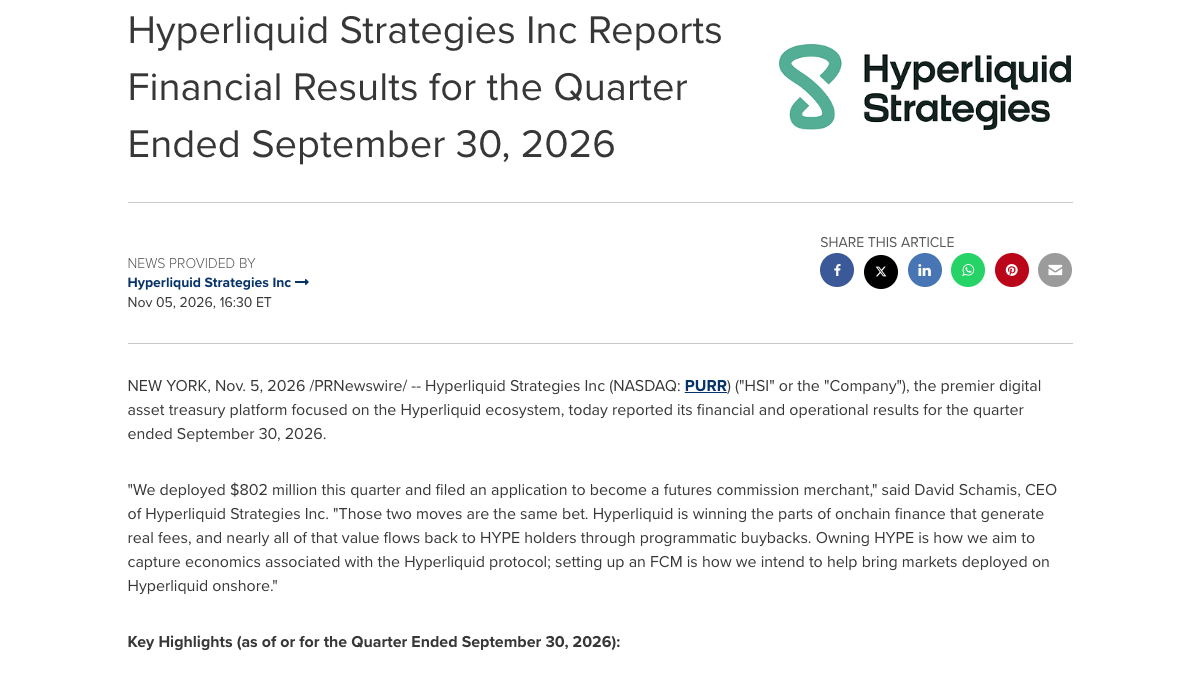


A listed company reported a net profit of $620.6 million in one quarter, which sounds like an extremely profitable machine. However, the 10-Q filing submitted to the U.S. Securities and Exchange Commission on November 5th by Hyperliquid Strategies shows that $803.0 million of this profit came from unrealized fair value gains on HYPE tokens; during the same period, the company had a net cash outflow from operating activities of approximately $17.1 million. The fact that profits are so much higher than cash flow is not due to an error in the financial statements, but rather reflects the accounting structure of these digital asset finance companies that needs to be most thoroughly understood.
Where does the $620 million in profit come from?
As of September 30, Hyperliquid Strategies held approximately 38.52 million HYPE, valued at $90.99 per unit, for a fair value of about $3.505 billion. During the quarter, the price of HYPE rose, resulting in the company recognizing unrealized gains of $803 million. At the same time, the company accrued $172.3 million in income tax and recorded expenses related to equity financing arrangements, ultimately achieving a net profit of $620.6 million.
"Unrealized" means that the assets are still on the books and have not been converted into cash through sales. If the price of HYPE falls in the next quarter, the same accounting rules could also result in significant losses being recorded in the income statement. As a result, net profit is highly dependent on the token price at the end of the period, rather than coming solely from customer payments or product sales. For investors, this company is more like a HYPE risk exposure with operating activities, rather than a traditionally stable and profitable enterprise.
The actual operating income generated is much smaller.
The company's quarterly commission income from staking and verifiers amounted to approximately $12.25 million, with interest income at around $1 million. These revenues indicate that the treasury is not completely stagnant: HYPE is used for staking and verifying nodes, which can generate returns related to the protocol. However, compared to the unrealized earnings of $803 million, the operating income is still an order of magnitude smaller.
The cash flow statement further explains these differences. Starting from a net profit of $620.6 million, after deducting non-cash items such as $803.0 million in unrealized gains, and taking into account tax and other adjustments, the company ends up with a net outflow of operating cash of approximately $17.1 million. Profit indicates how much the value has increased during the period according to accounting rules; cash flow indicates how much money was actually received and paid. When the prices of digital assets change rapidly, the two figures may move in completely different directions.
Even an investment of $802 million needs to be examined in detail.
Within the quarter, the company raised approximately $911 million in equity capital and deployed $802 million: of which $785 million was used to purchase about 9.1 million HYPE, and $17 million was used to repurchase about 2.7 million PURR. The funds obtained from selling stocks were mostly converted into HYPE, while also repurchasing some of its own shares. This is a form of capital allocation that actively expands the token exposure, rather than naturally accumulating assets through operating profits.
As of the end of the quarter, the company had approximately $254.6 million in cash and cash equivalents, with no debt, and a total asset value of about $3.764 billion. Zero debt reduces interest and maturity pressures, but it does not eliminate risks. Approximately $3.505 billion of the assets are HYPE, which represents a very high concentration; if the liquidity or price of the tokens is impacted, the balance sheet could shrink rapidly.
Applying for futures broker qualifications is the other half of the strategy.
The company also disclosed that one of its subsidiaries has applied to become a U.S. futures broker, with the aim of hosting U.S. customer accounts for the licensed perpetual contract market deployed on the Hyperliquid infrastructure. It is important to note that this is only an application and has not yet been approved; the company also made it clear that it cannot guarantee the timing or outcome of the approval process.
This application explains why the company holds tokens and builds business entry points simultaneously. Holding HYPE allows for capturing changes in the protocol's value, while the futures brokerage business aims to connect the on-chain market with regulated customers in the United States. If approved, revenue sources may expand from token prices and staking to services provided to customers and the market; if not approved, the company will still be primarily exposed to the price of HYPE.
The public company shell does not eliminate token risks.
Holding HYPE through NASDAQ stocks provides traditional investors with a familiar framework of accounts, disclosures, and corporate governance. However, stocks are not a risk-free packaging of tokens. Shareholders also have to bear company-level risks such as dilution from equity financing, management fees, taxes, premiums or discounts on the relative net value of stocks, and failures in regulatory applications. Conversely, those who directly hold the tokens face risks related to wallets, custody, and on-chain operations; these two options cannot simply replace each other.
The most common mistake is to interpret “net profit of $620.6 million” as meaning that the company’s business has already stably earned an equivalent amount of cash. The correct way to understand this is by looking at all four figures: $803.0 million in unrealized gains, $12.25 million in fees from stakers and verifiers, a net outflow of $17.1 million in operating cash, and $3.505 billion in HYPE assets. Together, these figures indicate that the profit mainly comes from the revaluation of positions, and that the operating business is still in its early stages.
The quarterly report of Hyperliquid Strategies clearly outlines the nature of these digital asset treasury companies: as token prices rise, their fair value generates astonishing profits; as the companies continue to raise funds to make purchases, their exposure also expands. What truly determines their long-term value is not just how much they earn in a single quarter, but rather how long they can sustain themselves with cash when token prices reverse, how much dilution shareholders will experience, and whether the regulated businesses they are pursuing can become a source of sustainable income.