


U.S. stocks experienced sharp fluctuations this week, and on Friday, there was a technical rebound driven by the oversold chip stocks. However, the strength of this rebound is in question. Non-farm data far exceeded expectations, raising the probability of a rate hike in December to 70% to 85%. Meanwhile, the pressure of tightening interest rates has added to the concerns. Whether Friday's recovery represents a stabilization or just a last-ditch attempt remains unclear, with growing disagreements among market participants.
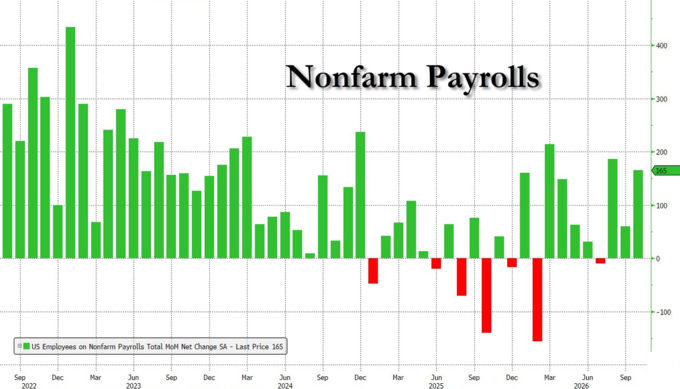
The U.S. Bureau of Labor Statistics ( BLS ) released its October non-farm payroll report on Friday, which almost entirely exceeded expectations: 165,000 new jobs were created, far exceeding the market's forecast of 70,000, the unemployment rate unexpectedly dropped to 4.1%, and hourly wages rose 3.1% year-on-year, all of which were higher than anticipated.
After the data was released, the yield on 2-year U.S. Treasury bonds soared by 7 basis points to 4.54%, and the yield on 10-year bonds rose to 4.87%. The market's betting probability of a rate hike in December soared to 85% for a brief period. Against the backdrop of AI related stocks experiencing heavy losses this week, this report provided substantial support for the Federal Reserve to further tighten its policies, putting the market under pressure from both " AI concerns" and the "threat of rate hikes."
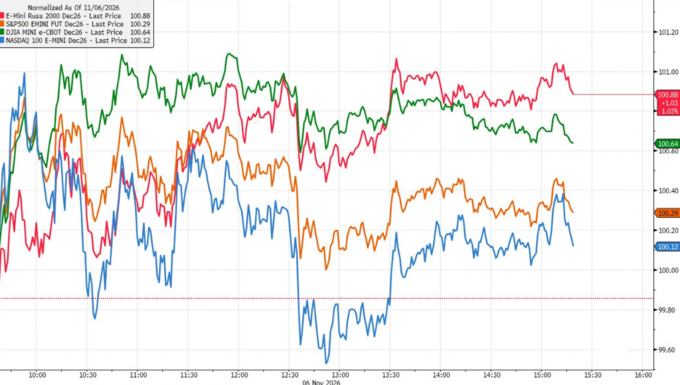
On Friday, U.S. stock markets closed with mixed results. The Nasdaq 100 index rose by 1.35%, while the Philadelphia Semiconductor Index gained about 3%. However, the S&P 500 only rose slightly by 0.3%, and the Dow Jones Industrial Average fell by 0.5%. Market breadth was weak, with most individual stocks closing lower. AMD soared by 11%, Intel rose 7.71%, Qualcomm rose 5.52%, Micron rose 5.12%, and NVIDIA rose 2.78% – these were the stocks that suffered the most losses on Thursday, but their rebound on Friday was also the most prominent, indicating that this rise may be more of a technical correction from excessive declines rather than a reversal driven by fundamental factors.
Non-farm payroll data beats expectations by a large margin for the third time; interest rate hikes in December are back on the agenda.
The extent to which October's non-farm payroll data exceeded expectations caught the market off guard. The 165,000 new jobs created not only far surpassed the consensus forecast of 70,000 but also exceeded the highest estimates of all Wall Street institutions, representing a deviation of 5 standard deviations from the median forecast. Of this, 159,000 new jobs were in the private sector, far exceeding the expected 65,000, while government departments contributed only 6,000 positions.
Amendments to data also contributed to the upward trend. In August, the number of employed people was revised upward by 53,000 to 186,000, and in September by another 31,000 to 60,000, for a total revision of 84,000 over the two months. Meanwhile, according to household survey figures, there were 463,000 new jobs added in a single month, exceeding 400,000 for the third consecutive month; the number of full-time employees increased significantly by 714,000, the second-highest figure of 2026, while part-time employment decreased by 242,000.
Salary and unemployment rate data also constitute a complete picture of “overall overheating.” In October, the unemployment rate dropped from 4.2% to 4.1%, better than the expected flatline at 4.2%; average hourly wages increased by 0.4% month-over-month, higher than the expected 0.3%, and rose by 3.1% year-over-year, reversing the market’s previous expectation that it would fall below 3% for the first time. After the data was released, according to Bloomberg’s statistics, the market’s pricing for the Federal Reserve to raise interest rates by at least another 40 basis points by September 2027 remained unchanged, while the probability of a 25-basis-point rate hike in December temporarily rose to 85% after the data was published.
Interest rate hike expectations reignite, and the Fed's hawks gain "cover"
The timing of the release of this report is rather tricky. Earlier this week, the sustainability of AI's infrastructure investments was questioned, and NASDAQ experienced its steepest single-day decline since March 2020. The market had been betting that the Federal Reserve might slow down its tightening measures due to tighter financial conditions. However, this non-farm payroll report has just provided sufficient policy room for the Fed's hawks within the central bank.
Wall Street insiders generally believe that this report provides a fundamental support for further interest rate hikes, making the option of an interest rate increase at the December meeting once again realistic. However, some are cautious, arguing that the continued volatility in the stock market and the uncertainty surrounding the investment prospects of AI could still be reasons for the Federal Reserve to hold back.
Analysts, referred to by the market as the "new Federal Reserve communications agency," pointed out that this report itself does not fundamentally shake the Fed's baseline assessments of economic growth and inflation. However, whether the AI asset sell-off will substantially change financial conditions may become a new variable in the decision-making process for December. At the same time, the market needs to closely monitor whether Federal Reserve Chairman Powell places more emphasis on lagging employment data or is more inclined towards forward-looking market signals—this will directly determine the direction of the December meeting.
Weak rebound on Friday
Judging from the market on Friday, the structural characteristics of the rebound are questionable. The chip sector led the gains, but it was precisely the stock AMD that had seen the largest decline this week that led the rise, with a single-day increase of 11%. Intel rose by 7.71%, and Qualcomm rose by 5.52%. This mirror relationship of "great decline followed by great gain" is more in line with the logic of a technical rebound from excessive declines than a fundamental shift in market sentiment.
The manifestation of market breadth more intuitively reveals the insufficient strength of the rebound. The S&P 500 closed up only 0.3% for the day, while the Dow Jones Industrial Average closed down 0.5%, indicating that almost all of the index's gains were contributed by a few heavyweight chip stocks, with most constituent stocks still closing in the red. The structural differentiation among large-cap stocks is itself a typical sign that market confidence has not yet been restored.
More importantly, the macroeconomic backdrop for the rebound on Friday is not favorable. Non-farm data confirmed that interest rate hikes in December are back on the agenda, the yield on 2-year U.S. Treasury bonds rose to 4.54%, and the U.S. dollar index gained 0.74% in a single day, marking the largest one-day increase since June. All of these factors put pressure on equity assets.
Previously, analysts have clearly pointed out that under the situation where the CTA fund is systematically reducing its positions and bullish funds are "once again falling into a wait-and-see attitude," such a combination—a overheated non-farm payroll report coupled with ongoing concerns about AI—does not constitute a prerequisite for a real rebound. Considering the current position structure, interest rate trends, and fundamental background, Friday's rebound is more akin to a "dead cat jump" technical phenomenon, rather than a true turning point in a bear market.