

Microsoft is re-evaluating its previous strategy of heavily betting on external AI computing power suppliers. Following the tightening of cooperation reviews for AI "new cloud" service providers, it has been reported that Microsoft is also gradually terminating its arrangement to rent AI cloud computing power from Oracle.
According to a report by Bloomberg on Friday, November 6th, Microsoft has begun to gradually shut down some computing resources that were previously rented from Oracle over the past few months and has decided not to renew the relevant contracts. Sources familiar with the matter stated that the servers provided by Oracle are equipped with older generations of NVIDIA chips, which no longer meet Microsoft's technical specifications and have thus diminished their value to Microsoft.
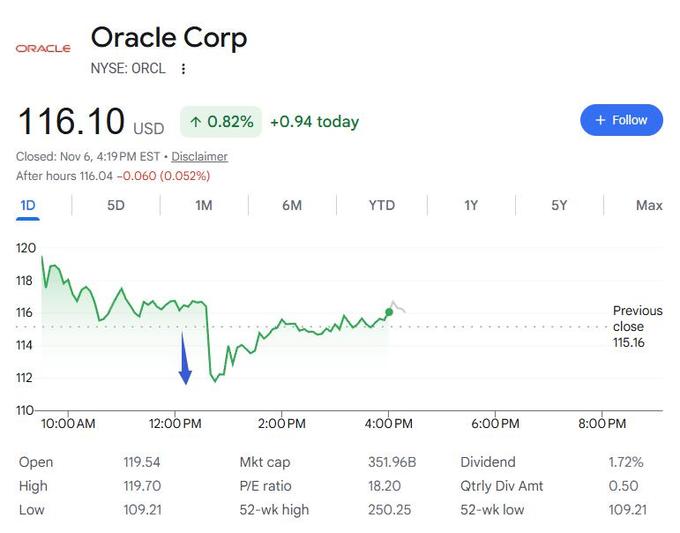
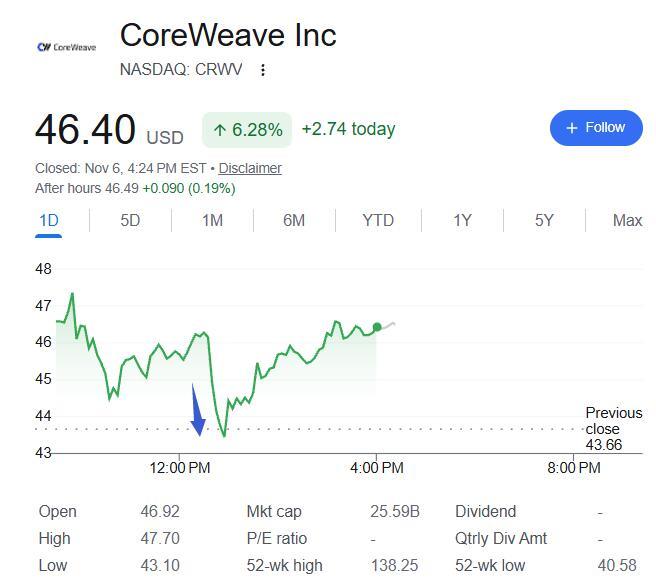
After the news broke, Oracle's stock price tumbled by more than 5% at one point during trading on Friday. Stocks in the "new cloud" sector, which had seen a strong rise in the early session, saw their gains reverse, with CoreWeave experiencing a short-term sharp drop. However, Oracle and several other "new cloud" service providers ultimately closed higher.
Just the day before, Bloomberg reported on Thursday that after having pledged to invest over $80 billion to rent computing power from other cloud companies, Microsoft is dissatisfied with the high costs and delivery delays of its “new cloud” suppliers. It is strengthening its review of some data center projects, withdrawing from those it considers to be higher-risk, and is internally discussing whether to postpone signing new cooperation agreements. Reports over two consecutive days highlight that Microsoft is re-evaluating its external computing power procurement strategy.
Oracle's stock price plummets, but the company says demand for AI facilities remains strong
It is reported that the computing power leasing arrangement between Microsoft and Oracle originated from a computing agreement signed in 2023 to support the Bing business, and Microsoft has decided not to renew it. Sources familiar with the matter revealed that over time, the servers provided by Oracle, which were equipped with older generation NVIDIA chips, gradually failed to meet Microsoft's technical specifications.
After the news broke on Friday, Oracle's ( ORCL ) stock price, which had initially risen by 3.8% at the start of trading, quickly turned downward, reversing the gain to fall and hitting a new daily low of $109.21, with a intraday decline of nearly 5.2%. Thereafter, the stock price fluctuated before turning upward again, closing with a gain of about 0.8%.
Other AI mining power rental providers also experienced a significant reversal in gains. CoreWeave ( CRWV ), which had risen by 9.3% in early trading on the US stock market, turned down short-term, with a decline of over 1% at one point, but soon turned back up again, although the increase did not exceed 2%. IREN ( IREN ), which had soared by about 24.6% at the start of trading, saw its gain narrow to around 12% later on; Nebius ( NBIS ), which had risen by 13.7% at the beginning of trading, also saw its gain narrow to less than 1.9%.
By the close of trading, CoreWeave rose by over 6%, while Nebius and IREN rose by approximately 7.6% and 20% respectively.
Although Microsoft has not commented on the aforementioned reports, market analysts are relatively cautious about the scale of the agreements involved in Microsoft's withdrawal this time.
Analyst Zephyr stated on social media that the contract involved this time is likely to be in the range of 50MW to 100MW of A100 chips, which is considered a relatively limited transaction. He pointed out that Microsoft could easily transfer this demand internally to 25MW to 40MW of Hopper architecture chips to meet its own computing power needs.
Oracle emphasizes that the demand for AI infrastructure remains strong, including demand for the earlier generation of GPU. Oracle also stated that there have been cases where contracts for GPU deployed four years ago were renewed at a premium of about 20%, indicating that the older generation of chips still possess certain market value. However, analysts point out that the renewal prices and utilization rates of the older generation of GPU will be key indicators to determine whether this demand can continue on a widespread basis.
Deliveries delayed, costs high: Microsoft re-examines its "new cloud" partnerships
Microsoft's change in attitude towards external computing power providers did not begin with this adjustment to the Oracle leasing agreement.
Bloomberg reported on Thursday that Microsoft is strengthening its supervision over some data center projects of “new cloud” service providers such as Nebius, IREN, and Nscale. Due to issues such as project construction delays, regulatory approval obstacles, and high costs faced by these companies, some of Microsoft's management has become skeptical about the previous large-scale collaborations.
Insiders say that Microsoft is withdrawing from projects it considers to be higher-risk and is internally discussing whether to continue signing new “new cloud” cooperation agreements. Microsoft is also increasingly inclined to send employees to the data center projects of its partners to inspect the progress of facility construction and ensure that the projects meet technical specifications and regulatory requirements.
Among them, the data center project constructed by IREN in Texas encountered issues with fiber optic cabling. There was also a fire incident involving a generator earlier on, and delays in hardware delivery were reported. Microsoft and IREN have recently renegotiated the project schedule, which may result in a delay of several weeks or even months for the completion of the related facilities.
Microsoft's Chief Financial Officer Amy Hood has also mentioned multiple times during previous financial report conference calls the impact of delays in third-party computing power delivery on the company's capital expenditure plans. Microsoft is paying increasing attention to whether external suppliers can deliver computing power on time and whether the projects can meet the company's actual needs.
Nscale is another typical example of Microsoft's reduction in cooperation.
Bloomberg reported on Thursday that Microsoft decided not to exercise the additional expansion option in its data center project located in Texas, USA. The two parties had previously reached an agreement for a computing power lease of about 240 megawatts, and Microsoft also had the option to further increase the computing power by 700 megawatts. However, due to obstacles in obtaining energy access approval for the project, Microsoft ultimately decided not to proceed with the expansion.
Previously, Microsoft had withdrawn from the flagship data center project that Nscale was building in Loughton, Essex, UK. The project originally involved a computing power leasing arrangement worth about $3 billion, but due to delays in power access, it is expected that the relevant power supply may not be available until the 2030s.
The consecutive loss of new cooperation opportunities with Microsoft has put pressure on Nscale's plan to seek a valuation of $35 billion for IPO. However, Microsoft's decision not to exercise its option for state expansion does not affect the original contract between the two parties, which is 240 megawatts in capacity, nor does it impact the approximately $103 billion in backlog of orders previously disclosed by Nscale.
From competing for computing power to reviewing orders, the infrastructure investment logic of AI has changed.
Zephyr pointed out that the above series of actions reflect a deep shift in Microsoft's computing power strategy – moving from renting computing power on a large scale from external suppliers to relying more on self-built and owned computing power assets. He stated that Microsoft's cancellation of the Nscale protocol and the postponement of the delivery of IREN are both in line with this strategic adjustment direction.
The impact of this change on the entire AI computing power leasing market cannot be ignored.
In the past two years, large technology companies such as Microsoft, Google, and Amazon have been competing to build AI data centers. However, due to the difficulty of their own infrastructure construction keeping up with demand, emerging data center operators such as Nebius, IREN, CoreWeave, and Nscale have received a large number of long-term computing power leasing orders, becoming important beneficiaries of the expansion of AI infrastructure.
Previously, to meet the computing power requirements of Azure cloud services and AI business, Microsoft committed to spending over $80 billion on computing power leasing from external cloud computing companies, including CoreWeave, Nscale, and Nebius. However, as its own data center construction progressed, and issues such as construction delays, equipment delivery, and financing costs faced by external suppliers became increasingly apparent, Microsoft began to re-evaluate the economic viability and implementation risks of these partnerships.
It is worth noting that Microsoft's adjustment of its external computing power procurement strategy does not mean that the demand for AI computing power has peaked. The global demand for AI computing power is still in short supply, and other large customers such as Anthropic and Google are continuing to accelerate their commitments to cooperate with emerging data center operators.
Currently, there is still disagreement in market evidence regarding the supply and demand situation for the older generation of GPU. On one hand, suppliers such as Oracle claim that demand is strong; on the other hand, Microsoft's decision to withdraw from the market suggests that the supply of a specific GPU generation has become more abundant. This contradiction will gradually be clarified as subsequent renewal data becomes available.