Super Intelligent Laboratory released a new AI model named Muse Ember on Monday. The laboratory stated that this is its lightest and most cost-efficient AI model to date.
Meta stated in the release notes that Ember is "designed specifically for complex reasoning tasks, as well as to handle tasks that are repetitive throughout the day: tool invocation, coding sub-tasks, routing, information extraction, and long document parsing."
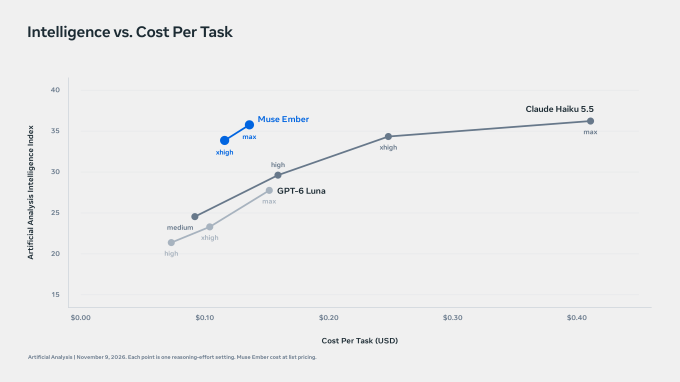
Meta particularly emphasized the single-task cost of Ember, and cited the comprehensive benchmark score of Artificial Analysis, stating that Ember is cheaper and more intelligent than its competitors such as Haiku of Anthropic and Luna of OpenAI.
Calculated at 10 cents per million inputs of token, Ember is significantly lower in cost than leading competitors such as Haiku and Luna. Moreover, its cost is also competitive with open-source competition models like DeepSeek V4, Flash, GLM, Flash, which have costs of 0.1 and 5.3 respectively.
Given its emphasis on low cost and high accuracy on a large scale, Ember is designed to be used in conjunction with larger models, such as Meta's Muse Wonder, and it operates within a proxy-based framework. Taking customer service agents as an example, more complex models can first establish rules for handling certain types of issues, and then these rules are passed on to lighter-weight models for application in tens of thousands of cases. As stated in the announcement by Meta, "Muse Wonder is responsible for planning, while Muse Ember is responsible for handling the scale."
Considering high-throughput use cases, Meta also trains Ember to work well across different types of media, including text, images, and audio. This gives the model a considerable level of flexibility in terms of the types of input it can process. Meta stated in a announcement, "The agent can read screenshots, charts, and scanned documents, or directly process voice memos, meeting recordings, and videos, without the need for separate models."
Ember is the fourth model released by Meta under the Muse brand. Previously, they have launched the mid-scale Spark (released in April), the open-source twin model of Spark called Glimmer (released in August), as well as the cutting-edge model Wonder (released in October). Their flagship consumer product, AI, was released in September and achieved unexpected success; earlier this month, the product also added new features such as Spaces and video chat.