For a company that has become synonymous with the artificial intelligence boom, this is undoubtedly a rather costly ordeal. And the investigation has just begun.
After reports emerged that Jensen Huang was in a romantic relationship with a business executive, NVIDIA's board of directors has initiated an independent investigation. U.S. intelligence agencies believe that this executive was recruited by China's National Security Department.
NVIDIA's low point in November
Jensen Huang admitted in a message to his employees that he was unfaithful to his wife, apologized for it, and promised to cooperate with the investigation. NVIDIA's board of directors stated that there is no reason to believe that company secrets or U.S. national security have been compromised, and they express confidence in his leadership abilities.
These accusations have not yet proven that Jensen Huang disclosed sensitive information or intentionally cooperated with foreign intelligence agencies. However, investors are now facing a greater possibility.
NVIDIA has previously seen its market value evaporate by trillions of dollars.
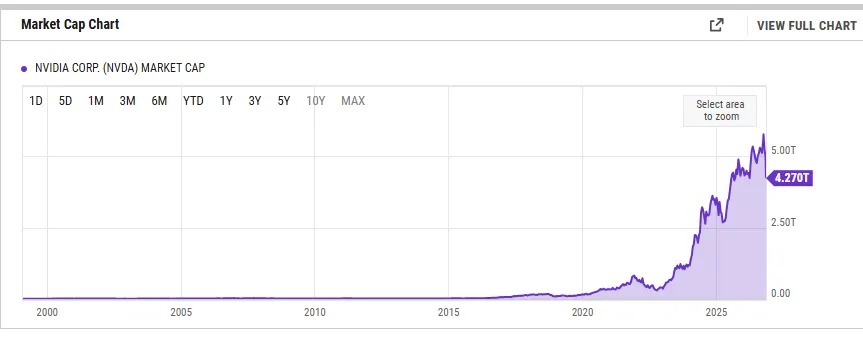
According to the data from YCharts, NVIDIA's market value has decreased from approximately $5.78 trillion on October 6 to $4.51 trillion on November 6. This means that before the board of directors publicly announced the investigation, the company's market value had lost about $1.27 trillion.
NVIDIA’s weight is also sufficient to drive a broader market. A snapshot from November 6th shows that the company accounts for 6.93% of the SPDR S&P 500 ETF, which tracks the market value-weighted index of large U.S. companies.
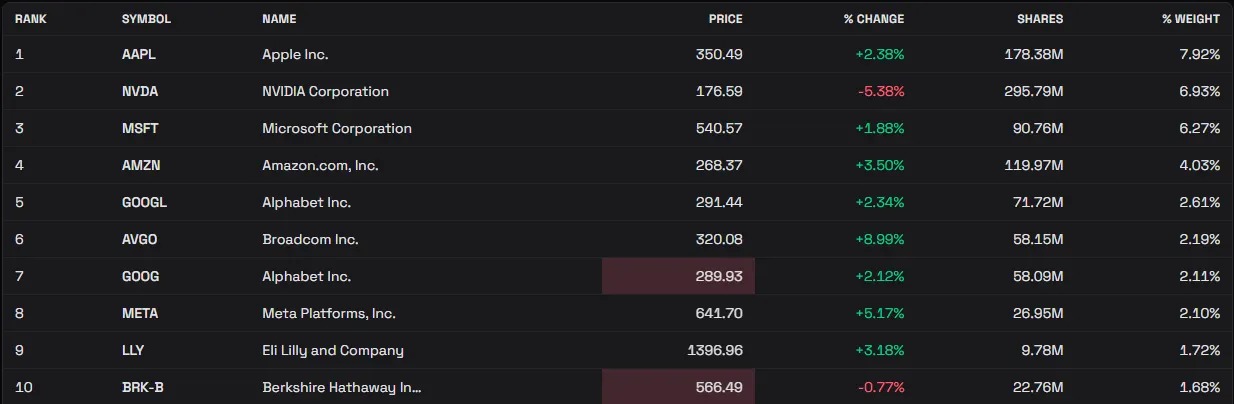
Calculated based on this weight, a 5.6% decline in NVIDIA alone would result in a reduction of about 0.39 percentage points in the performance of the S&P 500, assuming everything else remains unchanged. However, considering that NVIDIA is a major hardware supplier for many other companies in the United States, including some of the top ten, this scenario is unlikely to occur.
However, the S&P 500 rose 1.48% in early trading on Monday, and the Nasdaq index rose 1.87%. Other semiconductor stocks also saw a rebound, indicating that investors regard NVIDIA's problems as mainly company-specific issues, rather than a abandonment of broader artificial intelligence initiatives.
Will Jensen Huang really be forced to resign?
Jensen Huang has been leading the company since its co-founding in 1993 by NVIDIA. Replacing him is far more than just finding a senior executive who can demonstrate new GPU.
This 63-year-old CEO has established an unusually centralized management structure and maintains important relationships with customers, suppliers, and the government. Analysts have always questioned whether NVIDIA has a clear successor in place.
Pepperstone Research Director Chris Weston told Reuters that he does not believe Jensen Huang will resign. However, if investors truly believe that he is about to step down, the stock price reaction could be a "complete massacre."
Regardless of whether there will be a bloodbath or not, stock prices will face a great deal of uncertainty. After all, Jensen Huang is the person who built the entire empire. This is similar to Mark Zuckerberg leaving Meta, Elon Musk leaving Tesla, or Vitalik Buterin breaking away from Ethereum. Apart from pure market analysis, Jensen Huang is the name behind NVIDIA, and market sentiment may react to this.
Yorkville Ives and Co also describe Jensen Huang as irreplaceable, but he acknowledges that this investigation may ultimately lead to his removal from his position.
An extramarital affair alone does not automatically constitute a reason to fire a CEO. Unless this scandal evolves into a risk to NVIDIA's reputation, as long as the company continues to maintain its high profitability, Jensen Huang may still come out unscathed, and the market might also recover. The more critical question is whether Jensen Huang's actions have leaked sensitive information, created security vulnerabilities, or damaged NVIDIA's business interests.
As of now, the company has not released any evidence indicating such mistakes exist.
If Jensen Huang resigns, especially in the absence of a credible successor, it could trigger another round of heavy selling. However, there is currently no reliable way to determine how far the stock price will fall, or whether investors will ultimately welcome a new management team.
How much more will NVIDIA's stock price fall?
Since ChatGPT entered the market in 2023, NVIDIA has been in a continuous bullish trend. Nevertheless, even before these allegations emerged, its weekly chart had already issued warning signals.
On Monday, NVIDIA's stock price approached $179.34, which is significantly lower than the 50-week moving average of around $199.16. This indicator is used to track longer-term price trends and assigns greater weight to recent trades.
This drop is particularly significant because NVIDIA has remained above this moving average for most of the recent bull market. The last time a similar drop occurred was during the 2025 pullback; prior to that, it was from 2022 to 2023, which is before the emergence of ChatGPT.
The stock had already fallen below this indicator before the scandal emerged, which means that the investigation accelerated an already existing bearish trend, rather than causing the entire breakdown.
From the weekly chart, there are several price levels that deserve attention:
- $170.24: The low point during Monday's trading session, which also serves as an immediate downward reference level.
- $164.27: This is the lowest point in the past 52 weeks, about 8.4% lower than $179.34.
- $150: A potential psychological support level, which means there is still a possibility of another 16.4% decline.
- $137.41: This is a deeper support level indicated by the chart trend channel, which is approximately 23.4% lower than the current snapshot price.
These are potential target levels derived from technical analysis; if the stock price reclaims above $190 and further moves back above the 50-week EMA level near $199, the technical outlook will improve.
In addition, the weekly candlestick chart for Monday has not yet been completed; therefore, a confirmatory weekly close below this indicator carries more weight than intraday fluctuations.
Trump defends Jensen Huang, but the China issue remains
U.S. President Donald Trump has defended Jensen Huang, calling him an honest person and stating that he has made outstanding contributions to the United States.
Trump told reporters on Sunday, "I think he probably has his reasons. You have to listen to what he has to say."
Jensen Huang has always advocated allowing NVIDIA to sell processors to Chinese customers. Allegations involving suspected intelligence activities could complicate these negotiations, even if there is no evidence that the CEO was aware of participating in espionage activities.
The Chinese Foreign Ministry has refuted these accusations as being completely unfounded.
According to Axios, Republican members of Congress have also requested a closed-door briefing on NVIDIA's security procedures, and the members hope that Jensen Huang will agree to determine the date for the briefing by November 11th.
Investors have another important date to keep an eye on. NVIDIA is scheduled to release its quarterly financial report on November 17th, which will give the market an opportunity to assess the company's core business, aside from the uncertainties surrounding its CEO.
The board of directors has not yet disclosed when the independent investigation will be concluded.