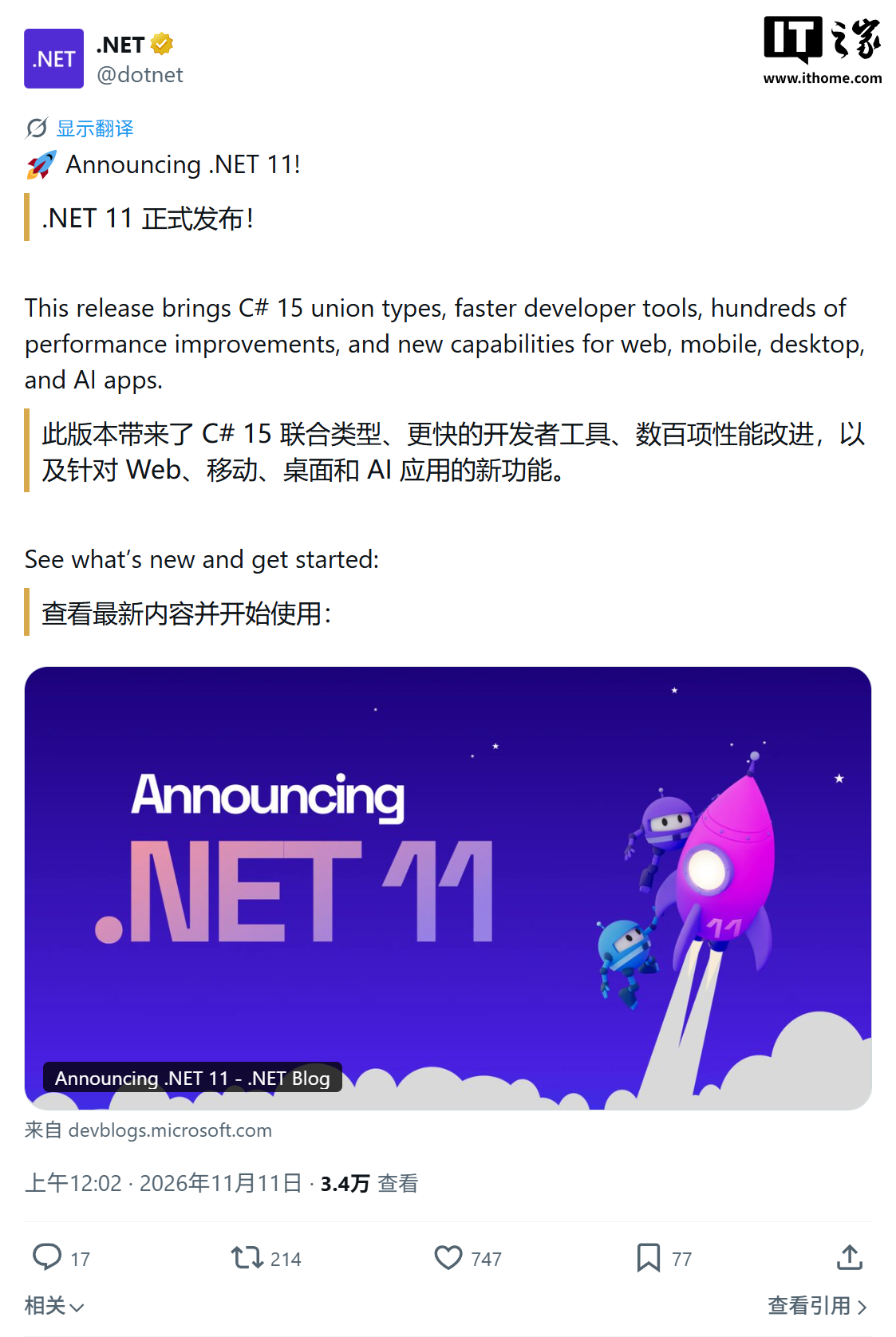
IT News on November 11th: At the NET Conf 2026 online conference held yesterday (November 10th), Microsoft officially released NET 11, introducing a series of updates focusing on performance, development efficiency, and AI application building, covering web, mobile, and desktop application development.
IT Note: NET is a software development platform supported by Microsoft and jointly maintained with the open-source community. It is free and open-source, allowing developers to use it to build various programs such as website backends, desktop software, mobile applications, and cloud services.
This time, the NET 11 focuses on performance, AI applications, and cross-platform development upgrades, covering C# 15, website development frameworks ASP. NET Core, and cross-platform frameworks NET MAUI, thereby reducing development wait times and simplifying the modern application building process.
In terms of performance, the new version brings hundreds of optimizations to the runtime and foundational libraries. It also utilizes a natively compiled command-line interface and a pre-warmed build service to reduce the overhead associated with repeated startup of tools.
In terms of AI, NET comes with a built-in development toolkit that includes MCP server templates, facilitating developers in integrating application functions. It is supported by a AI tool invocation system. The accompanying AI library and agent framework support model integration, tool invocation, and workflow orchestration; moreover, Blazor has also introduced experimental AI interface components that can be used for streaming chats, tool display, and operation approval.
In terms of programming experience, C# 15 introduces union types, which allow programs to explicitly list different outcomes of an operation, and the compiler can check for any missed handling. For cross-platform development, NET MAUI defaults to using CoreCLR at runtime, while also improving interface debugging and testing; Windows Forms offers optional modern visual styles.
.NET version 11 is part of the standard support edition, offering two years of support, while NET version 10 is still available as a long-term support option. Microsoft reminds users to check compatibility, dependencies, and hardware requirements before upgrading, and to verify the effects through actual testing.
refer to
Announcing . NET 11