


MSCI has scheduled to announce the results of the November index review on November 11th, and the index membership of Strategy is currently under attention.
JPMorgan Chase estimates that if excluded, it could trigger an outflow of approximately $2.8 billion in passive funds.
MSTR stocks are facing a crucial test from institutional investors, as MSCI is about to announce the results of its November index review. If it is removed, Strategy could be exposed to billions of dollars in passive selling pressure, which would add further strain to the stock price that is already under pressure due to market uncertainties. This decision may also raise questions about the company's future ability to finance Bitcoin purchases. Could MSCI's decision become another setback for Michael Saylor's Bitcoin strategy?
MSCI Why consider removing Strategy?
This risk stems from the revised qualification framework of MSCI. According to this framework, companies that primarily hold investment assets rather than operating actual business entities may no longer meet the criteria for inclusion in global stock indices.
According to this framework, companies are first assessed to determine whether they possess substantial operating assets, and then they undergo five financial tests. If a company fails in at least four of these tests, it may lose its qualification. For stocks that are already part of the index, they will only be removed if they fail the relevant screenings for two consecutive annual reporting periods.
Strategy is one of the companies identified as potentially affected, along with Japan's Metaplanet and the uranium investment company Yellow Cake. The final list of MSCI will be announced on November 11th, and the relevant adjustments will take effect after the market closes on November 30th.
Will MSTR face a passive selling order of $2.8 billion?
However, the estimated capital outflow does not necessarily mean that an equal amount of selling orders will appear immediately. The actual impact will depend on the fund's position holding, rebalancing decisions, and to what extent active investors continue to hold the relevant positions.
Can buyers hold the $120 level?
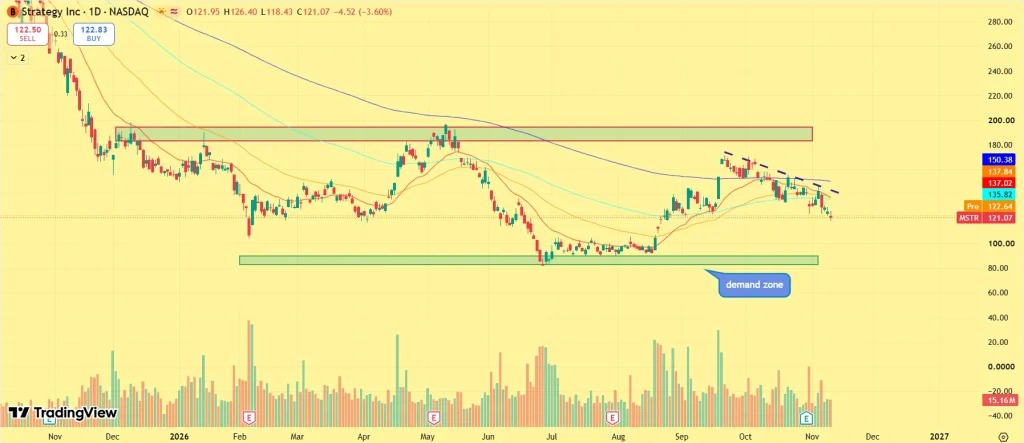
MSTR stock closed at $121.07 on November 10, down 3.60% for the day, with trading ranges between $118.43 and $126.40. The stock is still significantly below its 52-week high of $234.84, indicating that its recent price performance continues to be under pressure.
Key indicators also show cautious signals. Their Relative Strength Index ( RSI ) is around 34, close to the oversold area, and the data indicates strong selling signals. The range of $118 to $120 is a support level that needs attention at present. If the stock price continues to fall below this level, it may weaken further; if it manages to rebound above $126, it could be an early sign of improving buying interest.
MSTR Outlook: November 11th is a critical catalyst point
The announcement regarding MSCI may determine the main direction for MSTR's stock in the next phase. If it is removed, it will bring a new source of selling pressure; if it continues to retain its index qualification, it may alleviate an important unresolved pressure factor. However, the performance of Bitcoin prices and Strategy's ability to raise funds in the capital market will still be the core factors in its valuation.