The price of Bitcoin fell below $70,000 for the first time since August, with a decline of over 6%. The reasons include a strengthening US dollar, a renewed sell-off in tech stocks, and liquidations of cryptocurrencies worth over $1.2 billion that dragged down the market.
As the US dollar index rose to near its highest level since 2025, the price of Bitcoin fell below $70,000.
As NVIDIA CEO Jensen Huang resigned, there was also a resurge in selling off in the tech stocks and cryptocurrency markets.
Bitcoin traders suffered liquidation losses of approximately $677 million, with long positions accounting for the majority of that amount.
US spot Bitcoin ETF recorded a net outflow of $299.8 million on November 11, with BlackRock being among those that led the decline.
According to crypto.news market data, earlier on Friday, November 13th, Bitcoin (BTC) was trading around $68,750 and once dropped to nearly $68,500 on Binance. Ethereum fell below $2,000, XRP approached $1, and Solana fell below $80.
At the same time, this decline occurred after NVIDIA CEO Jensen Huang resigned, US spot Bitcoin exchange-traded funds continued to withdraw funds, and amid new geopolitical concerns involving Iran and Bahrain. The price of Bitcoin has fallen by about 45% from its record high of $126,198 set in October 2025.
Why has the price of Bitcoin fallen today?
As investors' expectations of a stronger U.S. dollar and the Federal Reserve's possible further interest rate hikes in December increase, selling pressure has intensified.
On Thursday, the US dollar index broke above 103, reaching its highest level in about 19 months. Inflation data that was stronger than expected pushed up Treasury yields and also increased expectations for further tightening of monetary policy.
Higher interest rates will make cash and interest-bearing investments more attractive compared to assets such as Bitcoin that do not pay interest.
Tech stocks are also facing separate pressures, as NVIDIA has confirmed that Jensen Huang has resigned from his positions as CEO and board member. The Chief Financial Officer Colette Kress has taken over as interim CEO.
As previously reported by crypto.news, on November 12th, amidst the crisis in NVIDIA's leadership, Bitcoin fell below $73,000.
Investors are also paying attention to another development related to Strategy, which is the largest listed company holding Bitcoin.
MSCI has confirmed its stock index adjustment, which will take effect after November 30th, including the exclusion of Strategy.
Bitcoin settlement amount exceeds $677 million
This round of selling brought about massive losses to the cryptocurrency futures market, especially for those traders who borrowed funds to bet on price increases.
According to the settlement data from CoinGlass, in the past 24 hours, cryptocurrency exchanges settled leveraged positions totaling approximately $1.23 billion, affecting over 151,000 traders.
Of which, Bitcoin accounts for approximately $677.5 million, including about $653.5 million in long positions and $24.1 million in short positions.
Long positions account for over 96% of the Bitcoin liquidation amount, indicating that this decline has had a particularly severe impact on traders who bet on a price rebound.
The maximum single settlement amount is Hyperliquid. The previous BTC-USD position was valued at 31.09 million US dollars.
Liquidation occurs when a exchange automatically closes leveraged positions, as the collateral falls below the required level due to losses.
When prices fall, forced liquidations will further increase selling pressure, especially when multiple leveraged positions trigger liquidation at nearly the same price level.
Institutional demand remains weak. Data from Farside Investors shows that US spot Bitcoin ETF experienced a net outflow of $299.8 million on November 11.
Among them, BlackRock's IBIT accounted for $269.7 million in outflows, bringing the total withdrawal amount over five consecutive trading days to approximately $1.44 billion.
Tensions in the Middle East
Earlier on Friday, geopolitical concerns emerged as the Iranian Islamic Revolutionary Guards claimed to have attacked a U.S. early warning radar facility located in Bahrain.
The Iranian military stated that this action is in response to an air attack on a communication tower in Sirak, southern Iran.
Iranian state media described this attack as a retaliatory action, however, the United States and Bahraini authorities have not yet confirmed the related losses immediately.
This statement comes amidst ongoing tensions surrounding military operations and shipping through the Strait of Hormuz.
During the development of these events, there was no immediate significant increase in the price of medium-quality crude oil from West Texas, with trading prices remaining close to $88 per barrel.
Analyst Doctor Profit remains bullish. What's the prediction for Bitcoin prices?
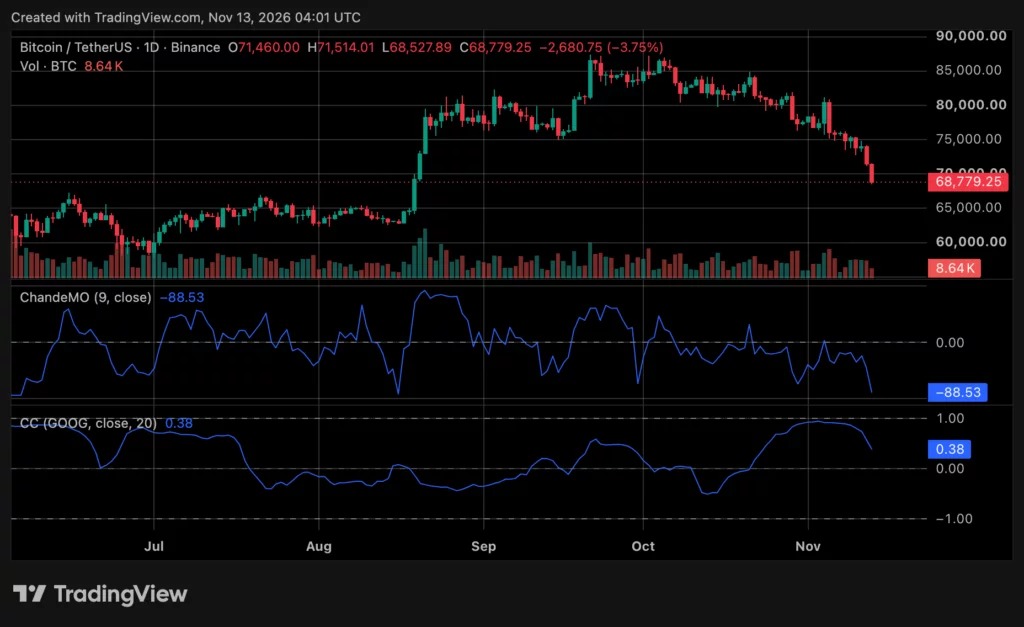
The Bitcoin daily chart shows that after BTC fell from an opening price of $71,460 to a low of $68,500, it traded around $68,750. This decline continued the trend of lower highs and lower lows, with Bitcoin having lost support at the $75,000 and $70,000 levels.
"Ignore the noise. I remain extremely bullish on Bitcoin," he wrote.
This analyst stated that he continues to hold a spot Bitcoin position purchased at around $60,000, as well as a leveraged long position starting from $80,000. He believes that investors who wait for the price to fall back to previous lows may miss out on potential rebounds.
However, the technical aspect remains weak. Bitcoin's Chande Momentum Oscillator is at -88.53, indicating strong negative momentum, and it is in a oversold region on the daily chart.
The immediate support level is between $68,500 and $69,000. If it continues to fall below this range, it could drop to around $65,000; however, if it manages to rebound above $70,000 again, then the range of $71,000 to $71,500 will become a key resistance zone to watch out for.
Further resistance levels are at $72,727 and $74,811. Bitcoin needs to regain these levels in order to challenge the trend of recent lower highs.
Ultimately, the next batch of Bitcoin ETF funding flow data, along with the upcoming US inflation data, may provide further clues for institutional demand and expectations regarding Federal Reserve policies.
Disclosure: This article does not constitute investment advice. The content and materials displayed on this page are for educational purposes only.