Key points:
- Hidden Road Founder Marc Asch will be leaving Ripple Prime
- After acquiring for $1.25 billion at Ripple, Noel Kimmel took over as the leader.
- Ripple is expanding institutional brokerage financing and stablecoin infrastructure
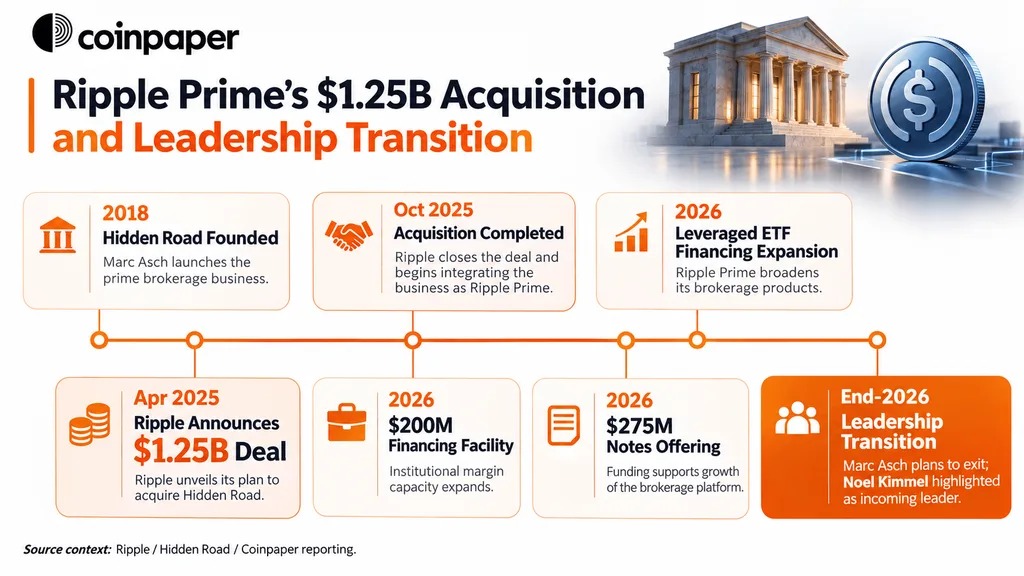
Ripple Prime is preparing for a major leadership transition. Hidden Road The founder plans to leave the institutional brokerage business by the end of 2026, which is about 14 months from the completion of the $1.25 billion acquisition Ripple.
Noel Kimmel currently serves as the President and Senior Vice President of Ripple Prime. He will take over that business and its team within Ripple. The company's spokesperson confirmed this transition on November 10th and stated that Asch intends to seek new opportunities.
This departure marks another stage in the transformation of Ripple from a cryptocurrency payment company to a broader financial infrastructure provider. The official leadership list shows that Kimmel is among the executives responsible for the company's institutional business.
Asch founded Hidden Road in 2018, establishing a principal brokerage business targeting institutional investors that covers digital assets, foreign exchange, derivatives, and fixed income.
Ripple announced in April 2025 its intention to acquire the company for $1.25 billion, and the transaction was completed on October 24 of the same year. Subsequently, the business was renamed Ripple Prime.
This acquisition has enabled Ripple to obtain ready-made institutional liquidation and financing capabilities, without the need to build a brokerage business from scratch.
Thereafter, Ripple Prime has expanded to leverage ETF financing, which is an institutional market traditionally dominated by large Wall Street banks.
According to the operational data previously disclosed by Ripple, the business has a clearing volume of over $3 trillion per year and serves more than 300 institutional clients.
Kimmel has long been deeply involved in this expansion. Previously, he represented Ripple Prime in a $200 million financing agreement aimed at enhancing the institutional margin capabilities.
As Ripple Prime expands its presence in traditional financial markets and integrates cryptocurrency infrastructure into institutional trading services, Kimmel has now taken over that business.
In August this year, Ripple Prime completed a $275 million issuance of senior unsecured notes and received an BBB investment-grade rating from KBRA. The funds raised were used for working capital and the expansion of its brokerage business in the United States.
Prior to this, the business launched the Delta One service, which provided institutional investors with derivatives and financing products linked to stocks.
More recently, Ripple has expanded its cooperative relationship with Brevan Howard. The latter is an investment institution that manages assets worth approximately $35 billion.
This agreement with Brevan Howard covers multi-asset principal brokerage, clearing, and financing, demonstrating the company's ongoing expansion of its business beyond cryptocurrency trading.
However, this announcement from the leadership does not imply that Ripple Prime will change its trading strategy, customer agreements, or product supply.
The expansion of Ripple Prime may bring more opportunities for the US dollar-pegged stablecoins RLUSD of XRP and Ripple, however, the growth in brokerage business does not necessarily translate into demand for cryptocurrencies automatically.
Ripple has been confirmed, and RLUSD can be used as collateral for certain prime brokerage products. The company is also exploring how digital assets can support financial guarantees, liquidity management, and institutional settlements.
Previous proposals involving the mortgage and lending of XRP indicated that Ripple intended to expand the financial uses of this asset beyond cross-border transfers.
Marcus Hale
Marcus Hale is a cryptocurrency and financial markets contributor who reports on Bitcoin, Ethereum, digital assets, regulation, ETF, and the adoption by institutions. His work focuses on factors that may impact market developments, investor trends, and the broader forces shaping the crypto economy.