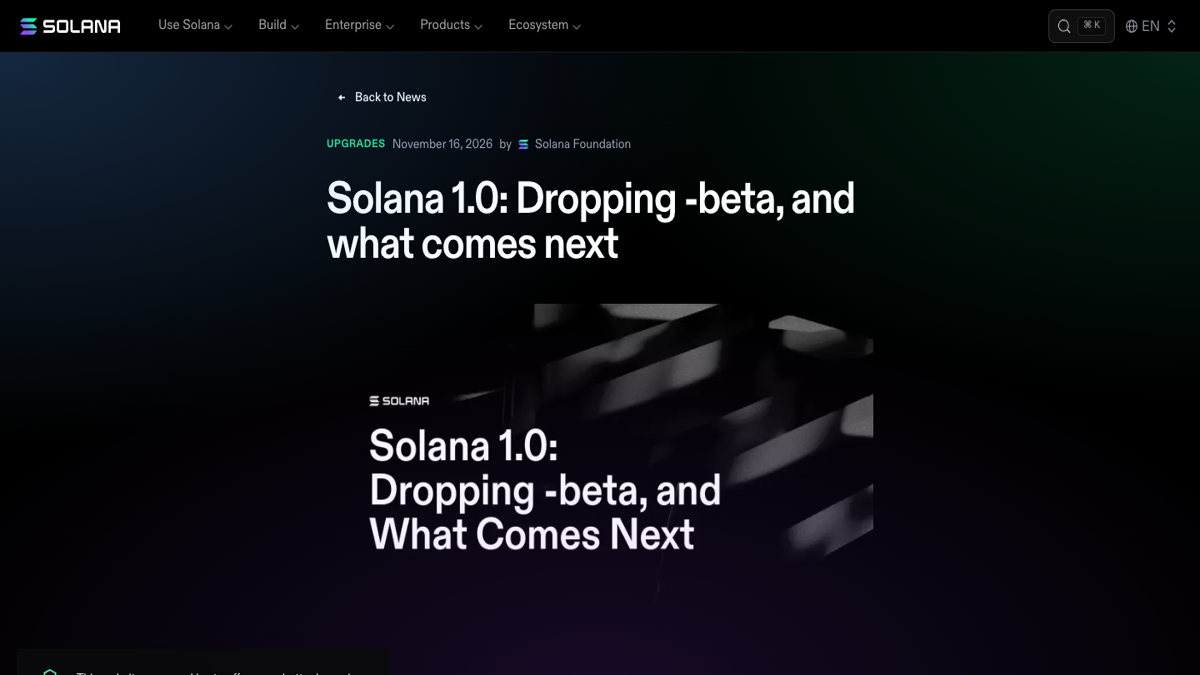


After using “mainnet beta” for so many years, it was officially renamed “mainnet” on November 16th, along with the activation of version 1.0 of the protocol. As the Solana fund clearly states: for users, it’s still the same blockchain, and nothing will change.
Your SOL, account, assets, currently used applications, and transaction records will all be retained in their original form. The official statement is that users do not need to do anything. There is no migration, no coin exchange, and no need for a new address.
First of all, the most important thing to note: this type of upgrade is the most likely to be exploited for fraud.
Every time there are announcements about "mainnet upgrades" or "version changes," some people take advantage of these to create links that prompt users to "migrate assets," "claim new coins," or "re-verify their wallets." However, this official announcement does not require any user action at all in any of these steps.
So the criteria for judgment are very simple: any request to transfer funds, import mnemonic phrases, or sign a strange authorization that is based on the reason of Solana 1.0 does not match this announcement. Even if the exchange's recharge page still displays mainnet-beta, it does not mean that you have connected to some old chain. The official statement mentions that various websites and browsers will gradually change their names, and there will be a period of time when both versions coexist.
Why is it necessary to remove Beta now?
Solana has been in use as a formal network since the beginning of time, handling real transactions, applications, and assets, yet it has always been labeled as Beta. The reason given by the foundation this time is due to two technical issues with the nodes.
One is the activation of Alpenglow on the mainnet. It has changed the way validators reach consensus, reducing the final confirmation time of a transaction to about 150 milliseconds. Final confirmation refers to the point in time when the network deems that the transaction has been settled and will not change thereafter.
The other is the deployment of Firedancer. It is a set of verifier software that was developed separately from the existing client Agave. If there is a defect in one set of software running on a chain, the entire network will be affected; with two independent implementations, if one side encounters problems, the other can still function.
1.0 Who is this number actually for?
In the past, when people said “Solana has been upgraded to a certain version,” they were actually referring to the version number of a particular client software. Now that there are two sets of software: Agave and Firedancer, each with its own code, release schedule, and version number, it’s no longer clear to use just one of these numbers to represent the entire blockchain.
1.0 is the number assigned to the “rules.” A protocol is a set of rules that all verifiers must follow, and a client is the software that implements these rules. With independent protocol versions, different versions of clients can support the same set of rules, meaning everyone is referring to the same thing. This release was coordinated by the foundation with the joint efforts of two teams: Anza and Firedancer.
Those who hold coins don't need to do anything; those who run nodes have work to do.
Announcements have made requirements for three types of people. Application developers should pay attention to any changes in the interfaces, development toolkits, and infrastructure they use. Verifiers and operators of RPC nodes need to check which client versions support each protocol upgrade, and proceed according to the documentation provided by Agave or Firedancer. Teams responsible for documentation and tools should update the network names accordingly.
There is another point that is easily overlooked: announcing a protocol version does not mean that all related improvements will take effect simultaneously. The release of software and the activation of network features have their own schedules. To assume that all new features are available just because a version number like 1.0 is announced is an overinterpretation.
Improvements in experience will not come automatically just because of a name change. According to the announcement, the changes that users perceive will depend on underlying upgrades and the adoption of these upgrades by applications. When the wallets and exchanges you use will start offering faster confirmation times depends on their own schedules.
The official has provided two places to check progress: Solana Changelog, which is updated weekly and records changes to interfaces and tools; and the Solana Upgrades page, which lists features that are about to be launched, compatible client versions, and activation status.
What does this mean for SOL? The announcement doesn't say.
The announcement does not mention prices, nor does it discuss the token economy, nor are there any new arrangements for issuance or destruction. It only talks about naming and version numbers. To interpret “Farewell to Beta” as a fundamental change is unfounded in the announcement.
Three things are certain: the network name has been changed, the protocol now has its own version number, and the approximately 150-millisecond final confirmation time, along with the second set of clients, were cited by the official as reasons for removing the previous system. As for whether the application makes use of a faster confirmation process and what share each of the two sets of clients occupies, the announcement did not provide specific numbers; additional data will need to be sought for this information.