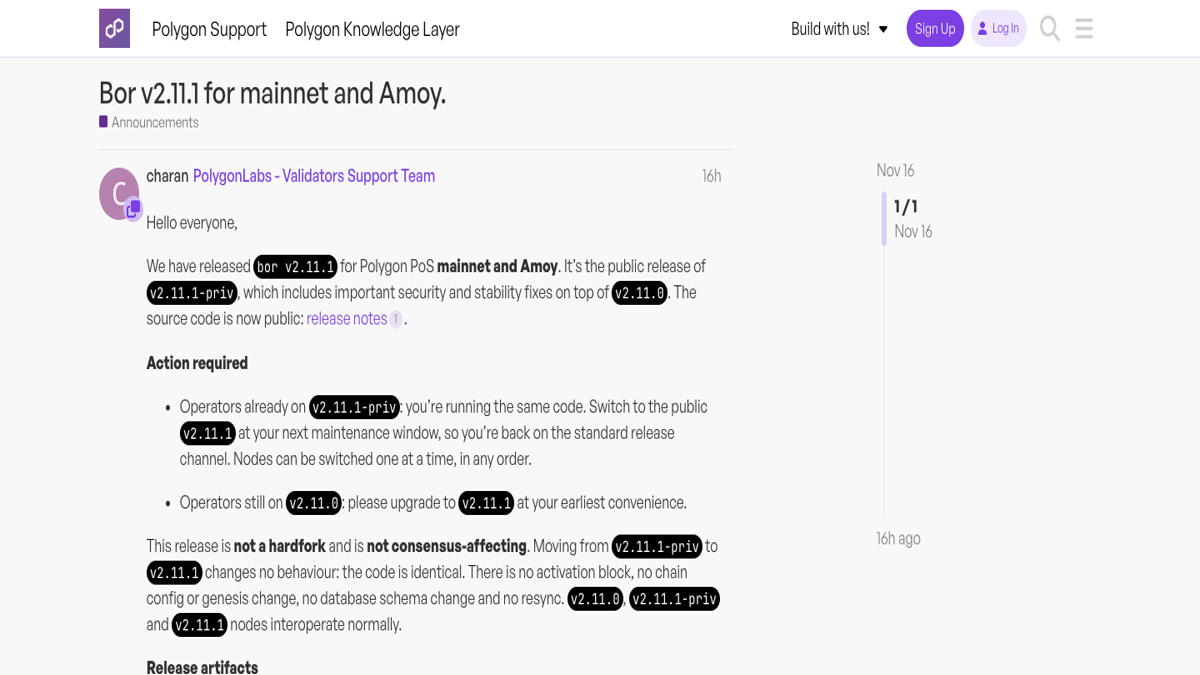


Polygon has a batch of security fixes that were first privately distributed to node operators before being made public. On November 16th, Polygon Labs released Bor and v2.11.1, putting these fixes back into the public channels, and requested that nodes still on v2.11.0 to upgrade as soon as possible.
Bor is the software running on the nodes of the Polygon PoS chain. This update will cover both the mainnet and the testnet Amoy. Officials have stated that it is not a hard fork and does not affect consensus: no blocks will be activated, the chain configuration or genesis file will not be changed, the database structure will not be altered, and there is no need for re-synchronization.
Why is it necessary to distribute it privately first?
There is a dilemma in fixing vulnerabilities: once a patch is made public, others can identify the issues from the changes made. Making the code public when most nodes have not yet been upgraded is tantamount to giving attackers more time.
Polygon This time, the approach is to release a private version v2.11.1-priv first, allowing operators to install it in advance; then, a public version v2.11.1 is released, with the source code also made public at the same time. The official emphasized that the code for both versions is exactly the same, with the only difference being the version identifier: the private version displays 2.11.1- private, while the public version displays 2.11.1. At the end of the announcement, special thanks were given to the operators who upgraded to the private version in advance.
The announcement does not specify which vulnerabilities were fixed, nor does it mention the severity of these issues; it simply refers to them as "important security and stability fixes." Whether these vulnerabilities have been exploited by anyone is also not mentioned in the announcement.
What do node operators need to do now?
There are two scenarios. For those already running on v2.11.1-priv, the code is the same; you just need to switch to the public version during the next maintenance window and return to the standard release channel. The nodes can be upgraded one by one in any order. For those still on v2.11.0, the official requirement is to upgrade as soon as possible.
Nodes of versions v2.11.0, v2.11.1-priv, and v2.11.1 can communicate with each other normally, so there is no strict deadline requiring that the upgrade must be completed before a certain block height. There is no need to modify the configuration file. After the upgrade, using the version command will confirm that the displayed version is 2.11.1.
Obtain the installation package from official channels: The GitHub release page provides the Debian package, configuration packages differentiated by network and role, as well as checksums and signatures. There is also an official Docker mirror. Please verify the checksum and signature before installation; don't skip this step.
A change that developers should pay attention to
The behavior of one interface has changed. eth_simulateV1 is an interface used to simulate the results of transaction executions. After the upgrade, if the simulation request contains the blob hash but does not specify the blob base fee, it will return the error “blob base fee unavailable”.
eth_call, eth_estimateGas, and various trackers are not affected. Therefore, only services that use eth_simulateV1 to simulate blob related transactions need to be modified: either include the base fee in the request, or recognize this new error in the code, and not assume that the transaction itself will fail.
This version also includes improvements in stateless synchronization and transaction processing. The compilation still uses the same Go 1.26.10 toolchain as v2.11.0.
Those who hold POL and use the application on Polygon.
This update occurs at the node software level. There is no content in the announcement that relates to ordinary users: no new tokens, no migrations, and no contracts that require re-authorization.
Like all upgrade announcements, it may be exploited by some for malicious purposes. Any request to transfer coins, change wallets, or sign unfamiliar authorizations under the guise of "Polygon Upgrade" has nothing to do with this announcement.
What really matters to users is the other aspect: have the nodes behind the wallets, exchanges, and applications that you commonly use been upgraded? Security fixes only count if they are actually installed. The compatibility among the three versions facilitates smooth upgrades, but it also gives some operators the option to delay upgrading, leaving the issues that have already been fixed in the older versions still on their machines.
This type of publishing method will be seen again in the future.
First sending it privately and then making it public indicates that the project team has implicitly accepted one thing: the patch itself will reveal the location of the vulnerability. The cost of this is that during the period when it was sent privately, the outside world could not see the code and could only trust the project team. This time, Polygon made the source code, checksum, and signature public afterwards, allowing anyone to verify whether the version they installed is the same as that of others.
Nodes don't need to wait for a hard fork, and users don't need to perform any operations. There's only one remaining issue, and it's quite difficult for outsiders to determine: how many nodes are still stuck at v2.11.0.