













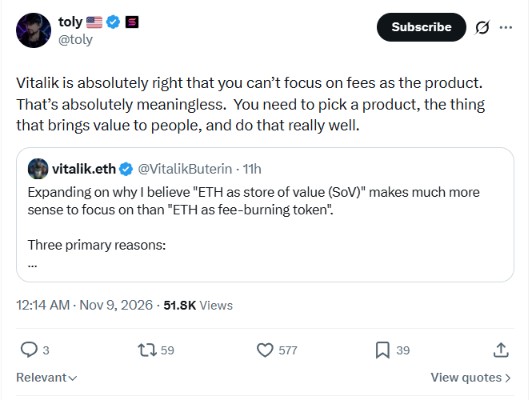
The founder of Ethereum stated that ETH should be regarded as a store of value asset.
Vitalik Buterin stated in a series of posts that the claim that ETH serves as a token for burning transaction fees has never seemed so compelling, and optimizing around this point would have a negative impact on Ethereum's 'decentralization and resistance to capture.'
On the contrary, he believes that the value of Ethereum should come from the stability it provides through its focus on “decentralization and CROPS.” Here, CROPS refers to resistance to censorship and capture, open-source, privacy, and security. He thinks that in this “AI disruptive era,” these characteristics will be even more valued.
In 2021, the EIP-1559 upgrade, during a period of high transaction fees, caused Ethereum to enter a deflationary state. This also led supporters, including the host of the Bankless podcast, to refer to Ethereum as "ultrasound money (ultrasonic currency)."
However, due to design choices, transaction fees and revenues have been continuously declining, making it difficult for this narrative to sustain. From January to October of this year, the average daily number of transactions increased by more than half, but the median transaction fee dropped from 35 cents to 3.5 cents.
Some Bitcoin supporters who regard Bitcoin's role as a store of value as sacred and inviolable have been harsh in their criticism of the series of posts by Buterin. The founder of Held Media, Dan Held, mocked this as “ETH attempting to shift to a narrative of Bitcoin as a store of value again, after all previous narratives have collapsed.” He also stated, “It’s absurd that a protocol with constantly changing monetary policies (just like fiat currencies) is considered to be a ‘sound currency.’” However, supporters point out that since The Merge in 2022, Ethereum has not changed its monetary policy, and each change has actually reduced the supply, rather than increasing it.
Strong supporters of Ethereum welcome the protocol's founder for setting a clear narrative direction for it. MetaLeX Lawyers Gabriel Shapiro state that this is a "natural moment of recovery" for Buterin, and they say, "I believe that from a fundamental perspective, ETH as a store of value may be even better than ZEC and BTC."
Even Solana, co-founder with Anatoly Yakovenko, stated that Buterin "is completely correct; one cannot treat transaction fees as the product itself." However, he later made a subtle mockery of Ethereum's "product" as well.
After the Democratic Party's sweeping victory, the future of crypto regulation remains uncertain.
Despite the Super Political Action Committee in the crypto industry investing $176 million in 100 seats, including an attempt of $64 million that failed to prevent Sherrod Brown from entering the Senate, the impact of crypto funds on elections seems limited. Or perhaps not?
Although the Democratic Party now controls both the Senate and the House of Representatives, Stand With Crypto points out that members supporting crypto now hold the majority in both chambers: 50 out of 100 senators are labeled as "in support of crypto," with only 33 being "against crypto"; in the House of Representatives, 241 members support the industry, while only 106 actively oppose it.
However, the anti-encryption camp will hold power in key positions. Brown may join the Senate Agriculture Committee, while Elizabeth Warren is considered to be appointed as the chairman of the Senate Banking Committee.
The Executive Director of the Decentralized Research Center, Kyle Bligen, stated: "The next congress will bring a fundamentally different environment to Washington's crypto industry, and the industry should expect to face significantly more scrutiny." It is reported that Democrats are considering expanding Representative Maxine Waters's proposal into a broader market structure bill. CLARITY Act still has a slim chance of being reintroduced, but only on the condition that stronger ethical provisions are added to address the corruption issues alleged to exist with President Donald Trump.
The founder Hadley Stern said to Magazine: 'The family of the current president has launched memecoin and stablecoins, and this is a real governance issue. If I did the same thing in Fidelity, I would be asked to leave the company that very afternoon.'
TRUMP memecoin This week, it has fallen by one-third, making it the asset with the largest decline among the top 100 largest cryptocurrencies by market value.
False job interview led to Binance suffering a $6.34 billion hacker attack
Binance claimed that North Korean hackers had breached their system as early as June. At that time, an employee downloaded a tampered Homebrew installation package while attempting to install the AI coding tool. Although the exchange quickly discovered this incident, the hackers had already obtained information about the employees responsible for Binance's wallet infrastructure.

In September, attackers pretended to be recruiters and targeted another software engineer, tricking them into downloading a malicious file disguised as a programming assignment.
On October 20th, attackers utilized the compromised computers and an internal AI tool to further gain access to the systems of two other engineers and deploy malware. Subsequently, they obtained access to the exchange's internal wallet signing service, thereby enabling them to steal billions of dollars in assets.
Binance co-founder CEO Richard Teng posted on X on Tuesday, stating: 'This is not a mistake, nor is it an intrusion; it is an operation that has been ongoing for several months.'
Ethereum developers have moved the goal of achieving quantum resistance forward by one year to 2028.
The goal of Justin Drake, a researcher at the Ethereum Foundation, is to complete Ethereum's post-quantum, post-AI transformation by December 2028, which is one year ahead of the previously announced deadline for quantum resistance set by the foundation.
On Tuesday in Mumbai, Devcon 8 introduced this acceleration timeline. He said, "We hope to complete the full post-quantum and post-AI transformation by December 2028." He also added that developers have 24 months to complete three additional network upgrades.
The roadmap announced by the Ethereum Foundation in September sets December 2029 as the deadline for achieving quantum resistance.
However, at present, this roadmap is in a stagnant state, and the core developers have postponed the Glamsterdam upgrade indefinitely until the security issues related to the 8 smart contract invariants are resolved.
THORChain Continued running after ignoring the FBI warning
Despite FBI clearly warning against dealing with funds related to the Binance hack incident, THORChain still resumed transactions for most networks. This permission-free protocol restored relevant functions on November 4th. After the announcement of the news, RUNE tokens rose by 15% within 24 hours. The networks that were re-enabled included Bitcoin, Ethereum, Bitcoin Cash, Doge Coin, Litecoin, Polkadot, and Zcash; Avalanche, Base, and XRP were already in operation prior to this.
Chainalysis reports that THORChain handled over $46 million in related funds within the first 72 hours after the hack incident and reportedly earned $200,000 in fees, according to The Wall Street Journal. Transactions were automatically paused due to an unrelated Ethereum block reorganization.
Co-founder JPThor stated that the warnings from FBI had no impact on this decentralized exchange, which actually proves that THORChain is truly decentralized.
He said, " FBI did indeed mention this protocol by name – but no one can do anything about it – which actually means that the protocol is decentralized. Any person with a sound mind, living in a Western country, would not openly ignore such instructions."
Ranking of Increases and Decreases
As of the end of this week, Bitcoin ( BTC ) has fallen by 4.5% to $74,302; Ethereum ( ETH ) has fallen by 6.3% to $2,117; XRP ( XRP ) has fallen by 5% to $1.11. According to CoinMarketCap, the total market value of cryptocurrencies is $2.49 trillion.
Among the top 100 largest cryptocurrencies by market capitalization, the three altcoins with the highest gains this week are: Pieverse ( PIEVERSE ), up 39.2%; Injective ( INJ ), up 11.1%; Tether Gold ( XAUt ), up 4.2%.
The top three altcoins with the largest declines are: OFFICIAL TRUMP, down 32.8%; Worldcoin ( WLD ), down 20.8%; Ethena ( ENA ), down 19%.
This week's most anticipated predictions
Grayscale indicates that the $6.3 billion hacker attack on Binance may temporarily dampen market confidence in crypto assets, but in the end, it will prompt various exchanges to adopt stronger security measures.
Grayscale Research Director Zach Pandl stated in a report on Tuesday: "This also highlights the importance of institutional custody, such as the custody provided by US crypto exchange trading products."
He added, "These products typically hold assets in state-chartered banks and qualified custodian institutions, which usually offer offline storage, multi-signature wallets, SOC authentication, and insurance policies."
This week's strongest FUD
According to the email sent to users by Binance, Binance France will withdraw from the French market. All accounts will be closed on December 31st, and starting from November 29th, any assets remaining on the exchange will incur a monthly fee.
Starting from that day, if there is still a balance in the account, a monthly maintenance fee of 0.025% of the balance will be charged, with a minimum of 10 USDC. USDC is a stablecoin pegged to the US dollar.
Cointelegraph reported in late June that since Binance failed to obtain authorization under the Crypto Asset Market Regulation Act ( MiCA ) from a certain member country by the deadline of July 1st, the exchange has notified its EU users that access to its key services will be restricted.
It is reported that shortly before the recent two New York Times/Siena political polls were released to the public, suspicious betting activities were observed in the market.
On October 31, researchers from Vanderbilt University reported that a user with the username Polymarket placed a bet of nearly $200,000 on Nebraska Senator Pete Ricketts succeeding in his re-election. An hour later, a poll conducted by The New York Times Siena was released, showing that Ricketts was in the lead.
The New York Times reported on Friday that it is still unclear whether the user possessed insider information, but they made a profit of over $77,000. The report also stated that the user placed similar large bets in other markets, including Kalshi.
Gnosis Pay Data breach exposes personal and bank card information
An encryption-related Visa debit card provider, Gnosis Pay, disclosed a security incident on Friday, in which customers' payment card information, home addresses, and cryptocurrency wallet addresses were exposed.
Gnosis Pay indicates that on November 3, the company discovered that its old version of the consumer card system had been accessed without authorization, and they began to take control of the situation within two hours. The company stated that customer funds, as well as their independent enterprise platform—which supports the white-label card project—were not affected.
This week's Magazine featured articles
- The Democratic Party swept in the mid-term elections in the United States, what does this mean for CLARITY Act?
- Bitcoin holders have received eCash — What can you do with it?
- How Australian Bitcoin Holders Can Avoid the Impact of a Significant Increase in Capital Gains Tax in 2027
- Can decentralized mobile networks provide the impetus for a revolution in AI?