













The S&P 500 index closed in a correction zone on Friday, falling 3.59% to 6,918.45 points, marking the seventh consecutive trading day of decline and the longest streak of losses since February 2020. The Nasdaq Composite Index fell 5.28%, and this year it has already seen a decline of over 2%. Goldman Sachs noted that the index is 12% below its record high on October 6th, and its strategists also listed three signals they would like to see before concluding that the market has bottomed out.
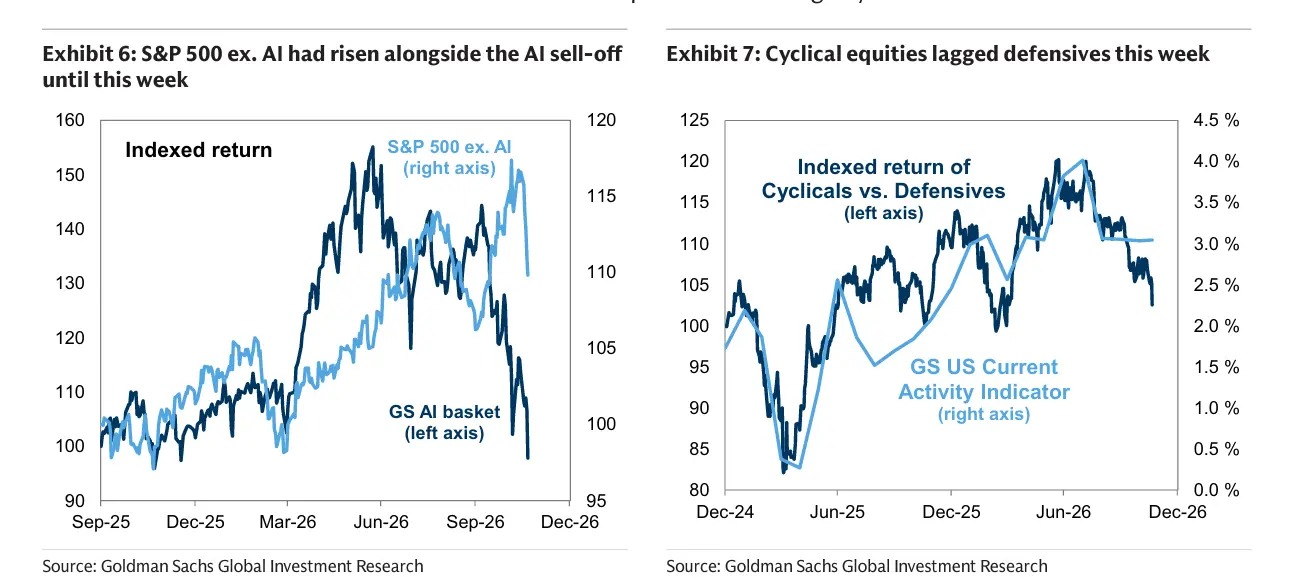
Goldman Sachs stated in a report authored by Snider that this round of selling "has expanded from AI this week to a broader downgrade of growth stocks," and pointed out that the S&P 500, excluding AI, had been performing strongly until now but also fell 6% from its high point this week. Goldman Sachs' AI stock basket has declined by 32% since October 6th. Over the past 10 days, cyclical stocks have underperformed defensive stocks by 5 percentage points.
Goldman Sachs' report was prepared before the market crash on Friday, and the data does not fully cover the selling pressure of that day. The chart prices in the report are up to November 19th, and the hedge fund data also only extends to that date. Therefore, the question is whether the signals sought in the report were already present on Friday—perhaps the market conditions were even worse than what the report acknowledges.
Three conditions
Goldman Sachs indicates that any one of the following three factors could support a market bottom and a subsequent rebound: news that boosts market confidence in the profitability of AI, the Federal Reserve sending dovish signals, or a significant reduction in investors' positions.
Condition one: AI profitThis is something that the market is currently testing. Investor Dan Niles stated that the price war between Anthropic and OpenAI is harming both parties, and pointed out that the combined year-over-year revenue growth rate has dropped from 75% in the second quarter to 48% in the third quarter, while the total losses have expanded from $7.9 billion to approximately $8.4 billion. Data cited by Reuters shows that the valuation of Anthropic is about 40 times its sales over the past 12 months. A senior executive at Bank of America Asset Management said that this valuation “assumes rapid growth for the coming years.” Goldman Sachs' own outlook suggests that the prospects for AI in 2028 and beyond are “highly uncertain.”
Condition Two: The Federal ReserveThe futures market indicates that the probability of a rate hike in December is about 95%, and the Federal Reserve is scheduled to hold a meeting on December 9th. Economists at Goldman Sachs expect the Fed to raise interest rates in December and March, pushing the federal funds rate to a peak range of 4.25% to 4.5%. The likelihood of dovish signals emerging in the short term does not seem high. On Friday, investors bought government bonds in large quantities due to risk aversion, but this does not equate to a shift in Fed policy. The chairman of the Federal Reserve Bank of Philadelphia, Anna Paulson, stated on Thursday that due to high inflation, the Fed will need to raise rates again. The yield on 10-year U.S. Treasury bonds is approaching 5%.
Condition three: Investors' positions have significantly decreased.This often marks the end of some past pullbacks.
At the very least, the first condition remains unclear. This historic IPO has, to some extent, turned into a referendum on the entire AI transaction; it is unfair to place such pressure on a company that, although extremely important, is still just a single entity. After the underwriters exercised their over-allotment rights, the company raised $93.5 billion, exceeding the previous record of $85.7 billion set by SpaceX, making it the largest IPO in history. Its stock price rose by 17% on Thursday, but it gave back most of that gain on Friday, closing at $88.91, not far from the $83 IPO. The Robert Pavlik from Dakota Wealth stated: “The Anthropic has fallen relatively quickly. I don’t think investors see any fundamental problems with the company itself... I think they are just skeptical about the market.” Morgan Stanley, the underwriter responsible for stabilizing the stock price, has ended its support position, removing a potential supporting factor.
NVIDIA fell 14% on Friday, recording its worst single-day performance in nearly two years. This week, it has seen a cumulative decline of 22.9%, and since October 6th, its market value has evaporated by $2.7 trillion. Reuters reported that the U.S. Securities and Exchange Commission is investigating its accounting practices. Jensen Huang resigned from his position as CEO on November 12th, and the Chief Financial Officer, Colette Kress, is serving as the interim CEO. Wall Street's “panic index”, VIX, closed at 35.89 points, hitting a 19-month high.
The Arun Sundaram of CFRA Research means: 'This is a collapse right now.' However, the David Kelly of JPMorgan Asset Management holds a different view: 'This is not a fatal disease; it's not even comparable to the flu.'
Positions have not been completely liquidated.
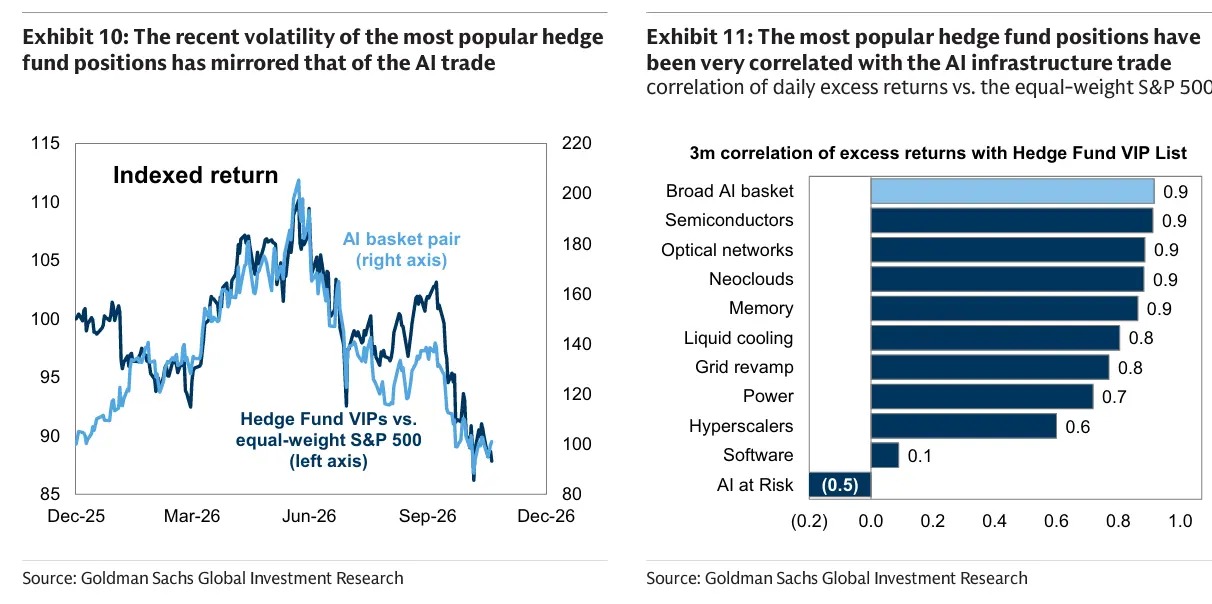
Regarding the third condition, a Goldman Sachs report states that hedge funds have begun to reduce their positions. Their net leverage level has dropped to its lowest since April 2025. A supporting report, “Snider’s Hedge Fund Trend Monitor”, indicates that the most popular long positions held by hedge funds are highly concentrated in AI trades, and these positions underperformed the S&P 500 by 14 percentage points over the past six months. This represents one of the worst performing periods in the 20-year history of this basket. The report describes the situation of hedge funds as “frustrating and spreading”.
However, Goldman Sachs' broader sentiment indicators are still above average. U.S. equity mutual funds and ETF have attracted nearly $170 billion in capital inflows so far in the fourth quarter of this year. The net stock futures positions of asset management firms are at the 82nd percentile over the past 10 years. Goldman Sachs' equity strategists estimate that the AI boom has pushed the S&P 500 earnings level 25% above the trend line. Goldman Sachs' research department stated that AI capital expenditure contributed "about half" of this year's earnings growth.
There is disagreement on Wall Street as to whether this represents the peak. Capital Economics expects the market to fall further. Goldman Sachs' outlook report dated November 17 was written before this decline, predicting that the S&P 500 would reach 8,700 points by the end of 2027. The report dated November 20 suggested a range of around 5,800 to 8,100 points, depending on whether investors regain confidence in earnings. Based on Friday's closing price, this means there is approximately 16% room for decline and 17% room for growth. The percentages mentioned above are calculated by the author of this article based on data and are not as stated in Goldman Sachs' original report.
Since 1980, the S&P 500 has experienced 22 pullbacks, with an average return of 4% in the following three months, and 17 of those periods resulting in gains. However, the research by E* Trade is not so optimistic. Since 1983, in 14 instances where the S&P 500 closed more than 10% below its record high for the first time, 5 of those situations eventually turned into bear markets.