


After conflicts related to Iran once again disrupted energy transportation in the Middle East, natural gas prices in Europe continued to rise, while the US natural gas market saw the opposite trend. The mismatch between supply and demand is widening the price gap between Europe and America, and it also puts additional pressure on Europe's energy supply and inflation prospects this winter.
European gas prices rise to their highest level in over three years
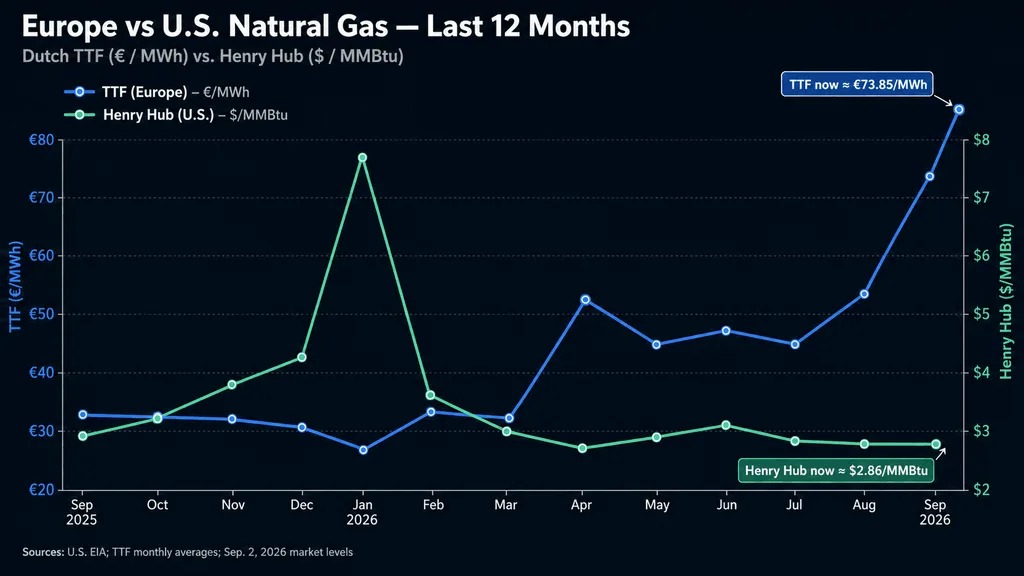
On September 2, Dutch near-month TTF natural gas futures rose to around 73.85 euros per megawatt-hour, an increase of about 25% from the previous month, reaching a high not seen in over three years. The main concern for the market is the rising transportation risks near the Strait of Hormuz, which could affect the supply of liquefied natural gas.
Approximately 20% of global LNG shipments pass through the Strait of Hormuz. Reports indicate that conflicts have disrupted some shipping arrangements, and some Gulf exporters have even resorted to unconventional methods such as ship-to-ship transshipment to maintain deliveries.
Increasing pressure on winter stock replenishment in Europe
Inventory levels in Europe are low before the onset of winter. In late August, EU natural gas reserves were around 63%, which is below the seasonal norm of about 80%. Based on the current rate of gas injection, this winter's reserves could be about 20% lower than the five-year average and may drop to their lowest level since the same period in 2013.
Low inventory, coupled with the risks of import transportation, makes European natural gas prices more sensitive to geopolitical situations. Once the arrival of LNG at port continues to be disrupted, procurement costs in Europe may remain high.
U.S. production reaches new highs, putting pressure on domestic gas prices
Unlike Europe, there has not been a noticeable shortage of supply within the United States. In August, the average daily natural gas production across the 48 states of the U.S. reached 111.5 billion cubic feet, setting a new record and exceeding the level from before July.
Adequate supply, coupled with milder weather forecasts, have pushed down the benchmark gas prices in the United States. On September 1st, the price of natural gas in the US was around $2.86 per million British thermal units (BTU), and on Henry Hub, October futures fell by 2.5% for the day. This has resulted in US gas prices being significantly lower than the benchmarks in Europe and Asia.
- In the first half of 2026 in the United States, LNG, the average daily exports were 17.4 billion cubic feet.
- Year-on-year increase of approximately 23%
- The additional production capacity comes from Plaquemines LNG, Corpus Christi, and Golden Pass.
Energy shocks transmit to inflation and interest rate expectations
Rising energy prices have begun to be reflected in European inflation. The inflation rate in the eurozone rose to 3.3% in August, from 2.9% in July; energy prices increased by 14.3% year-on-year. The market currently generally expects that the European Central Bank will raise the deposit interest rate to 2.5% at its meeting on September 10.
Rising energy costs are also affecting the bond and stock markets. As investors re-evaluate the likelihood of high interest rates lasting longer, yields on German and U.S. government bonds have both increased.
Currently, the global natural gas market is showing a more pronounced differentiation: Europe pays high prices due to scarcity, while the United States maintains low prices supported by high production levels. The key link between the two remains the LNG export capacity. If disruptions to supply from the Persian Gulf continue, the value of U.S. exports will further increase.