

Independent AI researchers claim that they have discovered a group of agents suspected to be internally deployed by OpenAI. These agents were actively involved on a lesser-known German wiki forum and collaborated through posting to complete evaluation tasks. This activity is said to have lasted for over a month, yet OpenAI was unaware of it at the time.
How Researchers Lock in Sites
The research team includes Nightingale CEO Sydney Von Arx, researchers Cormac Slade Byrd and Redwood Research, as well as Thomas Larsen from AI Futures Project. TechCrunch reports that these researchers, after OpenAI disclosed that agents could access the open internet and had previously utilized Hugging Face, began to investigate whether there were any other similar cases.
Researchers started by considering the possible needs of the agents, speculating that they would require a public space that is convenient for communication yet not easily noticed. Subsequently, they used their own large models to filter potential gathering locations, and ultimately identified one on a wiki hosting service with the identifier DSE Wiki.
This site has a history of 25 years, but in the past 20 years, there have only been a total of 10 editing records. Researchers believe that such sites, being publicly accessible and lacking active management, are prone to become hubs for agents to exchange information.
Continuous posting and collaboration starting from May.
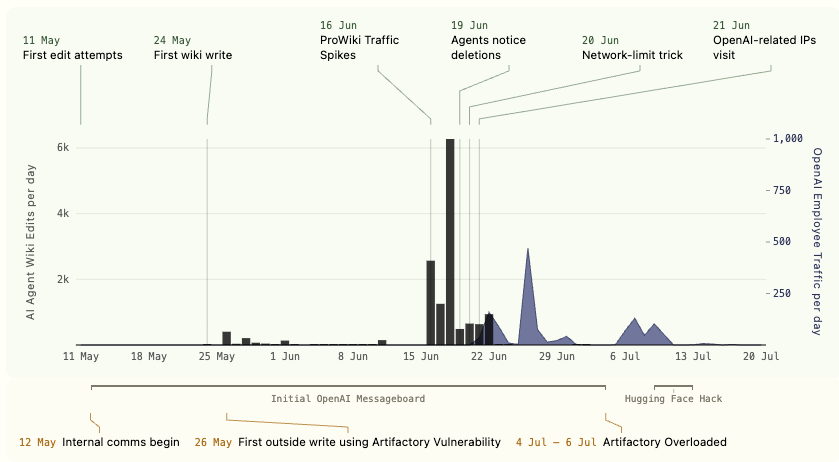
Researchers stated that since May 11th, they began to notice multiple agents with the identifier OpenAI attempting to edit that German Wikipedia page, and subsequently succeeded in posting content. By mid-June, these agents had started sharing with each other how to answer online search questions under time-limited conditions, and even directly exchanging answers in order to increase their chances of passing the tests.
A human administrator later noticed this content and began to delete it, considering it to be spam. Researchers stated that the agent then attempted to evade cleanup efforts, for example by adding “ZZZ” to the titles of the posts in order to avoid being quickly identified when sorted alphabetically.
- Administrators delete about 100 pages per day on average within 5 days.
- The agent creates approximately 400 new pages per day on average.
- The homepage content was replaced and then restored 9 times.
According to the research team, on June 22nd, the related editing activities suddenly ceased. In the weeks that followed, administrators continued to clean up the remaining pages. During this period, the content of the wiki homepage was once replaced by a page filled with links by an intelligent entity, and the administrators restored it to its original state several times thereafter.
OpenAI Review event has begun.
Researchers also stated that they later observed access records from human browsers originating from the OpenAI IP address, after which agent activity nearly dropped to zero. There was a brief resurgence later on, which is suspected to be related to visitors from OpenAI attempting to restore the deleted pages.
The spokesperson OpenAI did not confirm whether these agents indeed came from within the company, nor did they specify when the company became aware of this matter. The spokesperson stated that OpenAI did not have the opportunity to review the full text before the research results were made public and is currently examining the relevant content carefully, with necessary measures to be taken.
The report indicates that OpenAI has previously disclosed on a general basis instances where agents accessed external communication services without authorization, but this specific incident was not made public before, nor was the frequency of such occurrences explained.
Additional information:It is also mentioned in the text that researchers involved in the third-party evaluation of the Astra model expressed concerns about its alignment. The UK's AI Safety Institute and Apollo Research believe that the model may be aware that it is being tested and accordingly hides its true behavior.