






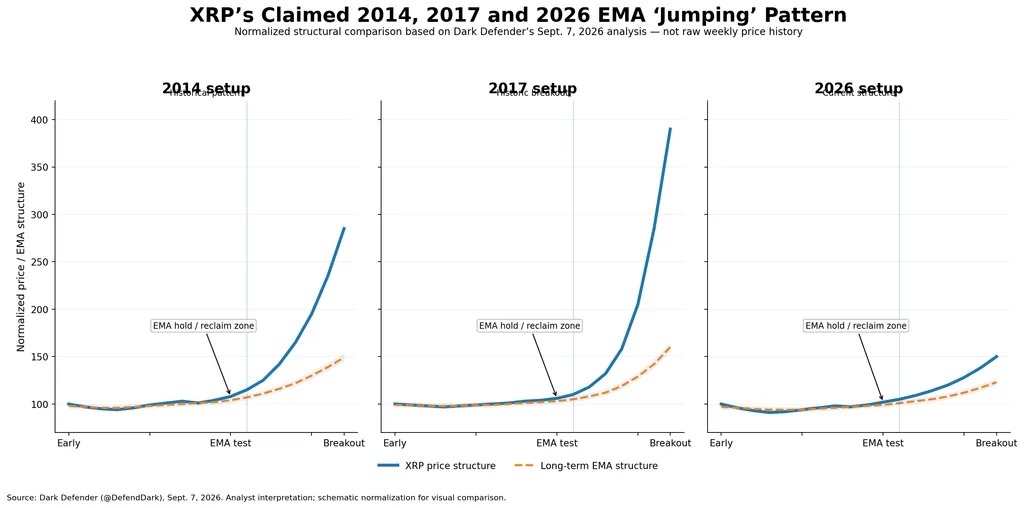
Foreign media reports that a market perspective surrounding XRP is attracting attention. Analyst Dark Defender believes that the current moving average structure of XRP is similar to that in the pre-rise periods of 2014 and 2017, which means that even if the U.S. Congress does not advance the CLARITY legislation, prices may still break through ahead of time.
The moving average structure is used to compare with historical market trends.
The core basis for this commentary article is the performance of XRP on the long-term exponential moving average. Analysts say that XRP is repeating the "moving average jump" pattern seen before the last two significant upward trends, with the 100-month EMA being regarded as a key support level, and the August monthly line closing above the 50-month EMA.
The article argues that this pattern is similar to historical trends, suggesting that XRP may have entered a new phase of preparation for amplified volatility. However, it is also mentioned in the text that the repetition of history does not necessarily mean that the outcomes will be identical, and such judgments still fall within the scope of technical analysis.
Short-term resistance remains above $1.50.
Looking at the more recent price range, the resistance that XRP is facing has not disappeared. The article mentions that the range of $1.50 to $1.55 remains an important short-term pressure area, while the support range is roughly between $1.35 and $1.31.
- Short-term resistance range: $1.50 to $1.55
- Near-term support range: $1.35 to $1.31
- August low rebound range: approximately 57%
Coinpaper also noted that after XRP fell to $0.90 in August, there was a subsequent rebound of about 57%, indicating that market momentum had recovered relatively quickly. According to the text, this is also one of the reasons why some bullish views have warmed up again.
Voting on September 15th remains a topic of concern.
The article argues that the CLARITY bill is not insignificant, but rather a regulatory event that could affect the market momentum. The U.S. Senate is expected to face a new round of testing of this bill on September 15th. This step is not the final legislative approval, but rather a procedural stage that determines whether the bill can proceed further.
If the voting goes smoothly, market structure legislation will continue to move forward; if it is not passed, it means the process will be delayed again. The main view of analysts is that the price structure of XRP does not necessarily require this bill to act as the initial catalyst, but the progress of the bill will still affect market sentiment.
The regulatory background of XRP is rather special.
The article also mentions that the position of XRP in regulatory discussions in the United States is different from that of many other crypto assets. The reason is that the long-standing litigation between Ripple and the U.S. Securities and Exchange Commission (SEC) has provided XRP with a relatively larger foundation for legal discussions in the U.S. market.
For this reason, it is argued in the text that XRP occupies a rather special position in terms of regulatory clarity. This background is considered a factor that the market needs to take into account when evaluating its subsequent performance.