





Solana is working towards shorter block generation times, but some validators are accused of deliberately slowing down the network in order to process more transactions and earn higher profits. In response to this practice, Solana, co-founder Anatoly Yakovenko, has once again made a public statement calling for tougher measures to be taken against such behavior.
Yakovenko advocates for restricting governance qualifications
According to Yakovenko, this kind of " slot lagging " behavior is contrary to the direction of Solana which aims to increase bandwidth and reduce latency. The so-called slot lagging refers to validators deliberately delaying the block production rhythm in order to process more transactions and increase their rewards.
He continued his previous tough stance, advocating for excluding violators from the governance of the protocol. Previously, within the Solana ecosystem, some also suggested that the operators of the staking pool should put the relevant verifiers on a blacklist.
Researchers specifically identified two types of subjects.
Researcher Corvus Labs and Andrei Vacariu indicated that DeFi Development Corp and the R&D company Temporal are among the key targets that are publicly visible.
According to him, a group of validators managed by Temporal, including DFDV, continue to experience delayed block generation. Vacariu also mentioned that DeFi Development Corp is enabling unnamed validators as well in order to continue this practice and reduce the likelihood of being identified.
He further pointed out that the sole staker of these verifiers is $dfdvSOL, a LST, and their staking scale is amplified through the recycling strategy of Jupiter Lend. Currently, these claims mainly come from public accusations by researchers, and the named parties have not responded in the text.
Solana approaching the 300 milliseconds target
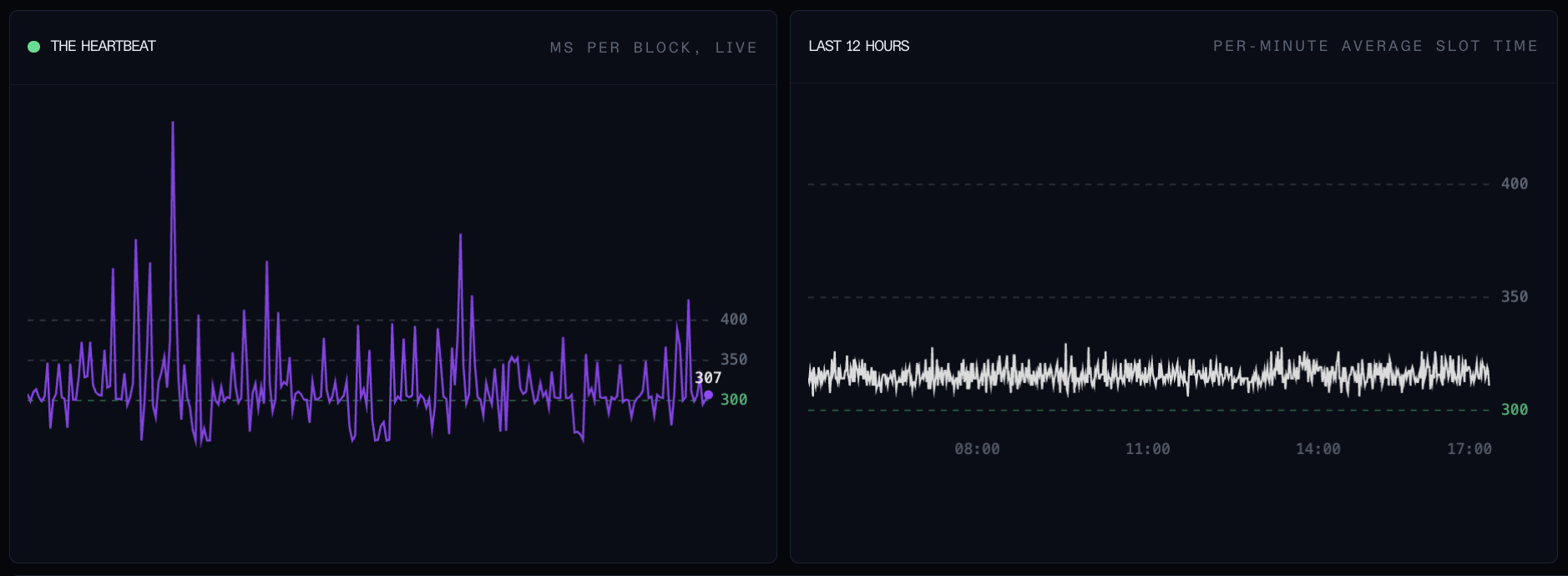
At the time of the dispute, Solana continued to reduce the block generation time. After the first reduction was completed at the end of August, the network underwent a second adjustment, with the target block generation time being lowered to 300 milliseconds.
On-chain data shows that currently, the average time is approximately 316 milliseconds per minute, which is close to the target of 300 milliseconds. According to Anza, 200 milliseconds is still the ultimate goal, and further efforts will be made through two more implementations in the future.
In addition to the block time adjustment, Anza also announced the launch of upgrades Transaction and v1, with plans to increase the maximum size of a single transaction from 1,232 bytes to 4,096 bytes in order to support more complex on-chain transactions.