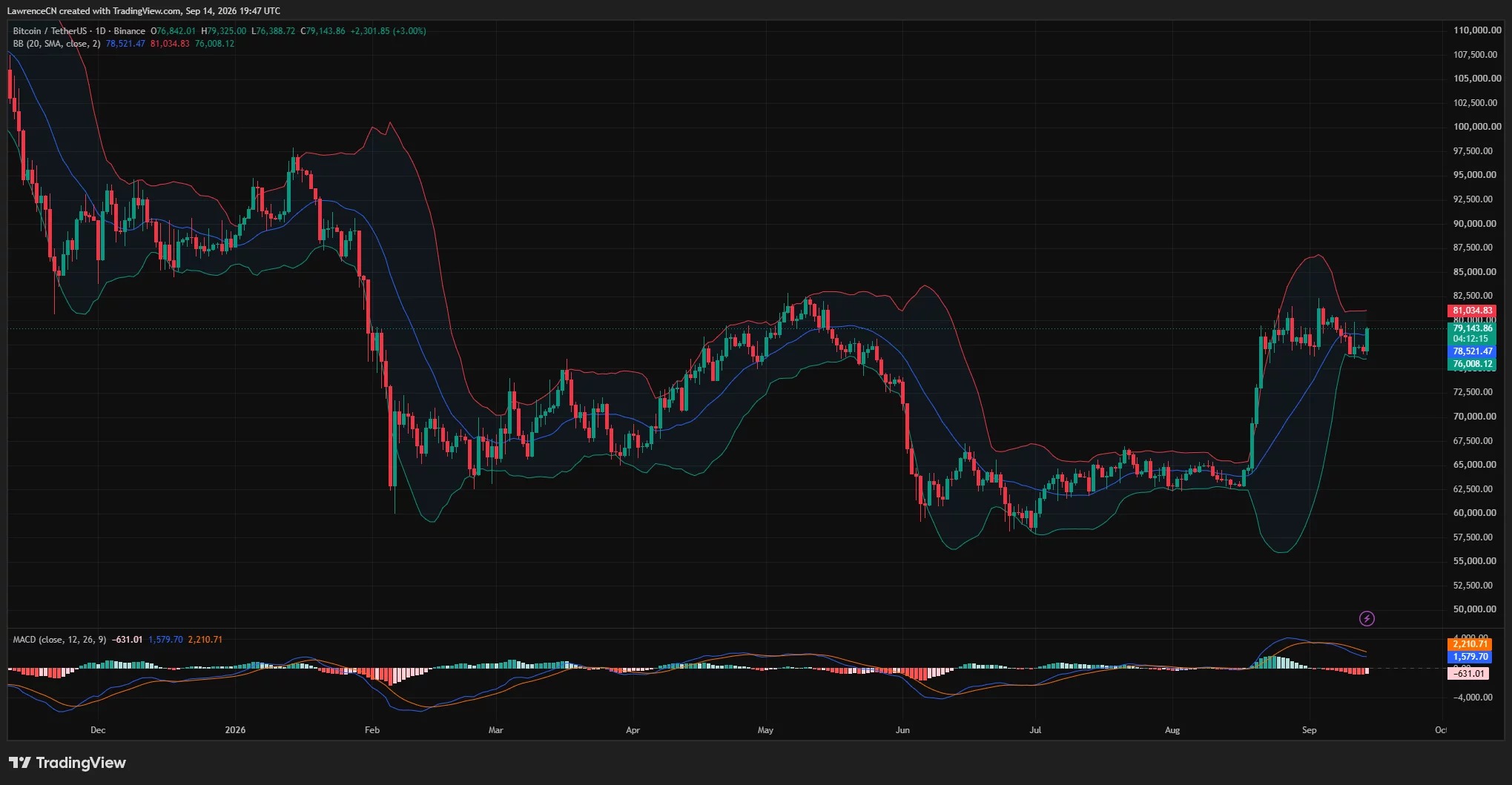






Bitcoin maintained a narrow range of fluctuations ahead of the Federal Reserve's interest rate decision, with prices hovering between the two key ranges of $76,000 and $82,000. Bitfinex Analysts believe that as derivatives leverage continues to accumulate, greater volatility may be triggered before and after the announcement of the decision, and prices are not ruled out from testing both the upper and lower limits successively.
Short positions accumulate above $82,000
As of press time, Bitcoin was trading at around $79,100. Bitfinex noted that the buying pressure failed to hold above $82,000 on several occasions, and the selling pressure also failed to push prices below the lower boundary of the range effectively, resulting in the market remaining compressed within a narrow range.
Despite the narrowing of volatility, derivative positions are still increasing. Data shows that short positions above $82,000 have increased by 43% compared to before, with a potential liquidation size of up to $1.95 billion. This means that once prices surge rapidly and break through the upper boundary of the range, short covering could amplify the increase.
- Short positions above $82,000 increased by 43%
- The corresponding potential liquidation scale is approximately $1.95 billion.
- The current price is approximately in the middle of the two major clearing zones.
Risks remain below $75,000 to $76,000
The main risks below come from leveraged long positions. Bitfinex indicates that there are already a considerable number of long positions accumulated between $75,000 and $76,000. If the price continues to fall below this range, it may trigger a chain reaction of forced liquidations, further increasing downward pressure.
Unlike the relatively concentrated short-selling liquidation area above, the long-selling liquidation points below are more dispersed and not concentrated at a single price level. However, the overall scale is still considerable. Once the lower boundary of this range is breached, the market may experience a deeper pullback.
Analysts believe that such clearing zones typically appear after a long period of sideways movement in Bitcoin. Traders establish leveraged positions around the boundaries of these ranges, and stop-loss and forced liquidation levels are also positioned outside the upper and lower edges. Therefore, once a breakthrough occurs, price fluctuations tend to amplify rapidly.
Spot selling pressure subsides, supporting a breakout above expectations
Bitfinex also mentioned that the selling pressure in the spot market has approached its lowest level of the past year, and the profit-taking by long-term holders since August has significantly decreased. This means that if buying pressure drives Bitcoin above $82,000, there may be less spot supply available for sale than before, and at the same time, short covering will further push up prices.
However, analysts do not assert that Bitcoin will definitely rise based on this. The reason is that the long position liquidation zone below $76,000 is still large enough, and if the market breaks down first, the downward trend could also be amplified.
Institutional funds are still providing some support for the market. Farside Investors Data shows that as of the week ending September 4, there was a net inflow of $986.7 million in US-listed spot Bitcoin ETF, compared to $924.5 million in the previous week. After three consecutive weeks of net inflows, a total of about $3.8 billion has been attracted.
The Fed's forecast path receives more attention
Bitfinex believes that the market already has high expectations for interest rate hikes. Therefore, what may truly affect Bitcoin is not this resolution itself, but rather the interest rate path forecast simultaneously announced by the Federal Reserve. If policymakers imply that there is still room for multiple further interest rate hikes in the future, U.S. Treasury yields and the dollar may continue to strengthen, thereby suppressing risk assets that do not generate returns.
Analysts specifically mentioned that the yield on 10-year inflation-protected Treasury bonds in the United States is currently around 2.55%. This increase in real interest rates means that risk-free returns are rising, putting non-yielding assets such as Bitcoin under greater competition. If this indicator remains above 2.5% around October, even if Bitcoin breaks through $82,000 in the short term, its subsequent gains may be limited.
In addition, energy prices are another variable. Bitfinex believes that if oil prices continue to drive up long-term inflation expectations, it will be more difficult for the Federal Reserve to ignore inflationary pressures in its policies, and real interest rates may also remain high. The institution suggests paying attention to changes in the retail prices of Brent crude oil and US diesel; if Brent oil prices fall below $90 per barrel, the pressure on long-term inflation expectations may ease more quickly.