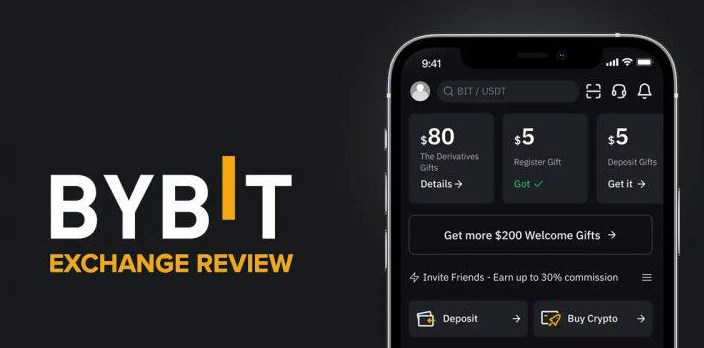


Bybit currently has over 82 million global users, covering 181 countries and regions, ranking as the world's second-largest centralized crypto exchange by trading volume. It holds dual European MiCAR and EMI licenses, yet has also experienced a $1.4 billion hack. This article examines Bybit's true picture from three dimensions: license compliance, security records, and regulatory risks.
What is Bybit Exchange?
Let's briefly outline its background: It was founded in 2018 and is currently headquartered in Dubai. According to CoinGecko data, the total spot trading volume of the top ten centralized exchanges globally reached $18.7 trillion in 2025. Bybit ranked second globally with an annual trading volume of approximately $1.5 trillion and an 8.1% market share, trailing only Binance's 39.2%.
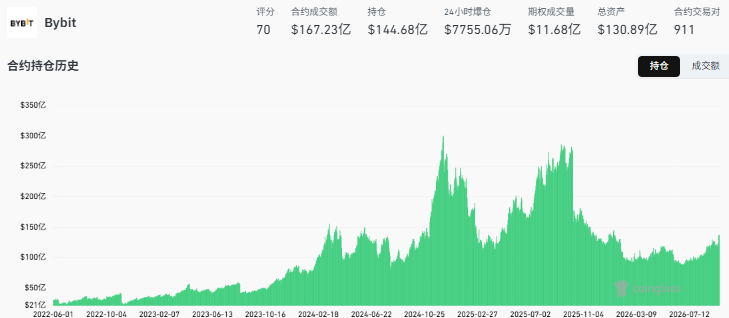
Bybit's trading volume
Regarding , you can trade over 400 cryptocurrencies on the platform. Its product line includes spot, derivatives, copy trading, wealth management, and Launchpad. In early 2026, Bybit launched its MyBank retail banking account service and ByCustody institutional custody solution, with assets under management exceeding $5 billion. In our view, this demonstrates its ambition to evolve beyond a simple trading platform into a more comprehensive financial services provider.
What are Bybit's Advantages? How Did It Achieve Global Second Place?
Bybit's ability to secure the global second place relies on the deep liquidity of its derivatives market and institutional-grade trading experience. Specific data supports this:
| Advantage | Key Data |
|---|---|
| User Base and Trading Volume | Over 82 million global users; daily trading volume exceeding $20 billion |
| Derivatives Market Dominance | Open Interest accounts for 12.78% of the total across the top nine derivatives platforms. OI/Trading Volume ratio reaches 0.81, the highest among top centralized exchanges. |
| Liquidity and Execution Quality | In Q1 2026, BTC spot slippage was 52%-84% lower than some competitors. |
| Compliance Moat | MiCAR crypto-asset license and EMI electronic money license |
| Reserve Transparency | The 38th PoR report shows USDT reserve ratio at 105%, USDC at 174%, and BTC at 104%. |
From our perspective, Bybit's derivatives dimension is the most compelling: its Open Interest (OI) share is 12.78%, and its OI/Trading Volume ratio is 0.81, indicating that its user structure leans towards medium-to-long-term holding rather than high-frequency speculation. This is the core support for its global second-place ranking. However, we must also point out that the slippage comparison does not list specific competitors, and data such as user scale comes from platform self-reporting.
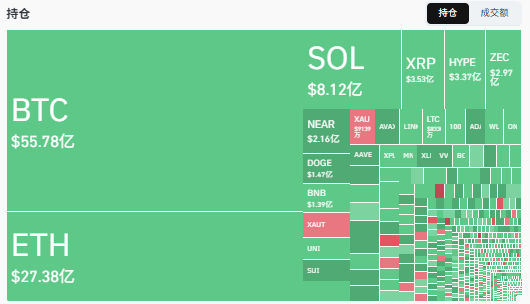
Bybit Open Interest Distribution
What are Bybit's Dual European Licenses?
Bybit's dual European licenses consist of the MiCAR crypto-asset license and the EMI electronic money license, covering compliance for both crypto trading and fiat payment businesses.
Specific Composition of the Dual Licenses
MiCAR License (Crypto Asset Business)Approval Date: Officially authorized on May 28, 2025.
Scope of Services: Authorized to provide 5 crypto-asset services defined by MiCA, including asset custody and crypto-to-fiat exchange.
Passporting Scope: Can operate across 29 European Economic Area (EEA) countries (excluding Malta).EMI License (Payment and Electronic Money Business)Approval Date: Officially licensed on August 4, 2026.
Planned Features: Will support personal transfers, electronic money services, Strong Customer Authentication (SCA), open banking, and merchant payments.
Bybit European Dual Licenses
Significance of the Dual-License Structure
Bybit has split its European operations into two companies. Bybit EU GmbH is specifically responsible for crypto asset services, while Bybit Payments GmbH focuses on electronic money and payments. However, users can access both types of services through the unified Bybit.eu platform. Additionally, Bybit has submitted a MiFID II license application through another entity, which is expected to be approved within approximately two months, further expanding its range of regulated products.
Is Bybit Exchange Safe?
Bybit Security Incident
Evaluating whether Bybit is safe requires confronting its biggest security blemish:
On February 21, Bybit suffered the largest hack in crypto history, losing approximately $1.5 billion. According to a Sygnia investigation report, this attack accounted for 44% of the total global personal wallet thefts ($3.4 billion) that year.
Crisis Response Performance: Bybit fully replenished user losses from its own corporate funds within 72 hours of the incident, ensuring no user bore any losses. This handling record has been regarded as a reference standard for "Tier 1 exchanges" in subsequent industry evaluations.Proof of Reserves: Overcollateralization of Mainstream Assets
Bybit regularly publishes Hacken-verified PoR reports. As of the 38th report on July 22, 2026, the reserve ratios for mainstream assets all exceed 100%: USDT at 105%, USDC at 174%, BTC at 104%, and ETH at 102%. The total value of mainstream assets exceeds $16.5 billion. Coverage has expanded to 50 tokens, utilizing a 1:1 reserve system. Simply put, the coins you deposit are largely there in its accounts, with a surplus.
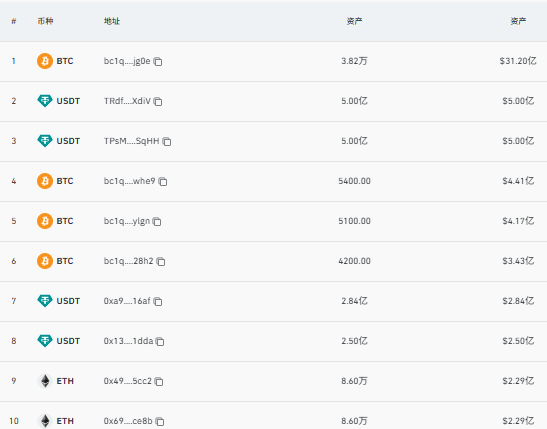
Bybit Proof of Reserves
Other Risk Warnings
The Monetary Authority of Singapore (MAS) placed Bybit on its investor alert list in June 2026, citing its lack of local financial services licensing. Additionally, some US investors have filed a civil lawsuit in ADGM seeking approximately $7.45 million in damages.
In our view, Bybit indeed has strong endorsements in compliance licenses, reserve transparency, and crisis management. However, the $1.5 billion hack also exposed systemic shortcomings in third-party infrastructure security and personnel social engineering protection. For users, Bybit is considered to have relatively high compliance transparency among mainstream exchanges, but it has also undergone major security tests. Ultimately, asset security depends on the platform's continuous security investment and risk control execution.
FAQ
Q1: Is Bybit a legitimate exchange?
Yes, but it depends on the region. Bybit holds multiple regulatory licenses globally, but it has not obtained operating licenses in the US, Canada, mainland China, and Hong Kong, meaning users in these regions cannot access its services.
Q2: Are user funds safe after the $1.4 billion Bybit hack?
Safe, users did not bear losses. After hackers stole approximately $1.4 billion in ETH in February 2025, Bybit completed reserve recovery within 72 hours. The CEO confirmed that all client assets are fully supported 1:1.
Q3: What exactly are Bybit's dual European licenses?
They are a combination of the MiCAR crypto-asset license and the EMI electronic money license. Bybit EU GmbH provides crypto asset custody and exchange services; Bybit Payments GmbH handles electronic money and payment services. The two entities hold licenses independently and bear compliance responsibilities separately.
Q4: Does Bybit have proof of reserves? What are the reserve ratios?
Yes, and it continuously discloses them. Bybit regularly publishes PoR reports verified by third-party auditor Hacken. As of the 38th report in July 2026, the USDT reserve ratio is 105%, USDC 174%, BTC 104%, and ETH 102%, with all mainstream assets overcollateralizing user liabilities.
Q5: Can mainland Chinese users use Bybit?
No. Bybit explicitly restricts mainland Chinese users from accessing its platform and has been prohibited from providing services in Canada, China, Hong Kong, and the US. Users are advised to choose licensed trading platforms that comply with their local regulations.
Conclusion
Returning to the initial question: Is Bybit safe? In our view, it depends on your region. Bybit holds MiCAR and EMI dual licenses in Europe, all reserve ratios exceed 100%, security interception capabilities continue to upgrade, and compliance construction has made substantial progress. However, it is not open to regions like the US, Canada, China, and Hong Kong, and the MAS has placed it on an alert list. When choosing an exchange, compliance licenses are only the bottom line. Regional access, security history, and fund protection are equally important. It is recommended to make a judgment based on the regulatory environment of your location.
Disclaimer: Readers are strictly advised to comply with local laws and regulations. This article is compiled based on public market data for reference and educational purposes only, and does not constitute investment advice. Follow CoinMeta for the latest updates.