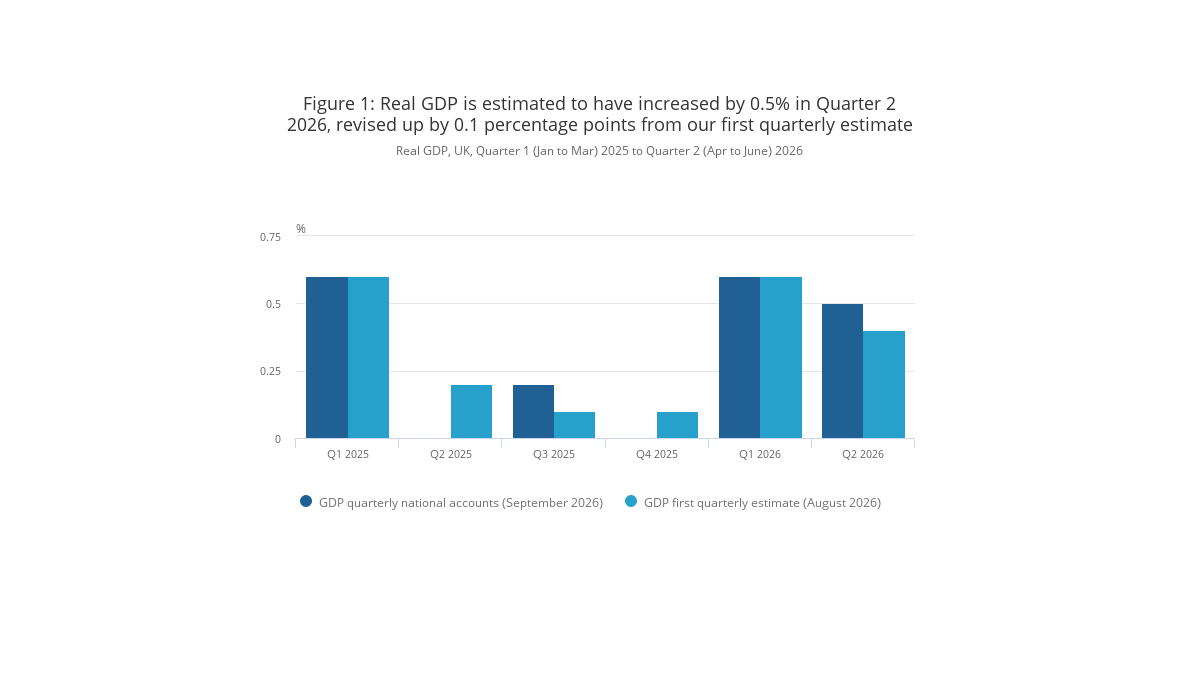


On September 30, the Office for National Statistics (ONS) in the UK released the final figures for the national accounts for the second quarter, revising the quarter-on-quarter growth rate of real GDP from the preliminary figure of 0.4% to 0.5%. This change indicates that the economic performance in the spring was slightly better than initially estimated, but it does not alter the overall picture of moderate growth: the growth rate in the first quarter was 0.6%, and it slowed slightly in the second quarter; while the services and construction sectors expanded, the production sector contracted slightly. For those observing the UK economy, the sectoral differentiation behind these revised figures is more noteworthy than the additional 0.1 percentage point.
The quarterly data GDP is typically subject to preliminary estimates and subsequent revisions. The initial figures rely on information from some enterprises, tax authorities, and administrative departments that is available at the time; once more data becomes available, the statistical office will recalculate industry output and expenditure. Therefore, an upward revision does not represent a sudden surge in production activities, but rather a more comprehensive measurement of activities during the same period. To interpret such statistical revisions as a sudden acceleration in the economy in September would reverse the logical sequence of events. This report reflects the UK economy from April to June, not the immediate conditions in October.
The service industry remains the main driver, while the production side has not kept up in synchronization.
From the perspective of output, the service sector grew by 0.6% in the second quarter, while the construction industry grew by 0.8%, and the production sector declined by 0.1%. Since the service sector is larger in scale, it contributes significantly to the overall economy. According to the National Bureau of Statistics, thirteen out of twenty sub-sectors of the service industry achieved growth. This indicates that growth was not solely driven by a single sector, but it also cannot be inferred that all enterprises experienced the same level of demand. Within the service sector, business services, consumer activities, and public-related businesses have different cycles and cost structures.
The growth in the construction industry also needs to be viewed in terms of its base level and sustainability. The advancement of projects over a quarter may lead to a rebound in output; however, interest rates, financing conditions, and engineering orders will determine whether this growth can be maintained in the next phase. A slight decline in the production sector serves as a reminder that improvements in services have not automatically translated into gains in industry. To simply interpret an "upward revision of GDP" as a full recovery in manufacturing would not only be inconsistent with the detailed data but could also mislead judgments regarding corporate profitability.
From a longer-term perspective, the GDP level estimated by the Bureau of Statistics for the second quarter this time is 2.0% higher than that of the fourth quarter of 2024, exceeding the previous estimate of 1.9%. This indicates that the level of cumulative expansion over the past period has been slightly elevated, but it still cannot be concluded solely based on this one point of comparison that potential productivity has improved. Population, labor hours, capital investment, and output per working hour all affect the perceived standard of living; an increase in the total GDP does not necessarily mean that the purchasing power of each household has increased accordingly.
The household sector provides another clue. The report shows that per capita real disposable income increased by 1.0% in the second quarter, after a decrease of 0.8% in the previous quarter; the household savings rate rose by 0.2 percentage points to 8.8%. The rebound in income has supported consumer spending power, but the savings rate did not decline significantly, indicating that residents have not immediately spent all of their improved income. For retailers, the nominal increase in wages and consumers' willingness to spend are still two different things.
To determine whether consumption can continue, we also need to look at inflation, employment, and interest rates. Actual disposable income, after accounting for the impact of prices, is closer to the quantity of goods and services that households can afford than nominal wages; however, this is a national average indicator and does not show the differences among different income groups. Families with high rent or high mortgage payments may still feel pressured. It is possible for statistical improvements and divergent living experiences to coexist, and there is no need to eliminate one aspect when reporting on these matters.
Upgrading does not mean that the policy prospects have been determined.
The final value of GDP will affect the market's judgment on growth and fiscal revenue, but monetary policy will not automatically change just because it is revised up by 0.1 percentage points for a single historical quarter. Policymakers will also need to observe wage trends, service inflation, unemployment rates, and subsequent monthly GDP. Investors, in particular, should avoid equating "better than expected" directly with "slower interest rate cuts," as higher growth could come from improved supply capacity or short-term demand, and both have different implications for price pressures.
Revisions also remind users to pay attention to the statistical methodology. The Office for National Statistics in the UK has also adjusted its estimate for full-year growth in 2025, revising it from 1.3% to 1.2%. The relevant series will be consistent with the upcoming Blue Book 2026 data. The complete Blue Book will be published on October 30th. If historical data from different versions are used interchangeably, it may lead to seemingly contradictory results when calculating year-on-year comparisons, trends, and the effects of policies before and after. News headlines focus on the upward revision for the second quarter, but analyses should also explain that the broader historical series are also changing.
For enterprises, the most practical approach is to allocate investments based on industry segments, rather than relying on a total amount. Consumer goods companies focus on whether residents' actual income can be converted into orders, manufacturing companies pay attention to whether production activities have stopped declining, and construction companies focus on projects and their capital chains. The expansion of the service sector indicates that the British economy still has resilience, but this is not sufficient to draw the same conclusion for all sectors. The fact that has been confirmed so far is that the growth rate for the second quarter has been revised to 0.5%, and the subsequent growth path still needs to be verified by new data.
It is also important to note that quarterly comparisons on a sequential basis and annual comparisons on a sequential basis answer different questions. A sequential increase of 0.5% compares the second quarter of this year with the first quarter, and after seasonal adjustment, it is more suitable for observing short-term momentum; however, annual comparisons may be affected by abnormal high or low bases from the same period last year. If the media alternately cites these two types of growth rates in the same article without clarifying the comparison baseline, readers may easily mistake the data for conflicting. Future monthly output, corporate surveys, and household consumption data can help determine whether the upward revision for the second quarter marks the beginning of a more solid recovery or merely a minor statistical adjustment.