

The U.S. Treasury bond market is facing multiple overlapping pressures. The yields on long-term Treasury bonds continue to rise, and buying interest has yet to materialize. The divergence between bonds and stocks is also attracting increasing attention.
The head of Goldman Sachs' trading desk, Rich Privorotsky, stated bluntly that long-term U.S. Treasury bonds "are still completely ignored." Although the latest PCE data fell short of expectations, slightly reducing the likelihood of a rate hike in October, this has almost no substantial impact on the trend of long-term Treasury bond yields. The expectation of a short-term interest rate hike has been largely absorbed, and the current real pressure remains focused on the far end of the yield curve.
At the same time, the expected volatility of long-term government bonds has also become significantly decoupled from the anxiety in the short-term interest rate market. Privorotsky summarized, "This situation urgently needs to be calmed down."
The rapid increase in yields is also triggering multiple early warning signals based on historical data. BNP Paribas CIB's Florian Roger indicates that 5.5% has been identified as the critical point at which the yield on 10-year U.S. Treasury bonds begins to exert substantial pressure on the stock market. 'We are very close to that point, and by then, stock valuations will start to seem excessively high.'
Bloomberg macro strategist Simon White reminds investors not to be misled by the seemingly low valuations; looking at the historical trend of U.S. Treasury bonds themselves, yields may not have yet reached their bottom.
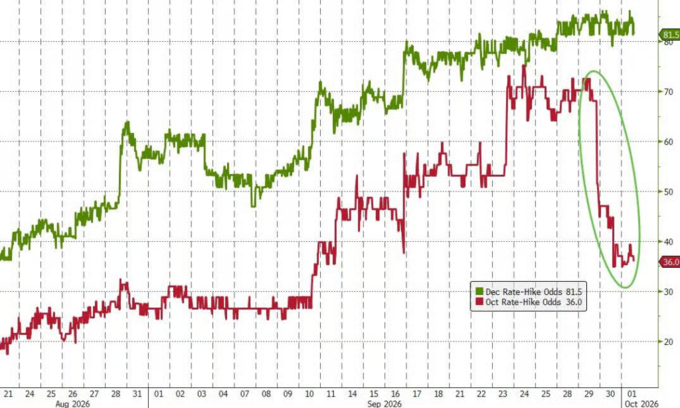
There is a lack of buying interest in long-term U.S. Treasury bonds, and a rebound in the bond market has not yet arrived.
The yield on 10-year U.S. Treasury bonds has risen to 5.34%, but this level has not yet triggered significant buying interest. Although, from multiple perspectives, the valuation of U.S. Treasuries is somewhat attractive, a cautious wait-and-see attitude still dominates the market.
Analysis by Simon White shows that when comparing the yield on 10-year U.S. Treasury bonds with the average yields of 10-year U.S. nominal GDP and 10-year German bonds, and excluding the two special periods of the pandemic and the global financial crisis, their historical trends are highly consistent. However, the current yield on U.S. Treasury bonds is significantly higher than this average.
At the same time, the 10-year yield is more than 60 basis points higher than the fair value model constructed by the global central banks' interest rate hike pace, the yield curve, oil prices, and policy interest rates, yet neither foreign capital nor domestic buyers have entered the market significantly.
The relative value between stocks and bonds also signals a similar trend. The stock risk premium, measured by the difference between the earnings per share yield over the past 12 months and the yield of 10-year U.S. Treasury bonds, has dropped to its lowest level in over 20 years, indicating that stocks are relatively less attractive compared to bonds. Even when calculated based on future earnings, this indicator is close to its historical low for 2025.
White points out that the adjusted yield after excluding the premium for the maturity period provides a more fair comparison. U.S. Treasuries still possess a certain level of attractiveness under this metric, but their advantage has narrowed.
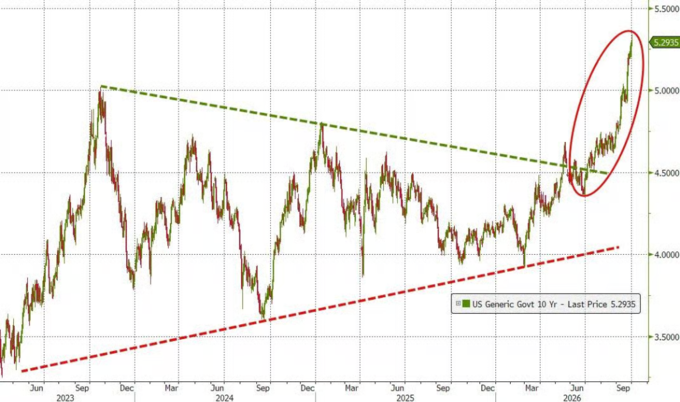
Historical mean reversion indicates that overselling has not yet occurred.
Although the aforementioned valuation indicators suggest that U.S. Treasury bonds are relatively undervalued, another more concise analytical framework adopted by White – which is a regression to the historical average of annual total returns on U.S. Treasury bonds – provides a more cautious signal.
The framework shows that the annual return on U.S. Treasuries has long fluctuated around its average, and during downward phases, there tends to be an overshoot below that average. Currently, the annual return on U.S. Treasuries has fallen back to near the trend average, but historical data indicates that this position does not necessarily mean that the bottom has been reached. Based on over 50 years of historical data, in cases where returns have continued to decline over the past six months and then fallen back to near the average, about three-quarters of the time, returns will continue to fall further after three months.
The trend of real yields also supports this judgment. The upward movement in nominal yields this round is mainly driven by real yields, with the inflation break-even rate remaining relatively modest. The 10-year real yield leading indicator constructed by White, which takes into account factors such as excess liquidity, the intensity of central bank interest rate hikes globally, and the Federal Reserve's policy rates, indicates that there is still room for further increases in real yields. This indicator has a lead period of about three to four months over real yields.
Fiscal pressures and liquidity risks cannot be ignored.
Potential buyers still have to face the severe fiscal situation in the United States before entering the market.
In major emerging markets and developed economies, the United States has one of the highest fiscal deficits as a percentage of GDP in the world, second only to Brazil, Poland, Hungary, and Colombia. Excluding interest payments, the U.S.'s basic fiscal deficit also ranks first globally, on par with that of the United Kingdom, indicating that the fiscal pressure cannot be ignored.
As yields continue to climb, market risks may also become self-reinforcing. Rising yields will increase volatility, which in turn affects margin requirements and the limits on treasury bond risk exposure. Historically, increases in volatility have often been accompanied by a deterioration in liquidity in the treasury bond market.
White also pointed out that when the 10-year yield rate consistently remains above 5.25% to 5.50%, the correlation between U.S. Treasuries and stocks tends to turn positively correlated over time, thereby further diminishing the demand for U.S. Treasuries as a hedging tool in investment portfolios.
Government intervention expectations are heating up, but this is unlikely to be a reason to buy.
Under multiple pressures, market expectations for policy intervention are also increasing. It is reported that the U.S. Treasury Department has hired Jefferies's Chief Market Strategist, David Zervos, as a consultant this week, and this move may not be coincidental. Zervos stated in an interview that the Treasury Department is taking back the initiative in debt maturity management and emphasized "the need to closely monitor how this process progresses."
However, White suggests that although government intervention expectations may increase the risk of short-selling, they are not sufficient to constitute a valid reason for buying. Once the market forms an expectation that the government will provide support, it may fall into a dilemma where it is both difficult to short-sell and difficult to feel confident about buying. Investors still need to remain vigilant.
The core contradiction in the current U.S. debt market is that although valuations have improved, multiple constraints at the technical, fiscal, and liquidity levels have not yet been resolved. Whether yields have approached their true lows remains to be further confirmed.