

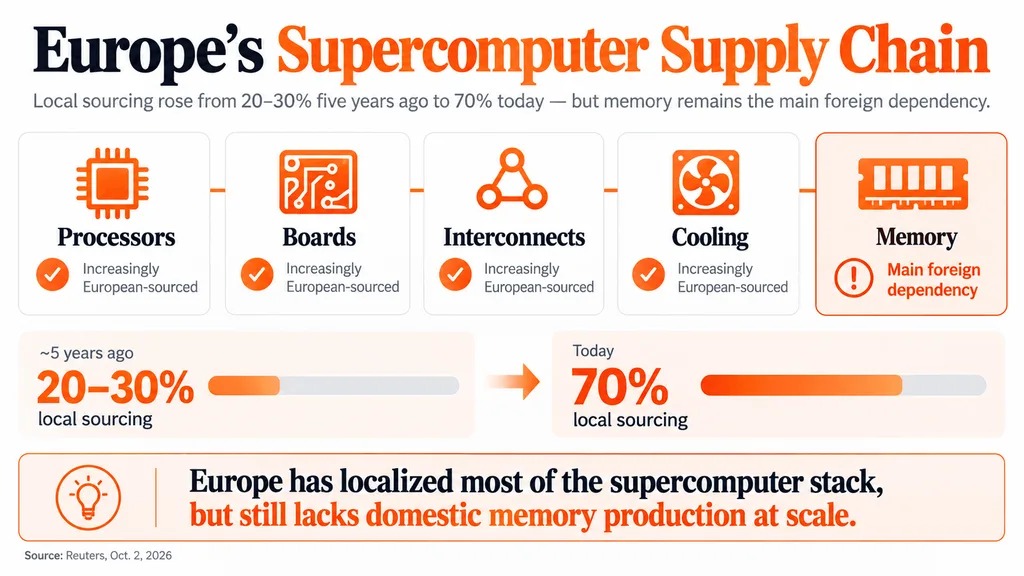
The CEO of French supercomputer manufacturer Bull, Emmanuel Le Roux, stated that approximately 70% of the components used in the company's systems are now sourced from Europe, compared to only 20% to 30% five years ago. Currently, circuit boards, interconnection devices, cooling equipment, and an increasing number of processors can all be purchased directly within Europe.
But memory remains a major exception.
Currently, there is no large-scale supplier in Europe that can compete with Samsung, SK Hynix, or Micron. This means that a key component of the AI computing stack still relies on overseas production.
Most of Europe's supply chains have been re-established.
This transformation comes at a time when Europe is pushing to build more autonomous and controllable computing infrastructure.
The Bull currently held by the French government has recently increased the monthly production capacity of its Angers factory from 6 racks to 12 racks, and is expected to raise it to 24 racks by 2027. The company has built Europe's first exascale supercomputer, JUPITER, and the EU plans to invest about 7 billion euros by 2027 to enhance local AI computing power.
The processor's dependence on overseas suppliers is also declining. European developers are beginning to produce their own chips, thereby addressing another long-standing weakness in the region's computing stack.
However, the importance of the processor itself may have been overestimated. Le Roux indicates that processors account for about 10% to 20% of the value of a supercomputer, while memory has become one of the biggest cost pressures in the industry.
Memory is becoming a bottleneck for AI.
The reason this is important is that modern AI systems require an increasingly large amount of DRAM and high-bandwidth memory.
The continuously rising cost of memory has driven up the prices of some NVIDIA servers by more than 15%. Nowadays, the broader AI infrastructure construction relies not only on GPU, but also on memory, networking, cooling, and power supply.
As the expenditure associated with AI accelerates, the importance of this shortcoming may further increase. Global construction already requires trillions of dollars in AI financing, and a shortage of any single component could drive up the cost of the entire system.
Ethan Mercer
Ethan Mercer is a financial journalist who covers cryptocurrency, stocks, and the global economy. He studied economics and finance before turning to market reporting, with a particular focus on Bitcoin, stocks, monetary policy, and investor sentiment. His reporting focuses on explaining daily market fluctuations and the broader trends behind them.