


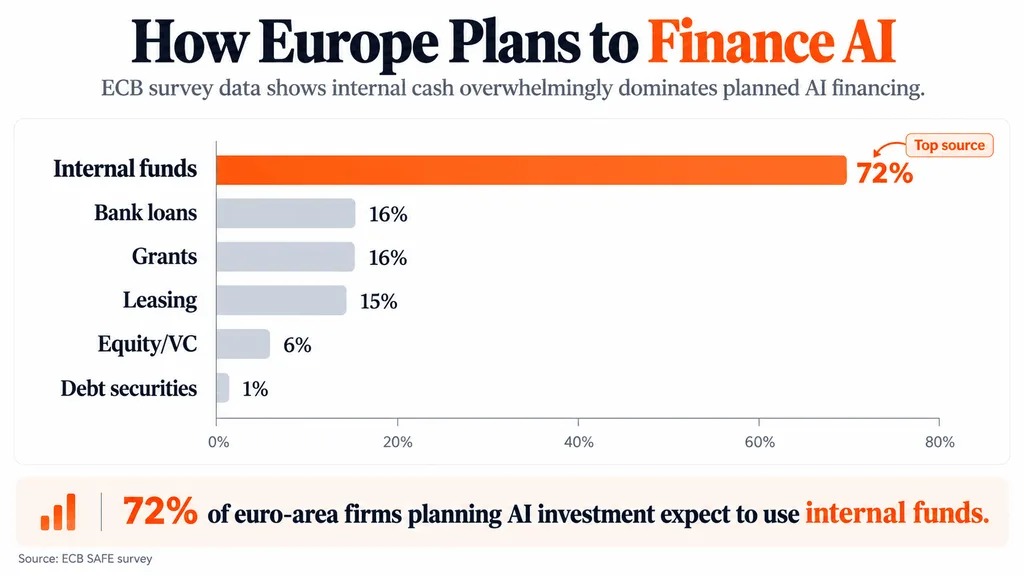
A new survey conducted by the European Central Bank among 5,087 companies in the eurozone shows that among those planning to invest in artificial intelligence ( AI ), 72% expect to use internal funds, including cash flow and retained earnings. Bank loans and subsidies were mentioned by 16% of the companies each, leasing by 15%, private equity or venture capital by 6%, and debt securities by only 1%.
The reason this financing structure is noteworthy is that the global AI craze is increasingly linked to the need for substantial external financing. Large cloud service providers, data center developers, and infrastructure companies in the United States are raising funds for AI through bonds, private credit, bank loans, and project financing.
It seems that Europe is taking a path that relies more on internal funds.
Cash is doing most of the work.
The European Central Bank's SAFE inquiry asks companies how they plan to invest and finance for AI in the next 12 months.
The results clearly favor the corporate balance sheet. Nearly three-quarters of the respondents chose internal financing, while external funding sources remain secondary. Another 18% of the companies did not choose any financing option, indicating that some firms have not yet decided how to pay for their AI plans.
Investment itself is not just about purchasing GPU. Approximately 49% of companies plan to allocate funds to AI technologies and tools, 46% to employee training, 40% to data and infrastructure, and only 12% to hiring AI experts.
European capital markets remain a weak link.
The European Central Bank itself believes that reliance on internal cash may limit the speed at which businesses adopt AI.
Internal financing provides flexibility and allows a company to maintain its independence from lenders, but it also limits the scale of investment to the cash flow that the company itself can generate. For smaller companies or those that are growing rapidly and have ambitious infrastructure needs, this can become a greater problem.
This comparison is particularly important because Europe already has a structural financing gap. Research by the European Central Bank indicates that European AI companies have access to a much shallower pool of venture capital compared to their American counterparts, which has prompted some high-growth companies to relocate overseas in order to expand.
As previously analyzed by Coinpaper, with the acceleration of infrastructure spending, global AI expansion has become increasingly dependent on debt financing. Large technology companies and data center developers have issued billions of dollars in bonds.
Maya Bennett
Maya Bennett is a financial journalist who has reported on cryptocurrencies, stocks, and broader market trends. Her work focuses on Bitcoin, major digital assets, the stock market, monetary policy, and economic developments that influence investor sentiment. She is adept at transforming rapidly changing market news into clear and concise reports.