


The importance of this disagreement lies in the fact that both governments already have a large-scale and formally defined investment framework in place, yet this $8.4 billion project is not mentioned in the publicly disclosed terms and conditions.
The total amount of the existing Korea-US agreement has reached $350 billion.
South Korea's broader commitment totals $350 billion, which includes $150 billion for the US shipbuilding industry and $200 billion for strategic investments.
Energy is clearly also part of this broader relationship. This week, Trump also announced a package of U.S. infrastructure projects supported by South Korea, which involve nuclear power, gas power generation, as well as the proposed LNG pipeline in Alaska. However, Seoul has taken a more cautious stance, stating that the Alaska project still needs to undergo commercial and legal reviews, and not treating each announced figure as a final commitment.
This makes the claim of $8.4 billion on Friday another example of the discrepancy between what Washington has publicly announced and what Seoul claims to have actually agreed upon.
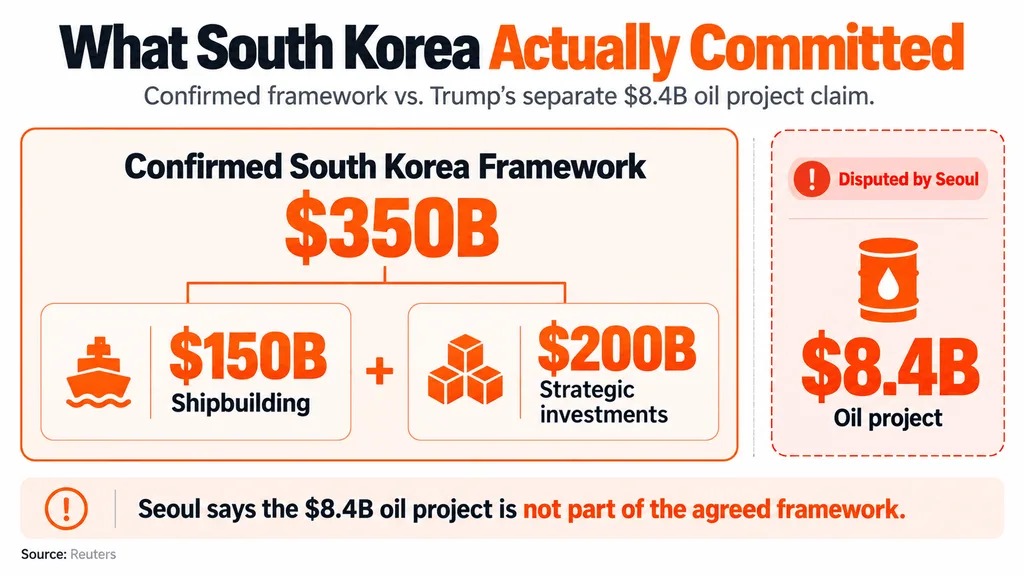
The oil factor has drawn more attention to this disagreement.
The timing factor also adds a stronger element of energy to this disagreement.
Recently, as supply risks in the Middle East have intensified, the price of Brent crude oil has risen back above $100 per barrel. At the same time, the United States released 40 million barrels of crude oil from its strategic petroleum reserves, bringing the emergency reserves to near their lowest level in 44 years. As Washington seeks to mitigate the impact of high oil prices, the diminishing buffer provided by these strategic reserves makes additional domestic production even more important.
Higher oil prices are also affecting a broader range of markets. Coinpaper recently analyzed that a crude oil price of $108 could boost inflation expectations, raise the yield on U.S. Treasury bonds, and put pressure on tech stocks and Bitcoin.
South Korea is particularly vulnerable to this situation due to its high dependence on imported energy. Earlier this year, rising oil prices combined with concerns about supply led to a significant sell-off in the South Korean stock market, which highlights why major energy commitments are of additional economic importance to Seoul.
Maya Bennett
Maya Bennett is a financial journalist with experience reporting on cryptocurrencies, stocks, and broader market trends. Her coverage focuses on Bitcoin, major digital assets, the stock market, monetary policy, as well as economic developments that influence investor sentiment. She is adept at transforming rapidly changing market events into clear and concise reports.