

SpaceX (Nasdaq ticker: SPCX) shares fell about 2% after the market closed on Tuesday. Previously, there were reports that Elon Musk's company was seeking $40 billion in financing to purchase NVIDIA chips. The proposed plan includes approximately $10 billion in bank loans, as well as another $30 billion in investment-grade debt, with completion expected in 2027. Such a large-scale financing arrangement adds another factor for investors to consider, following a cumulative increase of 18% since last Monday.
This recent upward trend is due to a number of developments that have boosted market enthusiasm for SpaceX stocks. The Starship's 14th flight mission was successful, deploying 26 new-generation Starlink V3 satellites, marking another step forward for Musk's giant rocket towards its ultimate capabilities. SpaceX also completed three launches within about 13 hours, including the NASA Crew-13 mission, as well as Transporter-18 and NROL-97. At the same time, Musk stated that he is "cautiously optimistic" that SpaceX can operate NVIDIA's Vera Rubin system at an average power of about 250 kilowatts on the planned Starmind satellites. Musk described this prospect as "significantly important" and noted that the close engineering partnership between SpaceX and NVIDIA is key to achieving this goal.
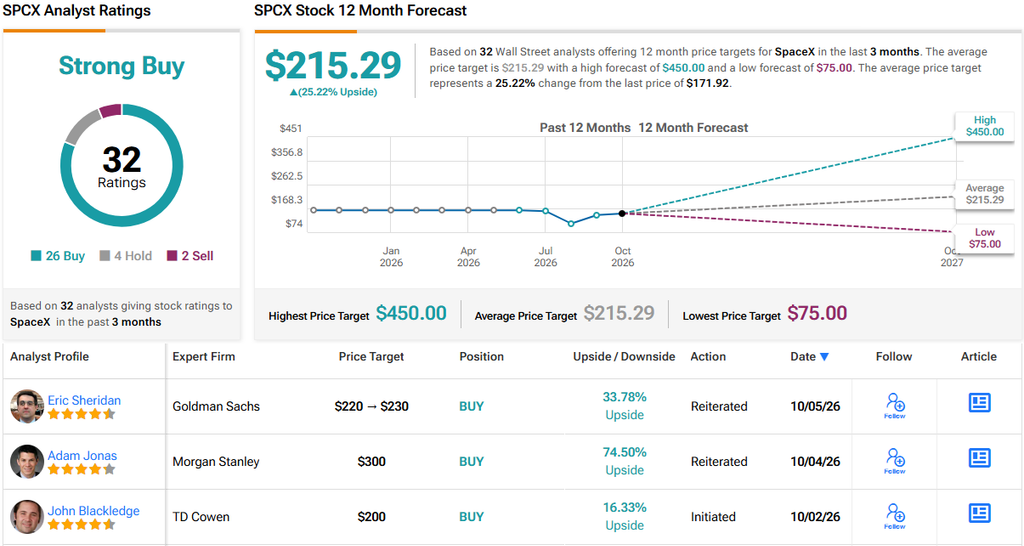
Today, top Wall Street analyst Daniel Ives believes that the potential of SpaceX is far more than just the rocket itself. Ives is covering this stock for the first time, giving it a "outperform the market" rating with a target price of $225, and stating that investors should consider how the various parts of Musk's continuously expanding business empire work together.
Eves stated, "Few competitors, like SpaceX, are able to fund starships, a global communication network, and large-scale AI infrastructure on the same balance sheet, while at the same time enabling each platform to enhance the economic efficiency of the others."
He believes that this perspective provides another way of looking at the long-term value of SpaceX. Rather than viewing rockets, satellite internet, AI, and software as separate businesses, it is more beneficial to see the advantages that arise from their combination. Lower launch costs can support more orbital deployments, while Starlink provides a continuous internal demand for its services and generates cash flow to support further expansion. AI adds another potential growth engine to an already quite large technological ecosystem.
The recent financial results also support Ivys' broader assessment to some extent. Revenue in the second quarter increased by 92% year-over-year to $7.81 billion; adjusted EBITDA grew by 191% to $3.54 billion. Starlink reached 12 million subscribers in that quarter, doubling from a year ago. Sales from its enterprise and government connectivity business also increased by 108% to $1.81 billion, driven by aviation partnerships, mobile communication agreements, and multi-year Starshield contracts.
AI has also begun to generate considerable revenue, and is no longer just a long-term investment. AI sales increased by 247% year-on-year to $2.56 billion; after adjustments, this business segment EBITDA shifted from a loss of $276 million to a profit of $1.15 billion. SpaceX also secured a cloud computing sales contract worth $14.1 billion and expanded its nominal computing power capacity to 1.4 gigawatts.
However, building multiple expensive platforms simultaneously requires a huge amount of capital. Capital expenditures in the second quarter reached $18.37 billion, of which $15.83 billion was invested in AI infrastructure. SpaceX currently holds approximately $100 billion in cash and tradable securities, which allows the company to maintain considerable financial resources while continuing with high-intensity investments.
But for Eves, SpaceX offers investors a broader opportunity than any single business. His bullish logic is based on multiple technologies supporting each other and creating multiple paths for future growth.