U.S. stocks are experiencing a rare internal rift – the index remains stable, but beneath it, there is complete chaos.
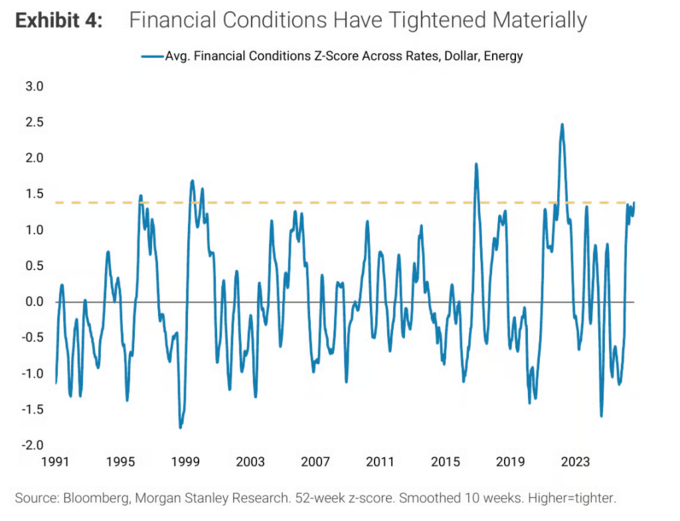
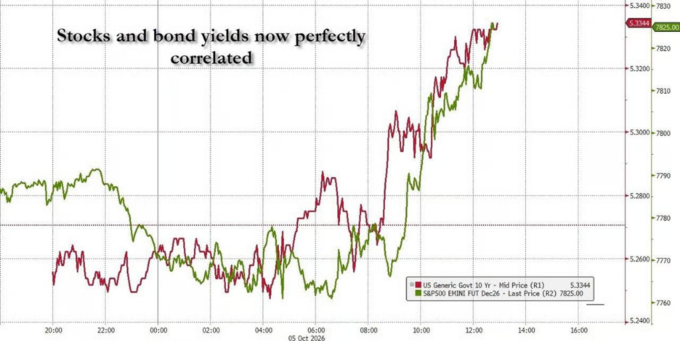
Morgan Stanley's chief equity strategist, Mike Wilson, warned in the latest report that tightening financial conditions are quietly accomplishing some of the Federal Reserve's goals, although this impact is being concentrated on ordinary stocks rather than a few giants centered around AI. The yield on 10-year U.S. Treasury bonds has broken through 5.3%, the dollar has risen to a new high in this cycle, and oil prices remain high. Under this triple pressure, Morgan Stanley's composite financial conditions index has jumped to about 1.4 standard deviations, a level that has only been breached a few times in the past 35 years, most recently when the Federal Reserve raised interest rates by 75 basis points at each meeting in 2022. Meanwhile, Goldman Sachs has revised its expectations to expect another interest rate hike by FOMC in October.
The key cracks in the market are now clearly visible: weight-based indices such as the S&P 500 have lagged behind the market capitalization-weighted index by 6% over the past six months. In September, when the 10-year yield broke through 5%, the equal-weight index fell by 5% in a single month, while the market capitalization-weighted index remained virtually unchanged. Although Goldman Sachs Tony Pasquariello holds a somewhat cautious attitude towards the notion of a "broad-based collapse," it acknowledges that the median of S&P 500 components has fallen 15% from its 52-week high, representing the worst reading since the bursting of the internet bubble. The disagreement between these two major institutions precisely outlines the most core question at hand for the current market: How will this divergence ultimately conclude?
Financial conditions have been significantly tightened behind the scenes.
On the surface, stock market indices appear calm and stable. However, Wilson points out that the real tightening measures have already been underway beneath the water's surface.
The composite financial condition indicator constructed by Morgan Stanley – a 52-week Z-score of composite interest rates, the US dollar, and energy prices – has risen to around 1.4 standard deviations, second only to the level during the aggressive interest rate hike cycle in 2022. This tightening is not due to a single variable but rather a resonance of multiple factors: last month, the Federal Reserve raised the federal funds rate by 25 basis points to 3.75%-4.00%, with Fed Chair Jerome Powell citing strong labor market data, sticky inflation, and geopolitical factors driving up commodity prices as justifications; meanwhile, the yield on 10-year US Treasury bonds has risen by about 130 basis points since February, of which approximately 120 basis points come from an increase in real yields.
Wilson emphasizes that the composition of yield drivers is of paramount importance. Historically, increases in yields driven by break-even inflation expectations have usually been absorbed by the stock market; however, increases led by actual yields often exert more direct pressure on valuations, which is precisely why the correlation between stocks and bonds has turned significantly negative at present. He also pointed out that against the backdrop of a nominal GDP growth rate of nearly 6%, it is not unusual for the ten-year yield to remain above 5% – the ultra-low interest rates of the 2010s were the historical anomaly, and the bond market is simply returning to equilibrium.
Ordinary stocks have already endured real shocks.
The cost of rising yields is being disproportionately borne by ordinary stocks.
The breadth indicator for Wilson shows that the proportion of S&P 500 constituents above the 200-day moving average fell to 43% at the end of September, near the low of 44% in late March. Although it has since rebounded slightly to 50%, the overall pressure has not dissipated. The forward price-earnings ratio of the S&P 500 has also retested the low around 19 times seen in March. What is more noteworthy is that the equity risk premium of the S&P 500 (the difference between the forward earnings yield and the ten-year yield) has fallen below zero, a level that has hardly been seen since 2002.
The "stability" at the index level masks structural damage. Financial stocks represent another warning sign: this sector has fallen by 7.7% within 30 days, and its performance relative to the S&P 500 has dropped to its lowest level since 2019. Wilson considers the trend of financial stocks to be "one of the most important reference indicators for the recent stock market direction." Whether this sector can stabilize before the start of the large banks' earnings reporting season will be a key observation point in determining the market's trajectory.
Is this really a valuation issue or a growth issue?
Wilson believes that the current impact is still at the valuation level and has not yet evolved into a threat to growth – but this judgment itself is controversial.
The data that supports their relatively optimistic stance includes: the nominal GDP growth rate has just recorded 8.5%, and the median earnings growth rate of the S&P 500 components is in the range of a dozen percentage points; the difference between the federal funds rate and the core CPI is about 1.4%, "well below the peak levels before previous recessions"; the yield spread between 10-year and 2-year U.S. Treasury bonds remains at a positive slope of about +45 basis points, indicating that the market has not yet priced in a recession. Wilson Concludes that, under these conditions, "it is rare for growth to deteriorate within 12 to 18 months in history."
However, he himself also acknowledges that a zero equity risk premium is also a rare state in history. Goldman Sachs Pasquariello suggests another dimension of risk: the expiration of lock-up periods in 2027 could push the net supply of U.S. stocks to the highest level since the Internet bubble in 2000, and the market's supply and demand dynamics could come under pressure at that time.
Two converging paths, which one is more likely to happen?
Differences will eventually converge. Will ordinary stocks catch up with the index, or will the index move closer to ordinary stocks?
Wilson provides two triggering conditions for observation: one is the stabilization of financial stocks, and the other is the decline in the MOVE index, which measures the volatility of U.S. Treasury bonds. He pointed out that both have shown some signs of stabilization, but more follow-up is needed. According to Bloomberg, Goldman Sachs' Rich Privorotsky has recently observed that the implied volatility of long-term bonds has fallen by about 30% from recent highs, providing some breathing room for the market.
The coming weeks will be a critical test period. In September, the CPI data, Walsh's statements at IMF, and the FOMC meeting on October 28th will all take place one after another. Consensus forecasts indicate that, affected by a 9.6% month-on-month increase in gasoline prices, CPI in September is expected to rise by 0.6% month-on-month and 3.6% year-on-year. Wilson believes that if the core indicators CPI are moderate and Walsh acknowledges that the tightening of financial conditions has already had some effect in substituting for interest rate hikes, the current pressure is expected to ease somewhat.
However, the long position of Wilson (corresponding to a target level of 8300 for the S&P 500) and the trading strategy of Pasquariello of "shorting fixed income and going long on the NASDAQ 100 index" essentially bet on two completely opposite outcomes. With the equity risk premium dropping to zero, breadth indicators approaching internet bubble levels, and potential supply shocks emerging, the market's preparedness for the tail risk of "indexes converging downward" may be far from sufficient.