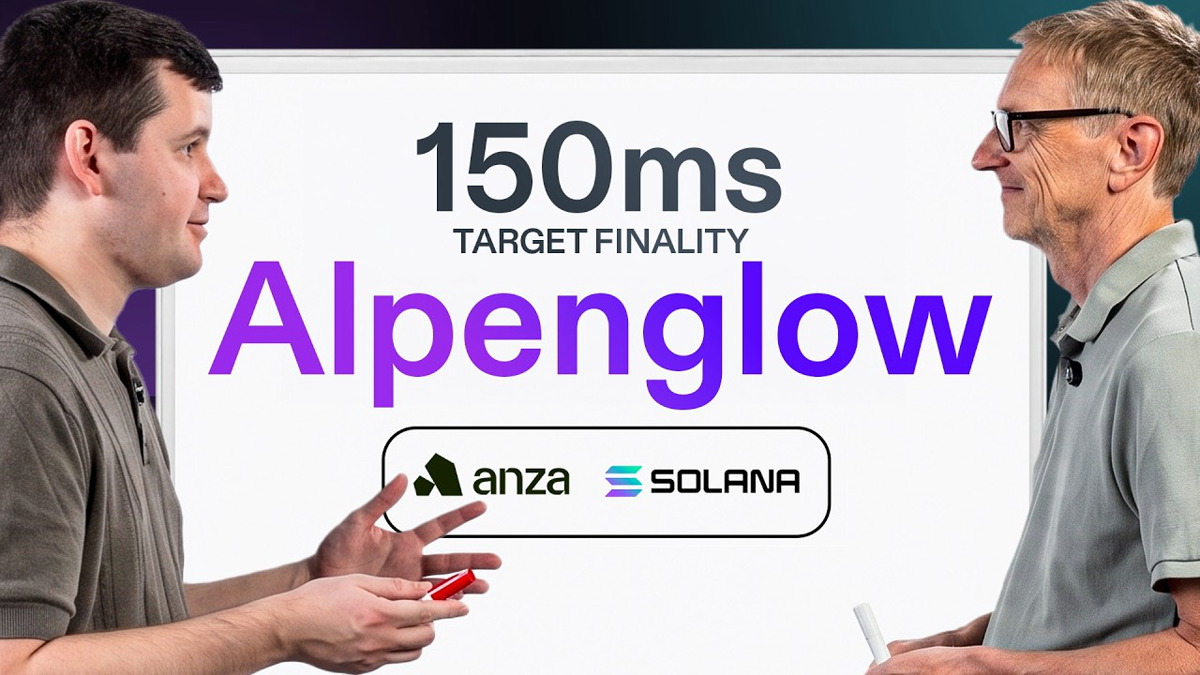


Solana has completed a mainnet upgrade that goes deeper than ordinary parameter adjustments. The upgrade page of the Solana foundation confirms that the Alpenglow consensus protocol was activated on October 21st at around 13:36 UTC on the mainnet epoch. The old TowerBFT voting consensus has been replaced by Votor; validators no longer write votes as ordinary transactions into blocks, but instead pass votes to each other and consolidate them into certificates. Usually, one to two rounds of voting are required to determine a block. This is a mainnet event that has already occurred and is no longer just a demonstration on the testnet; however, the statement "All capabilities have been fully implemented" Alpenglow is still not entirely accurate.
The official page clearly divides the upgrade into two parts: Votor has already entered the mainnet along with Agave version 4.3; Rotor, which is responsible for block data dissemination, is planned to be introduced in subsequent versions, but no specific time has been determined yet. Solana states that the target time will be approximately 150 milliseconds, while the comparative value of the old mechanism was about 12.8 seconds. However, the target time, the actual network observation values, and the complete experience that users see in their wallets are three different concepts. From the moment a user clicks to submit a transaction, to when it is packaged, to when it becomes final, and then to when it is displayed on the application interface, any delay at any step can make the overall experience seem longer than the consensus process itself. It cannot be assumed that every transaction will be settled in 150 milliseconds, nor can it be guaranteed that cross-chain transactions, withdrawals from exchanges, or bank transfers will also be accelerated simultaneously.
This upgrade includes verifiable on-chain anchors. The foundation stated that the genesis block with the identifier epoch at block 1064 is located at block slot 459,652,999, and it received the support of 446 out of 654 validators through their voting certificates; starting from the next block slot, the Alpenglow consensus will be adopted. For ordinary users, on-chain assets and applications will not change as a result. The foundation clarified that the Solana virtual machines, transactions, programs, and fee structures have not been altered by this consensus switch. Those who truly need immediate adjustments are node operators, index service providers, and developers who rely on voting and transaction calculation indicators.
The finality is accelerating, and the way of reading data on the chain is also changing accordingly.
In the past, voters' votes would be included in the blocks, and analysis institutions could count these votes within the transaction data. Votor has moved these voting transactions out of the regular block transactions. If a monitoring panel still counts "number of transactions per block" using the old method, the data before and after the upgrade will no longer be directly comparable. When there are sudden changes, it may not necessarily be due to a sudden influx or loss of users; it could simply be that voting transactions are no longer being counted. Foundations have instructed developers to reset the relevant statistical baselines, and this also applies to financial reporting: it is essential to first clarify whether consensus votes have been excluded from calculations of transaction volume, throughput, and user activity.
The upgrade also changed some assumptions in the data flow. The foundation notes that the same slot can carry more than one candidate block; applications that use Geyser or gRPC to receive events need to handle the new identifiers and determine the final record after the blocks are confirmed. If the system connects to multiple data providers at the same time, the local numbers of nodes cannot be considered a unified identity across platforms; instead, verification should be done in conjunction with the block hash. These terms may seem distant to ordinary users, but if exchanges, wallets, oracles, and analysis platforms do not handle them properly, there may be temporary inconsistencies in data display, duplicate calculations, or misjudgments of confirmation status.
The relationship between “confirmed” and “finalized” has also changed. The upgrade page states that currently both describe the same state, but in future versions, “confirmed” will be removed. Developers who have hardcoded the old semantics into transaction prompts or risk control rules may need to make modifications. Speed is not the only goal; ensuring that the system remains predictable under the new confirmation semantics is the prerequisite for infrastructure upgrades to truly serve payments and transactions. This is especially true for high-frequency transactions, lending settlements, and cross-chain services, where incorrect confirmation judgments can sometimes be more costly than waiting a few extra seconds.
Solana There have been previous upgrades where the target time for slot was gradually reduced from 400 milliseconds to 200 milliseconds, but slot time should not be confused with finality. The former relates to the pace at which new blocks are generated, while the latter relates to whether a particular transaction is irreversible. Adding, subtracting, or substituting one set of numbers for another can lead to seemingly astonishing performance conclusions. The news value of Alpenglow lies precisely in the change of consensus rules, and it cannot be summarized by the phrase "bloks are faster" to encompass all technical consequences.
Mainnet activation is just the starting point; stable operation and compatibility will still need to be tested.
Officially, verifiers participating in block generation and voting are required to run compatible Agave system clients. The listed versions include Agave 4.3.2, as well as the corresponding Jito-Solana and Harmonic Salsa. Firedancer and Frankendancer are not supported for this migration, so it cannot be said that all clients have seamlessly switched over. In addition, verifier voting accounts need to maintain at least 0.8 SOL in addition to the minimum rent-free balance to cover the Validator Admission Ticket fees for the next epoch. Those who fail to pay will not be able to vote or generate blocks in the next epoch. These rules may affect node operating costs and software choices, and it will be necessary to observe whether they impact the composition of verifiers in the future.
For payment institutions, faster on-chain finality is attractive, but a cross-border payment also involves compliance checks, fiat currency conversion, the receiving bank, and customer service. Even if the underlying consensus mechanism is fast, the bottleneck in the entire payment chain may lie outside of the blockchain. For developers, the first priority is not to promote speed, but to ensure that indexing, transaction status, billing, and risk control still function as intended after the upgrade. For investors, technical upgrades do not directly determine how token prices or network revenue will change; market demand and user retention still need to be verified separately.
The most solid conclusion at present is that the Votor phase of Alpenglow has been enabled on the Solana mainnet, while Rotor has not yet been released; the official target is approximately 150 milliseconds, but the actual user experience and long-term stability will need to be verified through continuous operational data. The previous discussions in the testnet articles were about the preparation phase, and today's activation on the mainnet marks a new milestone in deployment. The truly valuable observations to come are not about repeatedly stating that it is "theoretically faster," but rather confirming whether there is a sustained improvement in performance after the upgrade, whether the nodes are stable, whether data service providers have successfully migrated their services, and whether applications can convert this increased speed into more reliable services.
Source: Solana Foundation Alpenglow Upgrade Status and Migration Instructions, page updated in October 2026 https :// solana.com / upgrades / alpenglow