

A new report from Bitcoin infrastructure developer RootstockLabs suggests that the next wave of institutional demand for Bitcoin may come from lending, revenue generation, and balance sheet financing, thereby expanding its role beyond just being a “store of value.”
RootstockLabs It is estimated that currently only 1.5% of the total Bitcoin supply is involved in lending and native Bitcoin finance, while identifiable institutional investors hold a total of about 3.9 million BTC. If more of these holdings could be brought into operation, it might create additional demand for this asset without changing the fixed supply.
This analysis identifies two emerging financial uses: one is to generate profits from existing Bitcoin holdings through lending and structured credit; the other is to combine Bitcoin with liabilities denominated in fiat currency in order to improve the efficiency of corporate balance sheets. RootstockLabs believes that both of these methods could encourage institutions to buy and hold more BTC.
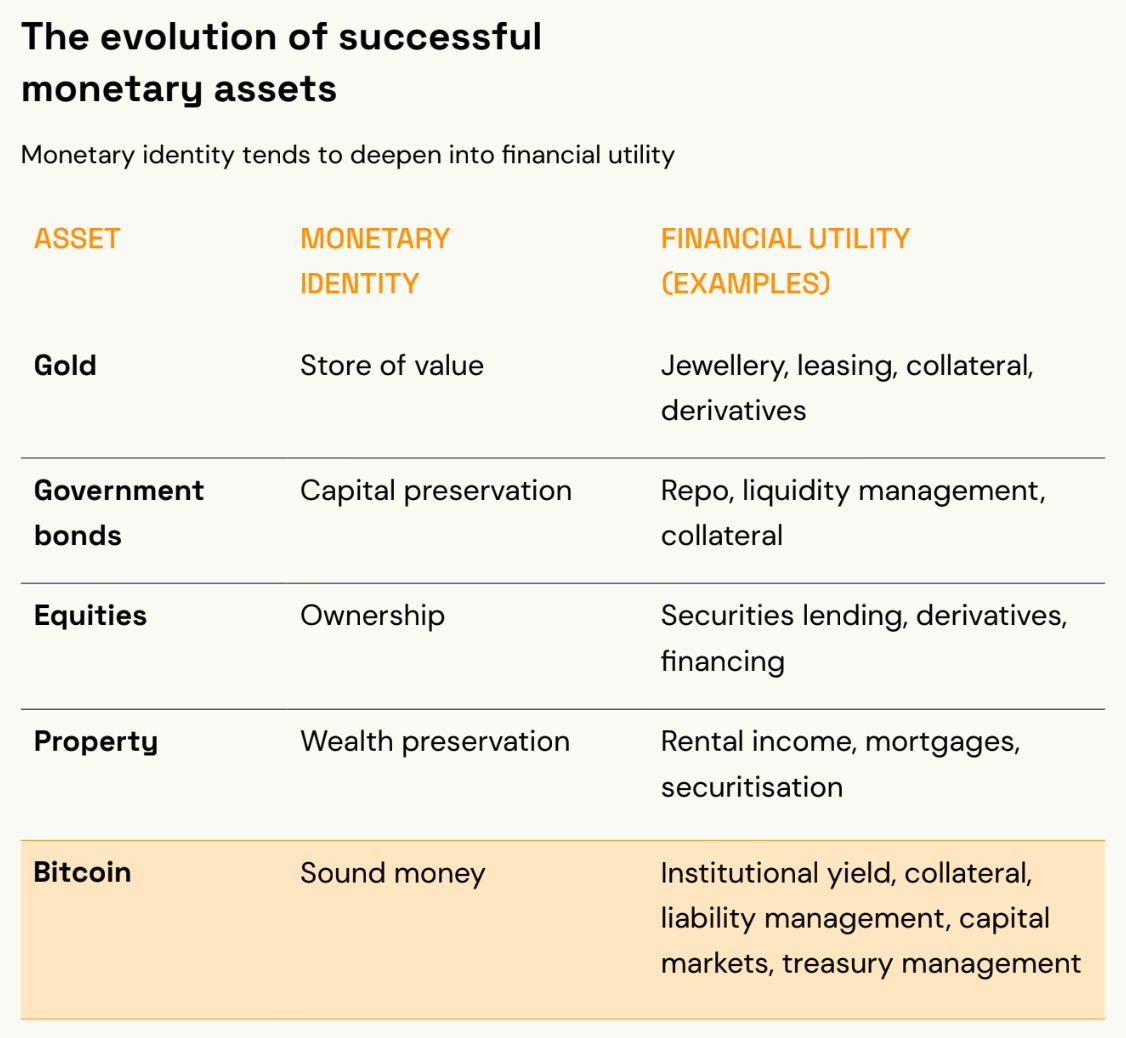
Comparison of the evolving financial uses of Bitcoin with traditional assets. Source: RootstockLabs Report
The report proposes a hypothetical scenario: if the amount of Bitcoin held by institutions doubles to 7.8 million BTC, and if 5% of that holdings generate an annualized return of 5%, institutions could produce a total of 19,500 BTC per year. This figure represents the potential return on existing holdings, rather than a forecast for the demand for additional Bitcoin.
The report compares Bitcoin to gold, arguing that a successful monetary asset will develop additional sources of demand beyond its initial use as a store of value. Gold later found applications in jewelry and electronic products, while RootstockLabs believes that Bitcoin’s next use will emerge in the financial market.
Will the financialization of Bitcoin bring new risks?
When asked about the risks associated with the deepening financialization of Bitcoin, RootstockLabs, the director of institutional solutions at the organization and author of the report, Tony DiCarlo, acknowledged these concerns, but he believes that Bitcoin's underlying design has significant advantages. He stated to Cointelegraph:
"Yes, financialization indeed brings real risks. Partial reserves, rehypothecation, and excessive leverage can occur around any scarce asset. However, the characteristics of Bitcoin can reduce some of these risks, as collateral can be verified on-chain, liquidation rules are programmable, and the supply of collateral will not be diluted."
DiCarlo indicates that borrower default, custody failure, and legal enforceability remain risks, while the volatility of Bitcoin also increases the risk of leverage.
However, he believes that the benefits brought about by financialization may far outweigh these risks, and he mentioned the case of MARA using a $750 million Bitcoin mortgage loan to finance the acquisition of a power plant in Ohio as part of its plan. This arrangement allows MARA to retain its Bitcoin holdings while using them as collateral to finance real-world infrastructure.
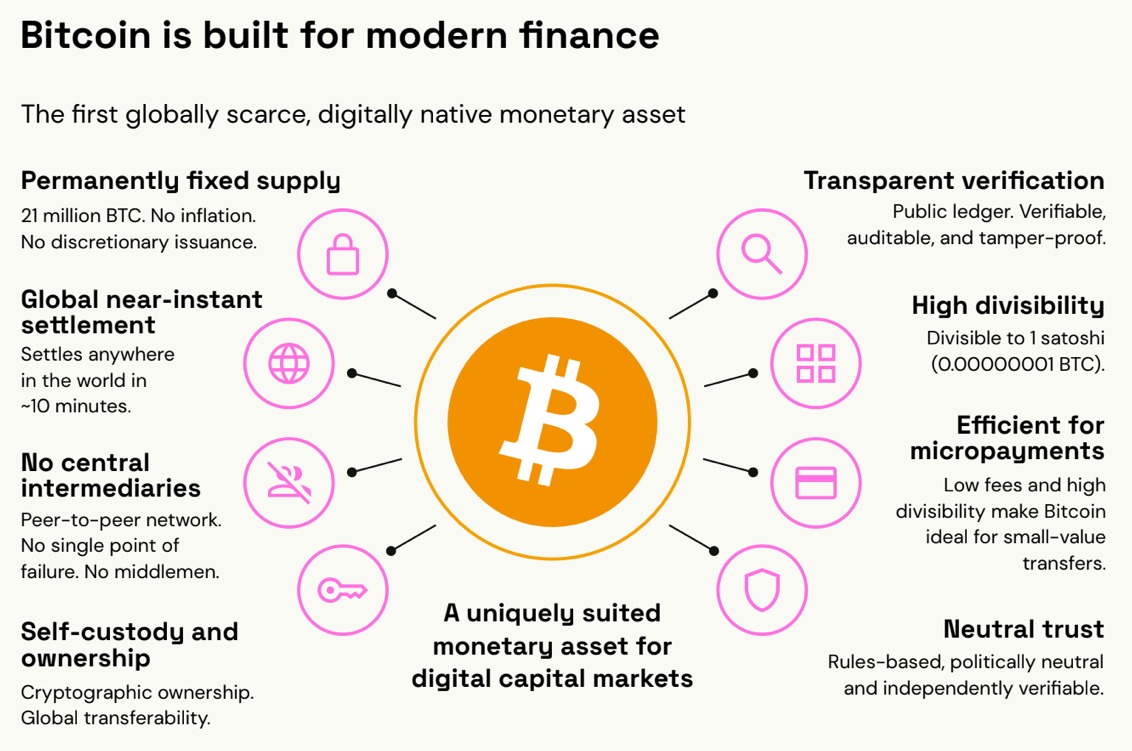
The key characteristics of Bitcoin for modern finance. Source: RootstockLabs Report
DiCarlo also acknowledges that such practices could lead to a concentration of Bitcoin holdings in the hands of a few custodians. Although spot Bitcoin exchange-traded funds have always been a significant driving force for institutional adoption, he stated that "shareholders hold shares, not coins," and warned that a handful of large custodian institutions could eventually end up holding most of the Bitcoin.
Nevertheless, DiCarlo still believes that Bitcoin's decentralized architecture is a fundamental advantage. It allows holders to retain control over their assets and supports financial services with fewer intermediaries, which potentially reduces counterparty risk and costs.
The decisive characteristic of Bitcoin is that no one owns it, and you can use it without the need for intermediaries. Holders retain control over their private keys, and because there are fewer intermediary steps, financial services built on Bitcoin can offer lower counterparty risks and lower fees. These advantages will attract users and also reward those builders who design products around these strengths.
Magazine: Crypto may outperform AI. Stocks: Wall Street veterans Jordi Visser.
Bitcoin Price
Lending
Layer2
Research
Bitcoin
More related content
- Bitcoin ETF saw a net inflow of $137 million, driving it back into positive growth in October.
- The Fed's hawkish stance keeps interest rates unchanged, continuing to put pressure on Bitcoin: Analysts
- FOMC and before the financial report, Bitcoin price rebounded but was hindered by the 50-day trend line