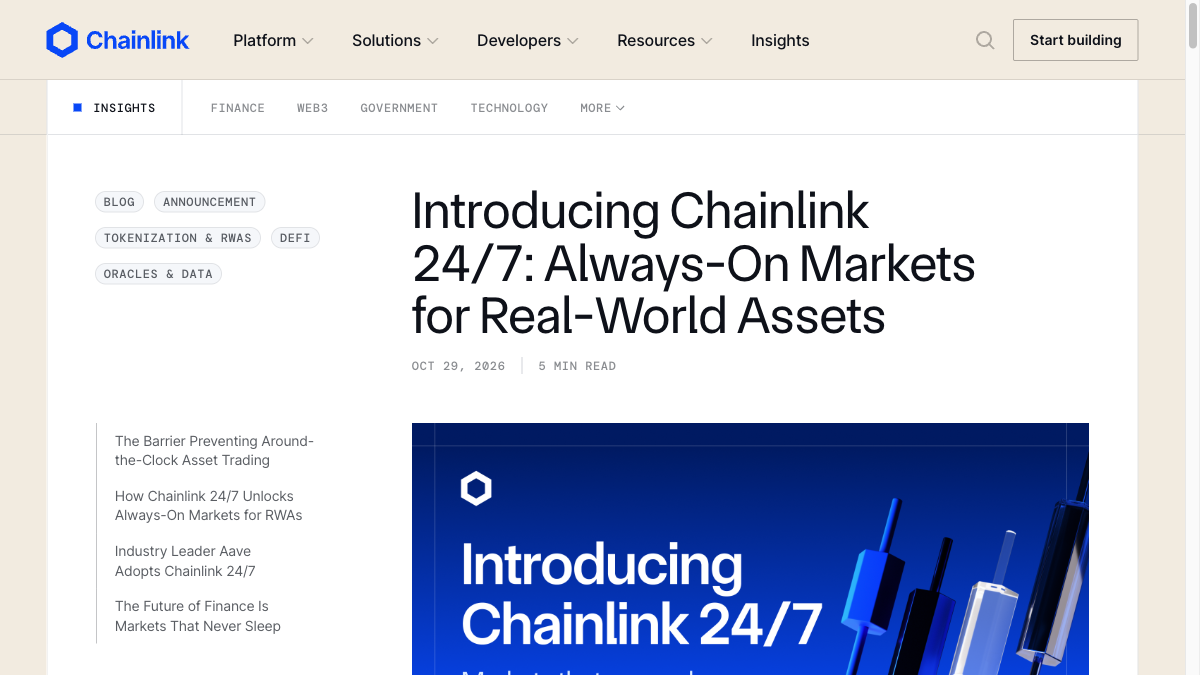


On Friday evenings, while traditional stock markets are closed, online lending positions continue to operate. If the collateral is tokenized stocks, protocols cannot stop managing risks just because the exchanges are resting. Chainlink launched 24/7 market data on October 29th, extending the pricing coverage of assets such as stocks and commodities to weekends and holidays; Aave is the official partner for this launch.
This upgrade is built upon the data from the previous 24/5 period. Coverage already exists for pre-market, regular, post-market, and overnight periods on weekdays. The remaining gaps are from 8 PM on Friday to 8 PM on Sunday Eastern Time, as well as during market holidays. In the past, on-chain applications had to choose to pause, use the last available prices, or handle the closed-market data and switching logic manually. Each of these options left price gaps that needed to be managed by the applications themselves.
For borrowers, the price is not just a reference figure for one time. Officials link continuous valuation with automatic liquidation and risk parameters: as long as a position remains open, the collateral needs to be reassessed. The time required for this re-assessment affects when funds can be utilized and also how risks are continuously measured.
Weekend prices are derived from derivatives, and the source is not concealed.
The key mechanism comes into effect after traditional markets close. During normal and extended trading hours, the system utilizes the existing 24/5 session data; during market closures, it switches to quotes from multiple major perpetual contract trading venues, filters out outdated inputs, limits the impact of abnormal prices, and then generates a continuous reference sequence for each supported asset.
This explanation changes the intuitive notion that 'the stock market has also started to trade throughout the day.' The reference to closed markets pertains to derivative trading activities related to assets, and does not mean that traditional exchanges that are already closed are still providing real-time transaction prices. The continued change in on-chain prices does not imply that the trading, clearing, and delivery schedules for the underlying stocks have also been altered by the same service.
The system manages source switching by recognizing the manner in which market sessions connect, while preserving price discovery during the reopening of regular trades. Developers do not need to assemble market data for each time period individually, but they should still understand that the same sequence depends on different markets at different times. Reduced continuity alleviates the engineering burden; however, it is not possible to turn two sources into the same trading reality.
Chainlink also indicates that the supported assets must meet the requirements of market coverage, liquidity, and price consistency. What is specified here are the supported assets; not all tokenized securities automatically enjoy the same level of coverage. The announcement does not provide a depth for each asset based on which the actual transaction cost can be calculated; therefore, the reference price cannot be directly equated with the price at which users can transact.
How data is delivered depends on how the application uses it.
The announcement also states that for short-term market forecasting, the time-weighted average price can be used as a reference for determining results. This is one method of application and should not be directly taken as proof that all forecasting markets have adopted this approach.
The service provides data in two ways: through Data Feeds and Data Streams. Lending protocols can read prices that are directly published on the chain; prediction markets and perpetual trading scenarios can obtain low-latency off-chain data as needed. The same continuous reference may have different delivery paths when entering different products.
Data Streams reports also identify the current market session and provide buy and sell quotes at the opening of trading. Applications can use this background information to adjust risk settings. For developers, this makes "what is the current market state" an available input; simply passing in the price values would result in missing the context that the announcements intentionally retain.
In the initial collaboration, Aave utilizes the institutional lending platform Horizon to have 24/7 Data Feeds value tokenized real assets as collateral, initially involving high-volume U.S. stocks. This scope cannot be extended to cover all markets of Aave; not all collaterals have been uniformly switched over, and moreover, the collaboration statement should not be misconstrued as an increase in the amount of new loans.
For those holding tokenized assets, continuous valuation may allow financing and position management to continue beyond traditional market closing hours; accordingly, the risk assessment that relies on reference prices does not automatically cease. Officials regard this as an infrastructure for managing risks, but the actual liquidation conditions are still subject to the parameters and rules of the specific application. With the launch of data services, no guarantee of safety is provided for any particular position.
What has changed this time is the division of labor for weekend risk pricing. Chainlink is now responsible for aggregating data from multiple sources and switching time periods, while the protocol continues to determine how to handle collateral and positions accordingly. Users will now face a continuous price that varies with market conditions across different sources. As the available time for capital utilization increases, it becomes necessary to clearly understand both the basis for pricing and the associated risk responsibilities.