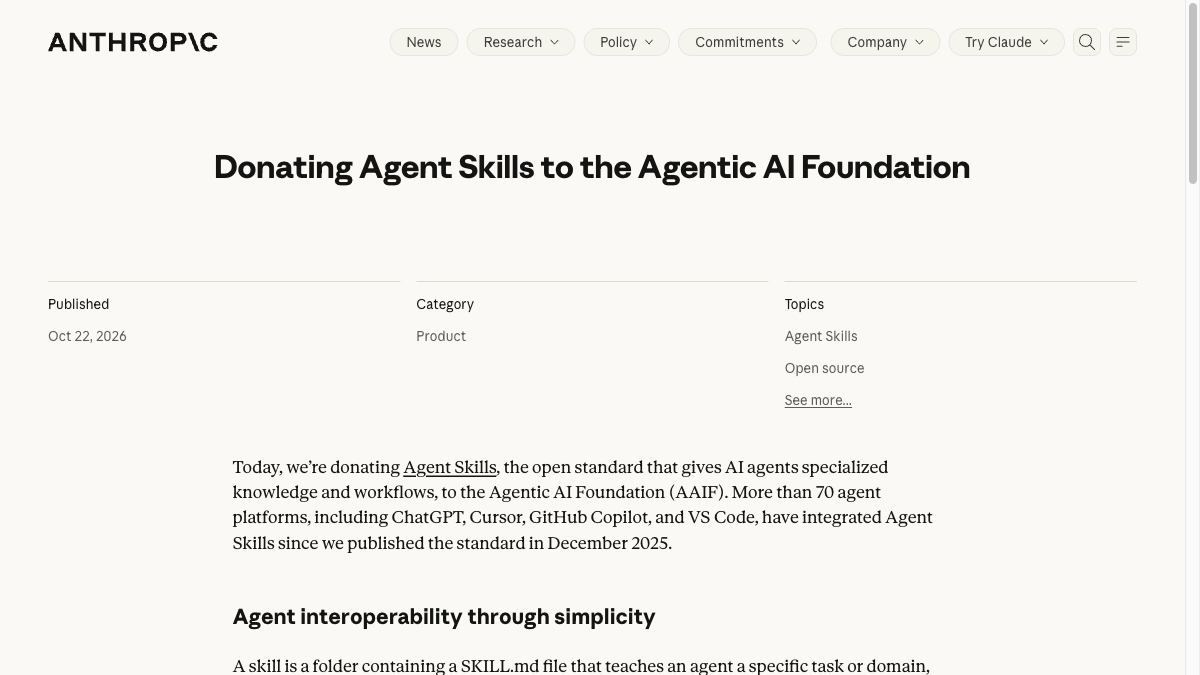


By placing SKILL.md in a folder, along with scripts and reference materials, the methodology for a specific task can be handed over to an agent. On October 22nd, Anthropic announced that it would donate the Agent Skills standard to Agentic AI Foundation, which is under the umbrella of Linux Foundation and is referred to as AAIF. What was donated included the name, logo, GitHub organization, and the agentskills.io domain name. The change first occurred in terms of who would maintain these rules.
According to Anthropic, since its standardization was announced in December 2025, more than 70 agent platforms have integrated it. The listed products include ChatGPT, Cursor, GitHub Copilot, and VS Code. For teams that have been transferring processes between different tools, the importance of this announcement lies in the fact that the file formats they use to describe their work methods now have a cross-vendor governance framework.
This is not just another model release. In an official review, Claude Code is capable of handling general knowledge tasks, but it often lacks the procedural knowledge required for real-world business tasks. The skill documents aim to fill this gap by providing detailed instructions on how to perform these tasks, placing operational steps, domain-specific materials, and available scripts in locations that the model can read.
A portable work method that lasts longer than a single chat window.
The basic unit of a skill is a folder. The files that describe the task exist together with the supporting materials, allowing users to see the work rules before use, as well as to continue to maintain the scripts and reference materials. This format provides a medium for business knowledge that can be modified, checked, and contributed to, without having to be retained entirely within a single conversation.
Officials stated that within a few weeks of the launch of the skill in October 2025, developers had published thousands of skills on GitHub, and also wrote loaders for Codex, Cursor, and OpenCode. Later on, the standard acquired its own independent organization and domain name, which could be adopted by any agent. The platform support here indicates that the format has gained a distribution channel; however, it does not guarantee that the operating permissions, available tools, and execution results will be exactly the same across all platforms.
For enterprises, this difference is particularly practical. A process can be shared across products, but where the script will ultimately be executed, what data it can access, and who is authorized to allow it to call tools are still determined by the usage environment. This judgment stems from the structure of putting instructions and execution materials together in a single skill, and it cannot be simplified to the idea that "by installing the same skill, all systems will gain the same capabilities."
The company disclosed that it has released 1 million skills in total, with nearly 280 million installations. These two figures represent different aspects: the number of releases does not indicate the number of active authors, and the number of installations does not represent the number of business tasks completed. They showcase what the company calls the scale of its ecosystem, but they are not sufficient to indicate how much cost the company has saved or how much the success rate of tasks has increased.
What is donated is the ownership of public rules.
One change in the announcement that requires clarification is that there is no need to add AAIF for either usage or contributions. The governance transition does not change the participation requirements to membership permissions, nor does it require developers to migrate to a specific entity's product. The public ownership of these rules remains separate from how manufacturers implement them within their products; there is still a distinction between the two.
Anthropic indicates that engineers from companies such as Anthropic, Google, and OpenAI will maintain the standards in their personal capacity, with David Soria Parra and Mahesh Murag serving as the main maintainers. This outlines a specific maintenance structure; it cannot be interpreted as meaning that there will be no one responsible for the standards from now on, nor can the list of companies be considered as an endorsement by all participants for each implementation.
The next step roadmap is still a proposal, which includes versioned releases, formal proposal procedures, and security guidelines for skill writers and installers. These cannot yet be considered a complete list of fully implemented functions. For teams that require long-term maintenance processes, the relevance of versioning and change procedures lies in the fact that once these processes are integrated into daily work, rule updates may affect ongoing use, rather than just being a one-time demonstration.
Skills and MCP were both donated by Anthropic to AAIF. The announcement presents both within the same governance context. However, just because a skill describes tasks and required materials does not automatically grant access to data from an external system merely by being part of the foundation. Open standards lower the barriers for different tools to use the same description methods, but the authorization for organizations to access data and perform actions still needs to be established within the actual systems.
This transfer has left the company with a clearer choice: they can adopt a universal format to accumulate their work methods, and then decide which agent will execute them. There is now a common point of negotiation for the maintenance of files, scripts, and rules, and the knowledge invested by the team into the processes is also easier to save separately from any particular product interface.