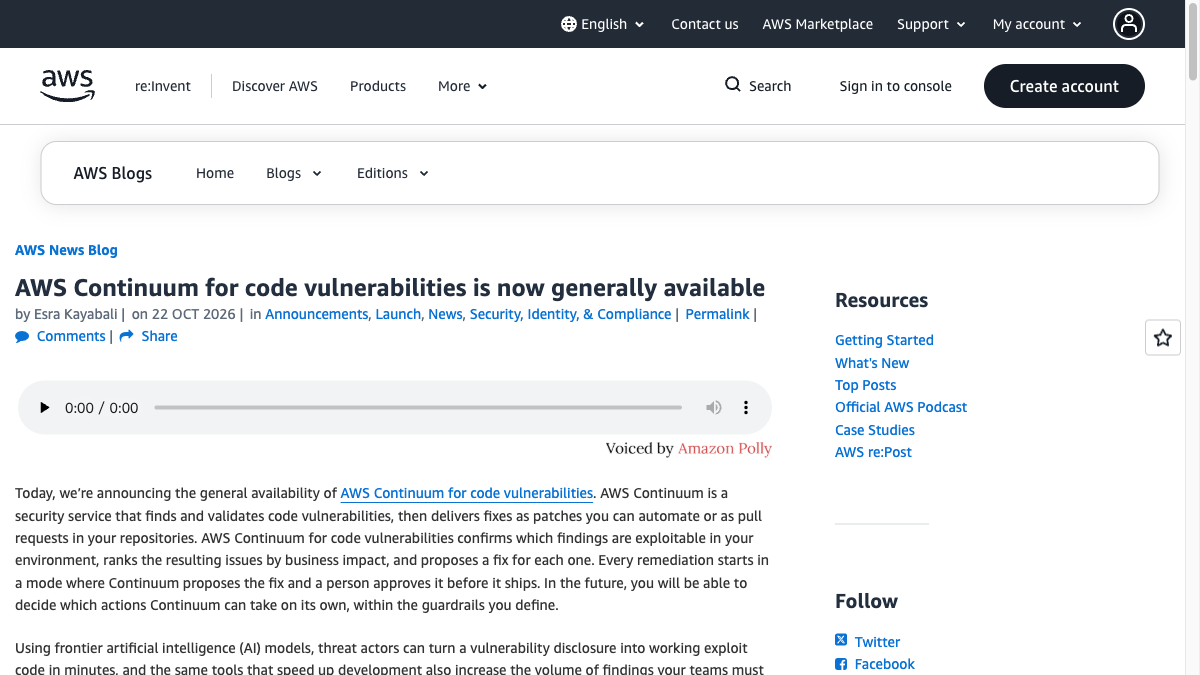


In the AWS console, the status of a vulnerability fix is displayed as "delivered to GitHub", and there is also a pull request in the code repository to modify four files. However, this vulnerability cannot yet be considered fixed. The officially available versions on October 22nd are AWS Continuum, for, code, and vulnerabilities. The process involves searching for, verifying, and generating patches, but the final review and merging are left to the team. This pause serves as the entry point for understanding this AI security service.
In the official demonstration, the patch added 50 lines and deleted 24 lines, which involved the cart service. What reviewers saw was not just a list of modification suggestions; it also included an analysis of the source code to determine whether attackers could access the service, whether authentication was required, which data could be affected, and other relevant factors. The fixes were sent to where developers usually work, so the security team no longer needed to translate the conclusions from the console into development tickets.
The friction faced by the product becomes clear from this: having many alerts does not mean that each one requires immediate attention from engineers. AWS gives an example: a tool used only in the development environment and a service that is close to the payment database may not be able to distinguish their actual processing order based solely on the general severity score. What this service attempts to do is to add business context and attack paths, rather than provide a longer list of scans.
The same piece of code can have different priorities when placed in different environments.
Integration starts from setting up the environment. Teams can connect to GitHub, or use the code from Amazon S3 as a source, and then choose the scanning frequency. When using S3, the bucket must be located in the same account and region as the service that is enabled, and access rights must be granted through the IAM role. What the software can read depends first and foremost on what the organization is willing to provide.
The team can also deploy collectors in the AWS account and region where the code is running, authorizing the environment to use cloud resource information. Collectors gather resource and network configuration data to help services determine whether vulnerabilities can be exploited over the network, as well as where attackers could potentially reach from that location. Officials state that based on this information, they construct a context map that links code with the environment, identifying service dependencies, responsible parties, and the data that is accessed.
There's a detail that can change the initial understanding: The product retains both the originally discovered issues and those that have been verified and prioritized. The Findings tags display the basic information provided by the scanner, while the Issues tags represent the results that the team processes according to priority. The approach to reducing workload is to turn these findings into understandable issues, rather than having developers manually process each machine-generated alert one by one.
Evidence also comes in different levels. One of the issues presented in the demonstration was marked as proof of static analysis; for issues that could be reproduced, the system was run in an isolated sandbox to demonstrate the process, along with proof-of-concept code and steps for reproduction. It is not appropriate to generalize 'each one has evidence' as 'each one has been successfully attacked in a real production environment.' The level of evidence itself is precisely the information needed by reviewers to determine the degree of trust they can place.
Only after the patch is completed does the responsibility enter the development process.
Fixes can be in the form of code patches, dependency upgrades, or configuration adjustments. Pull requests include risk analysis, a summary of the fix, and proof. Code reviewers can understand why changes are being made without leaving GitHub. The system also evaluates whether existing protections can prevent the verified paths, ensuring that the patch does not exist independently outside of the running environment.
However, the official release notes provide clear time boundaries: each fix currently begins with human approval; allowing the system to automatically perform certain fixes within designated limits is a capability that will be available in the future. We cannot use the broader vision of automation from the previous preview phase to replace the permission guidelines for this officially available product.
For corporate purchasers, this will change the issues during the trial period. Rather than simply comparing how many vulnerabilities a model can detect, it is more useful to check whether the environmental information is sufficient, whether the evidence can be reproduced, whether the scope of impact of the patches is clear, and whether the reviewers have the necessary conditions to make a decision regarding integration. These judgments are based on the processes officially presented; however, the announcement does not provide independently verifiable average repair times for customers or figures regarding the reduction in false positives.
The available regions are currently Northern Virginia in the Eastern United States and Oregon in the Western United States. Scan records, source settings, collectors, and whether to generate repair patches can all be managed within the environment. Organizations can adjust the frequency and inputs without having to integrate all the code and infrastructure at once.
From the console to the pull request, Continuum has added a step where machines are responsible for organizing evidence and repairing deliverables. The starting point for the development team has become more concrete: attack paths, business impacts, and potential modifications all arrive together. The authority to go live is still held by those responsible for reviewing the code, and the speed of automatically generating patches has not been canceled due to this organizational decision.