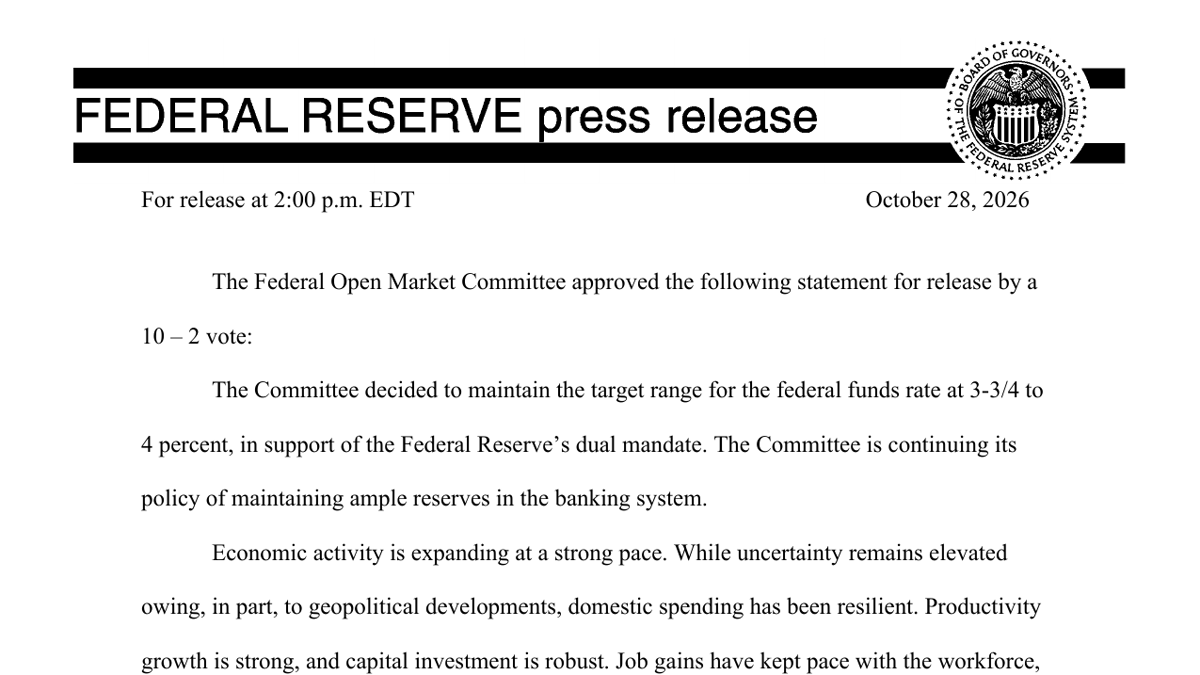


The Federal Reserve did not raise interest rates at its October meeting, and the target range for the federal funds rate remained at 3.75% to 4%. If we only look at the decision, it was a calm meeting; however, if we consider the voting, the picture is quite different: among the twelve members with voting rights, ten supported maintaining the current rate, while the two opponents both called for an additional 25 basis points increase in interest rates.
These two votes came from Director Lisa Cook and Federal Reserve Chairman of Cleveland, Beth Harkemack. The opposing views were not about one vote to lower and one to raise rates, but rather both pointed towards tighter policies. For the market, this contains more information than simply taking no action: the committee has chosen to observe for now, but the hawks believe that the current interest rates are not sufficient to curb inflation risks.
Economically strong enough that interest rate cuts are no longer urgent.
The description of the economy is described as being strong. The Federal Reserve states that economic activity is expanding at a steady pace, domestic spending remains resilient, capital investment is strong, and productivity continues to improve. Employment growth is roughly in line with labor force growth, and there has been little change in the unemployment rate. Such a combination does not create an immediate pressure for the committee to cut interest rates.
The maintenance of policy interest rates unchanged does not mean that the committee has deemed the risks to have been eliminated. The statement still indicates that inflation is "on the rise and remains high," and it also notes that the uncertainties regarding economic prospects remain significant. The Federal Reserve's statutory goals are maximum employment and 2% inflation. Currently, on one hand, employment has not significantly deteriorated, while on the other hand, price pressures have not fully returned to the target level. Therefore, continuing to wait remains the choice for most people.
Two interest rate hikes highlight the cost of this wait. If inflation remains high in an environment of strong economy and resilient domestic spending, maintaining current interest rates may be criticized as not tight enough; however, further rate increases would further increase the costs for corporate financing and household credit. The majority did not commit to a direction for the next step in their statement, leaving room for judgment at each subsequent meeting.
It is worth noting the way the votes are recorded. The official record indicates that the decision was passed with a ratio of 10 to 2, which means that there were twelve people counting the votes during the meeting, rather than it being summarized as "nine out of ten committee members in favor." The correct interpretation is: ten votes supported the current decision, and two votes were against it with a preference for raising interest rates. This detail may seem technical, but it is crucial for the market to understand the weight of the dissent—these are not isolated votes; rather, they represent two decision-makers openly calling for stricter policies.
The same interest rate can represent different levels of pressure for different people.
The target range of 3.75% to 4% is merely a policy anchor for interbank short-term funding rates. For these rates to affect the real economy, they must be transmitted through lending, bonds, deposits, and asset pricing. The statement does not promise any changes to mortgage rates, corporate loan rates, or credit card interest rates, nor does it outline any specific actions for the next meeting. What it does confirm is that the tightening monetary environment did not end with the October meeting.
For borrowers, "no interest rate hikes" mean that the additional pressure has not increased for the time being, but the existing financing costs will not automatically decrease as a result of this meeting. For depositors and those holding short-term assets, higher interest rates continue to provide returns. For businesses, the coexistence of strong investment and high financing costs indicates that overall data has not yet been significantly impacted by interest rates, but it cannot be inferred that all industries are in the same comfortable position.
The tendency to compress the differences in policy transmission into a few macro judgments is also where interest rate news is most prone to misinterpretation. Strong economic activity does not mean that every household has a strong cash flow; stable employment does not mean that all regions and income groups face the same credit pressures. What the committee does is make trade-offs at a national level, while the specific costs are still borne separately by different borrowers.
Two votes against set the direction for the next meeting.
The Federal Reserve reiterated that it will continue to assess new data, changing prospects, and the balance of risks. If risks emerge that hinder the achievement of its goals, the committee is prepared to adjust its policy stance. Such wording does not lock in either interest rate hikes or cuts, but indicates that this current policy stance will not be automatically extended.
Opposition votes thus became the clearest signal of direction before the next meeting. They sent a message to the market that there is a significant consensus within the committee: with growth and consumption still showing resilience, higher inflation may require more stringent measures to curb it. The majority has not yet accepted this view, but they have also not refuted it by lowering interest rates.
The policy situation after this meeting can be summarized as follows: interest rates remain unchanged, while debates have intensified. What has truly changed is that the stance of "maintaining stability" no longer appears completely neutral. If future data continues to show stubborn inflation, two votes in favor of raising interest rates could become the starting point for hawks to expand their influence; if employment trends significantly weaken, the majority will have even more reasons to wait. The decision to postpone the choice was made in October, but the disagreements have already been made public in advance.