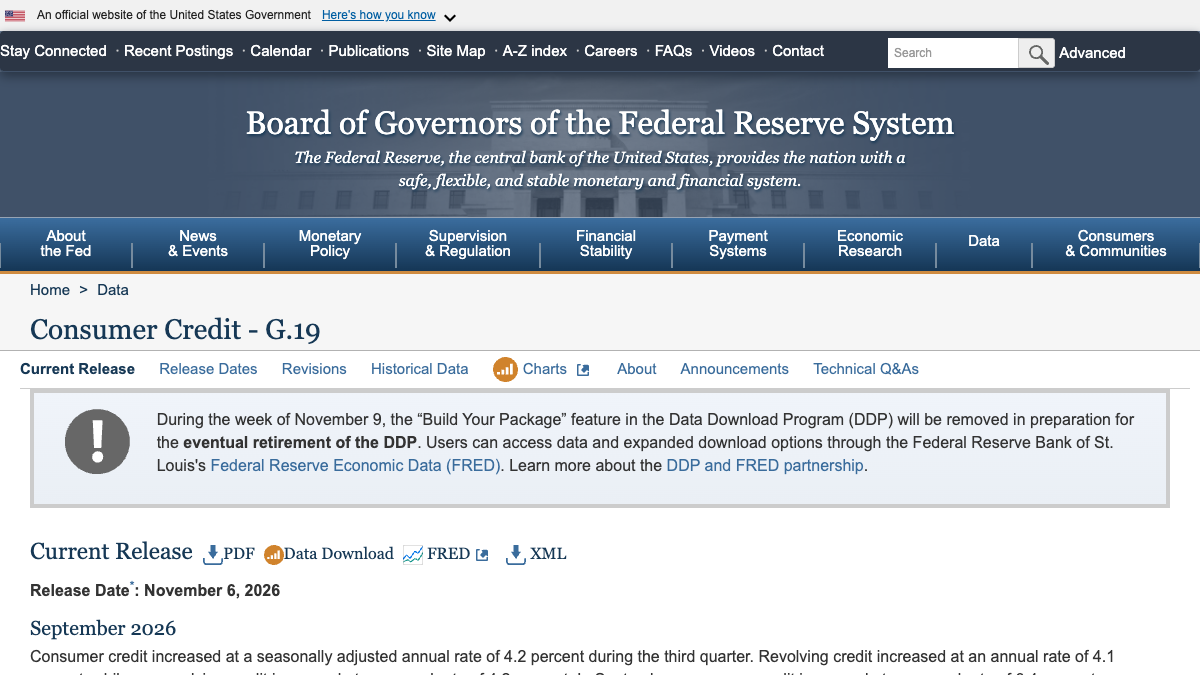


A report released by the Federal Reserve on November 6th, identified as G.19, showed that U.S. consumer credit grew at a seasonally adjusted annual rate of 6.4% in September, significantly higher than the 1.9% in August. Of this, revolving credit, which is mainly composed of credit cards, had an annualized growth rate of 14.5%, while non-revolving credit grew by 3.6%. By the end of September, the seasonally adjusted balance of consumer credit was approximately $5.224 trillion. A rapid increase over one month alone does not necessarily prove that households are losing their ability to pay, but it does reveal changes that are taking place between consumption, interest rates, and household cash flows.
First, understand the meaning of “14.5%”.
14.5% does not mean that the credit card balance increased by 14.5% in one month, but rather that the monthly change in September is extrapolated to represent an annual rate. The Federal Reserve uses an annualized basis for comparison between different months and quarters, but this method can exaggerate the fluctuations of a single month. In September, the annualized volume of revolving credit was approximately $195.6 billion, with the balance rising to about $1.369 trillion; in August, revolving credit had decreased at an annual rate of 4.4%.
A decline to double-digit growth indicates that households resumed cyclic borrowing in September, which may also be influenced by seasonal adjustments, billing cycles, and one-time expenditures. To determine the trend, it is necessary to observe whether this pattern continues over the coming months. If the growth falls back in October, September's increase would merely seem like a fluctuation; however, if it continues to accelerate, it would suggest that credit cards are playing a more significant role in supporting spending.
Non-cyclical credit is more stable, and structural differences deserve attention.
Non-cyclic credit, which includes loans such as car loans and student loans that are repaid according to a fixed plan, saw an annualized growth of 3.6% in September, with a balance of approximately $3.856 trillion. In the third quarter, overall consumer credit had an annualized growth of 4.2%, with the cyclic and non-cyclic parts growing by 4.1% and 4.2% respectively. The quarterly data is smoother than monthly data, indicating that household borrowing is generally expanding, but it did not experience a sudden spike like the credit card data in September.
These differences can help distinguish between two types of needs. Automotive and education financing often correspond to decisions involving larger amounts and longer terms; credit cards, on the other hand, more readily reflect short-term consumption and cash flow turnover. A sudden acceleration in revolving credit may stem from consumer confidence or from households using loans to cover daily expenses. It is not possible to determine the motive by merely looking at the balance; it is necessary to observe it in conjunction with retail sales, income, delinquency rates, and savings data.
High interest rates make new balances more expensive.
G.19 Also lists the credit card interest rates of commercial banks. The average interest rate for all accounts in the third quarter was 21.19%, and for those with actual interest calculation, it was 22.36%. This means that the growth of revolving balances occurs in an environment where financing costs are still quite high. For those who make full monthly payments, the balance on the account may merely be a figure in the settlement process; however, for those with long-term outstanding debts, interest rates of over 20% can quickly erode disposable income.
Therefore, the same additional $1 in credit card balance has completely different implications for different families. High-income families may use the card for convenience and to earn points, and pay it off before it expires; families with tight cash flow might shift expenses such as medical bills, food, or rent payments onto their credit cards. Aggregate data does not reveal this distribution, nor can it tell us who will ultimately bear the interest on this additional balance.
It is a support for consumption, but also a constraint on future expenditures.
Credit expansion can allow households to make purchases before their income arrives, supporting demand for retail, services, and durable goods in the short term. However, borrowing is not free income. The additional balance in the cycle today will turn into tomorrow's minimum payments and interest, especially under high interest rates, which means future budgets are being used up in advance. If wage growth cannot keep up with the cost of repayment, consumer momentum may be sustained by borrowing at first, but then it will be suppressed by debt service.
This is also why the market cannot simply interpret an increase in credit as a sign of a strong economy. It may indicate that households are willing to spend, or it may suggest that some households lack a cash buffer. A more explanatory combination would be to consider whether there are simultaneous changes in credit growth, real income, credit card delinquency rates, and bank standards. If borrowing increases while delinquencies and loan rejections also rise, the implications of that would be more concerning; however, if income remains stable and delinquencies are under control, then the expansion may still be within an acceptable range.
The Federal Reserve will not change its interest rate trajectory based on just one G.19.
Consumer credit is part of the transmission of monetary policy. High policy interest rates affect households through credit cards, car loans, and personal loans, which in turn cause households to adjust their consumption and borrowing patterns. The acceleration in credit in September may indicate that demand has not declined rapidly; however, G.19 does not include real estate mortgages, nor does it directly measure household net worth, loan quality, or the purpose of consumption, so it cannot independently determine whether inflation will pick up again.
When it comes to policy judgment, what is more important is whether the trends can be corroborated by employment data, price levels, and bank statistics. The annualized growth rate of 14.5% for revolving credit is certainly a cause for concern, but it does not automatically signal an economic recession. It is more like a yellow warning light: American consumers are still able to borrow money, and they have indeed increased their borrowing; what remains to be seen is whether these borrowed amounts will lead to sustainable consumption or more expensive financial pressures.