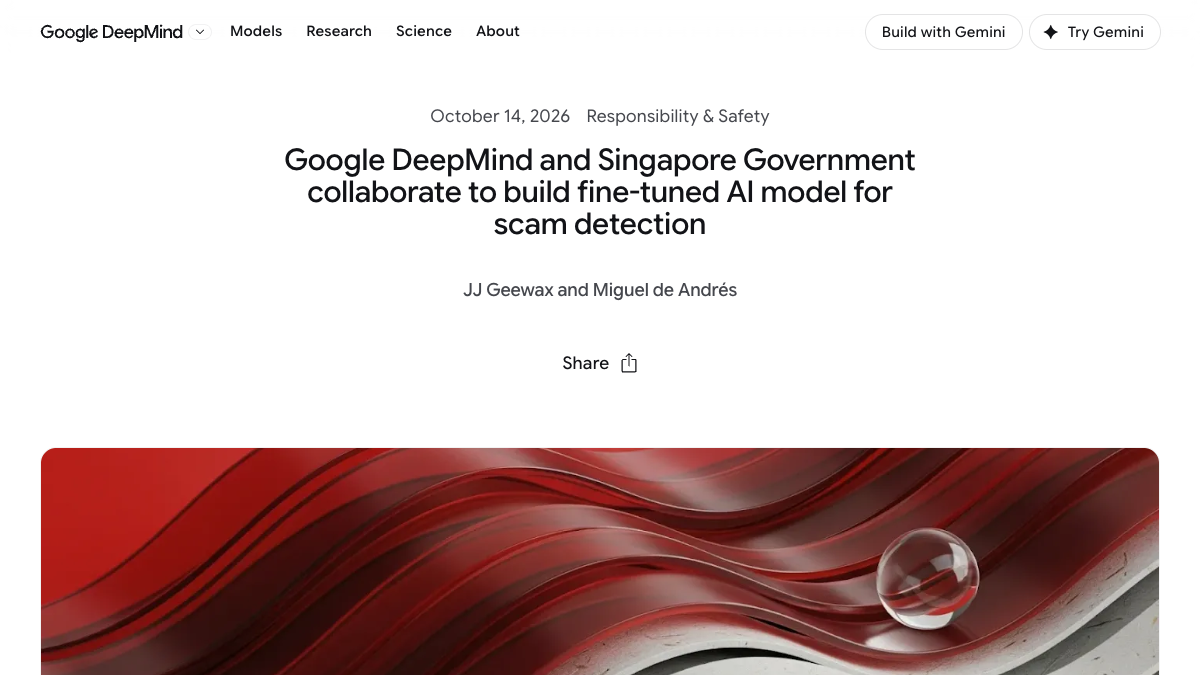


Google DeepMind has collaborated with the Singapore Government Technology Agency to fine-tune a model for detecting fraud on the user's end. Based on a lightweight Gemma, this model learns about common scams involving impersonations of government agencies, banks, and public figures in the region. Once users give their consent, the model will analyze conversations directly on their phones and issue real-time alerts. This approach aims to address a long-standing issue: fraud increasingly relies on extensive social engineering tactics, while end-to-end encryption prevents platforms from arbitrarily reading messages. By moving the judgment process to the device itself, it is possible to reduce the time to issuance of warnings, but it also brings issues related to permissions, false positives, and device performance to every single phone.
Fraud is no longer just a suspicious link.
Official materials indicate that fraud accounts for more than half of the crimes reported in Singapore, with losses exceeding S$4 billion since 2019. The tactics used in these scams have evolved from simple phishing to more sophisticated forms of conversational manipulation: fake customer service representatives build trust initially, fake investment advisors continuously promise high returns, and individuals impersonating officials use urgency to compel victims to transfer money. Losses caused by such social engineering techniques can account for up to 80% of all fraud-related losses.
Traditional rules are adept at identifying URLs, phone numbers, and keywords, but it is difficult for them to understand how a sequence of conversations can gradually alter a person's judgment. A single statement like "transfer the money to a secure account" might seem like an ordinary discussion on its own, but it only becomes dangerous when it follows a series of acts of identity impersonation, threats, and urging. What end-side models need to do is not to search for banned words, but to identify patterns of manipulation within longer contexts. This is also why they must learn local institution names, language habits, and recent scams.
Two-stage recognition is implemented to save power and to reduce false positives as well.
Running complex models continuously on a mobile phone consumes battery power and computing power. The solution introduced by DeepMind adopts a two-stage process: in the first stage, a lighter detection method is used to screen for suspicious signals, and in the second stage, the fine-tuned Gemma is called to analyze larger segments of conversations to confirm threats or rule out false alarms. Only when there are sufficient signs of a threat will the system make a more in-depth judgment.
This design serves both performance and accuracy. If each message triggers a full inference process, users might turn off the feature due to high power consumption, latency, or frequent reminders. On the other hand, if the filtering is too stringent, it could result in missed scams that progress slowly. The real challenge for anti-fraud systems is not identifying a typical scam in a laboratory setting, but rather running them on actual mobile devices over a long period of time and keeping the number of reminders within a range that users are willing to believe.
End-side processing has changed who can see messages.
The project emphasizes that conversations are processed locally on the device, and neither Google nor the Singaporean government will obtain any user chat content as a result of the model deployment. Once the model is integrated into the application, it can only access the conversations on the device with the user's consent and in compliance with the terms of use of that application. The training data does not contain any private citizen information or personally identifiable information; instead, it uses anonymized data from fraud reports and intelligence materials. The fine-tuning of the model is completed in a cloud environment managed by the Singaporean government.
These arrangements reduce the risk of centrally uploading private messages to the cloud, but "running locally" does not automatically mean there are no privacy issues. Applications still need to clearly state which sessions they read, what logs they save, whether alerts will be sent back, and how users can revoke their authorization. If a device is controlled by someone else, if there are vulnerabilities in system components, or if the application uses these risk labels for other purposes, new harms may arise. Privacy protection is a continuous process of permission design, not just a simple statement of "data not going to the cloud."
Both false positives and false negatives can affect real decisions.
When a model labels a normal conversation as fraudulent, users may miss legitimate bank notifications, job opportunities, or family remittances; when the model does not alert authorities, users might interpret silence as a guarantee of safety. Therefore, anti-fraud reminders must clarify their purpose: they serve as a signal to pause and verify the situation, rather than providing a final determination on behalf of the users or law enforcement agencies. The most useful reminders should offer actionable steps, such as stopping transfers, calling back through official channels, not sharing verification codes, and providing a way for users to see the reasons and provide feedback about errors.
Localized data can also become outdated over time. Scam groups will change their tactics, mix languages, and even study the prompts to counter them. Models need to be continuously updated, but each update may alter the distribution of false positives. Governments and platforms should make public the scope of testing, main restrictions, and channels for complaints, and assess the effectiveness based on different languages, age groups, and device performance, to avoid the average accuracy rate masking the unintended harm suffered by specific populations.
Anti-fraud technologies must ultimately be integrated with financial processes.
The phone issues a warning before the transfer, which only buys a few minutes of time. If banks, payment platforms, and the police do not have rapid freezing, verification, and reporting procedures in place, users may still proceed with the transaction under pressure from the other party. An effective defense mechanism needs to combine end-side identification with transaction limits, suspicious recipient accounts, trusted contacts, and official inquiry tools. Models can understand conversations, while financial systems can track the flow of funds; each plays a different role.
This collaboration is currently planned to be implemented in phases, and the official description does not suggest that it has become a mature service that covers all smartphones. It offers a route worth observing: allowing devices to understand fraudulent narratives without centrally reading private messages. However, the true measure of success is not how many cases the model can identify during demonstrations, but whether users are willing to enable this feature, whether the alerts are credible enough, whether the amount of money lost due to fraud decreases, and whether incorrect judgments can be corrected in a timely manner. Privacy and security are not mutually exclusive; both require long-term testing.