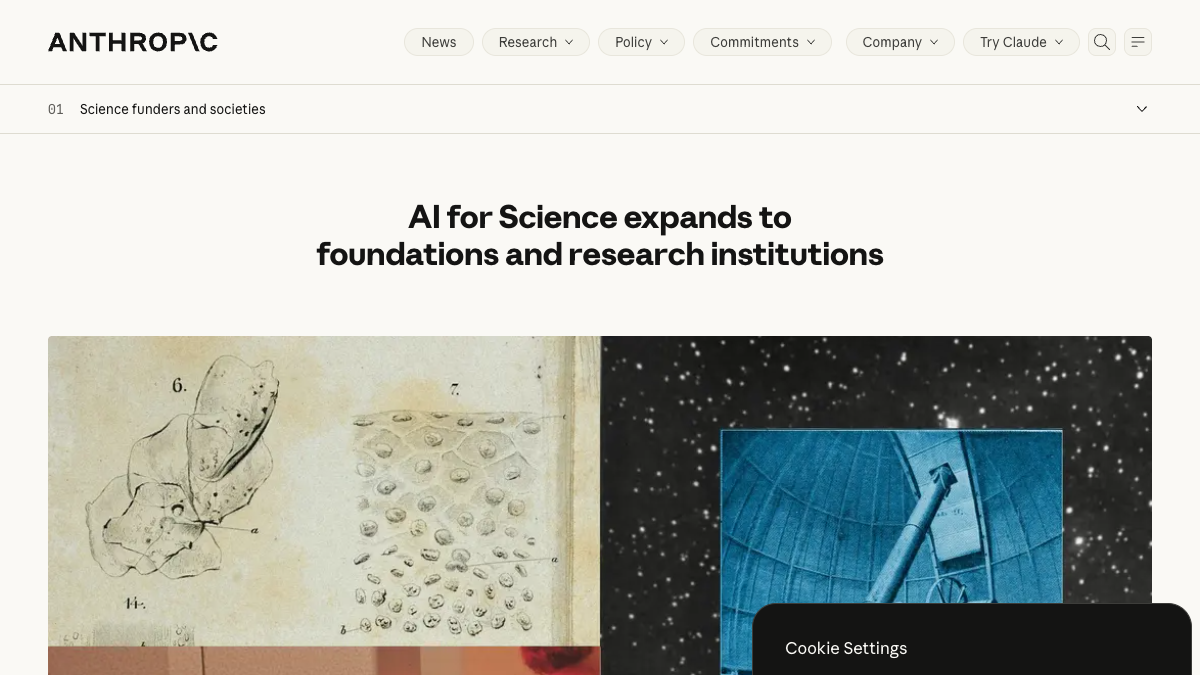


Anthropic has expanded the quota program, which was originally aimed at individual researchers, to include 20 scientific foundations, research institutions, and projects. The list includes organizations such as the Sloan Foundation and the National Science Foundation of the United States, as well as the Space Telescope Science Institute, which is responsible for the scientific operations of the Hubble and Webb telescopes, the European Molecular Biology Laboratory, and teams that study the brain connectomes of fruit flies, climate models, and genes of rare diseases. What the company provides are Claude usage quotas, not ready-made scientific conclusions. This distinction is what makes this program particularly noteworthy: AI Upon engaging in scientific research, what is first changed is the cost of exploration and trial and error in research, rather than providing researchers with pre-determined answers.
From a personal account to institutional capability
Early scientific research AI projects often began with individual trials. Researchers used models to organize literature, write code, interpret data, and then found ways to bring the results back into the laboratory process. While individual trials were flexible, they also tended to lead to several issues: who could obtain sufficient resources, whether sensitive data could be entered, who would review the generated code, and how team members could replicate the same process. Institutional collaboration brought these issues to the fore, as resources, accounts, data, and methods had to shift from being managed according to "individual habits" to a work approach that could be jointly managed.
The partners listed in Anthropic span across astronomy, genomics, tumor imaging, climate science, and mathematical formalization. The ways models are used in these different fields vary. Astronomical data analysis requires processing large-scale observation archives, genomic projects emphasize sample privacy, while mathematical formalization demands that every step can be verified by machines. A unified chat interface cannot bridge these differences. What institutions truly need to establish are domain-specific constraints, validation tools, and chains of responsibility, rather than training all researchers to use the same set of prompts.
The speed improvement first occurred in the "intermediate links".
According to the official introduction, researchers are using Claude to generate hypotheses, design experiments, analyze complex data, and communicate results. Among these four tasks, the model can most significantly streamline the intermediate step: converting natural language questions into preliminary code, quickly comparing various analysis approaches, or organizing lengthy materials into a structured format ready for verification. This enables researchers to determine earlier whether a particular approach is worth pursuing and also lowers the barriers to interdisciplinary communication.
But speed does not equate to the strength of evidence. Just because a model proposes a seemingly reasonable experimental design does not mean that the variables are correctly controlled; and generating a piece of code that can run does not mean that the statistical hypotheses are valid. The value of scientific research lies precisely in its reproducibility, refutability, and traceability. If AI compresses ten manual attempts into one conversation, the team should still retain the input materials, versions, parameters, failure results, and human judgments. Otherwise, the research may become faster, but it may not necessarily become more credible.
Public achievements are more important than a single impressive presentation.
Anthropic emphasizes that some collaborative projects will result in open data, open-source software, open standards, and shared libraries. This direction holds more long-term value than simply showing how much a model improves on a certain benchmark. Once the scientific research infrastructure is made open, other teams can review, improve upon it, or point out issues; if the results remain within a few rounds of discussions in closed accounts, it becomes difficult for outsiders to determine whether the progress comes from the model, the data, or the researchers' experience.
Taking model hardware standards as an example, it attempts to establish shared specifications for AI to act as a proxy for safe operation of laboratory equipment. The challenges here are not just about making the proxy able to "press buttons," but also include issues related to permissions, emergency stops, device status, and error recovery. Only by making these rules into public standards can different laboratories collaborate on a common safety framework. Similarly, open connection groups, gene mutation reference libraries, and formal proof libraries can also ensure that the benefits of a single project are available to subsequent researchers.
Free quotas can also lead to new dependencies.
Providing free quotas to research institutions can expand the scope of use, but the institutions still need to consider the costs in the second phase. After the trial period ends, who will be responsible for the payment, whether the workflow can be migrated to other models, whether the key code is bound to a certain interface, and whether research data can be securely transferred across different environments are all factors that affect the sustainability of the project. The scientific research cycle is often longer than the product development cycle. If there are changes in model versions, prices, or usage policies, experimental processes that rely on a single supplier may face re-validation.
Therefore, while institutions receive these quotas, they need to treat the models as replaceable research components. Important conclusions should be able to be reproduced independently of a particular chat record; core data must be stored separately with access control in place; and model outputs should be incorporated into version-controlled code, notes, and review processes. Only in this way can free resources truly enhance research capabilities, rather than quietly accumulating technical debt.
AI can expand the scope of problems, but it cannot choose the direction for scientists.
Although the lineup of 20 collaborating institutions seems impressive, they are still at different stages of development, and officials have clearly stated that many of these collaborations have just begun. It is not yet possible to infer from this list that there have been any concrete breakthroughs in drug discovery, climate prediction, or mathematical proofs. A more accurate observation is that scientific research organizations are seeking a stable role for these models: to enable them to perform high-frequency, verifiable cognitive tasks, allowing researchers to devote their time to problem definition, experimental judgment, and the interpretation of anomalies.
Scientific progress rarely emerges automatically just because answers can be written more quickly. What is truly scarce are questions that are worth exploring further, experiments that can distinguish between coincidence and mechanism, and the judgment to be willing to reevaluate when results do not match expectations. The value of AI, for, and Science lies in their ability to provide more time and better tools for these processes. Claude can expand the scope of exploration that researchers can undertake at one time, but deciding which path is worth taking and which evidence is sufficiently credible remains a human task.