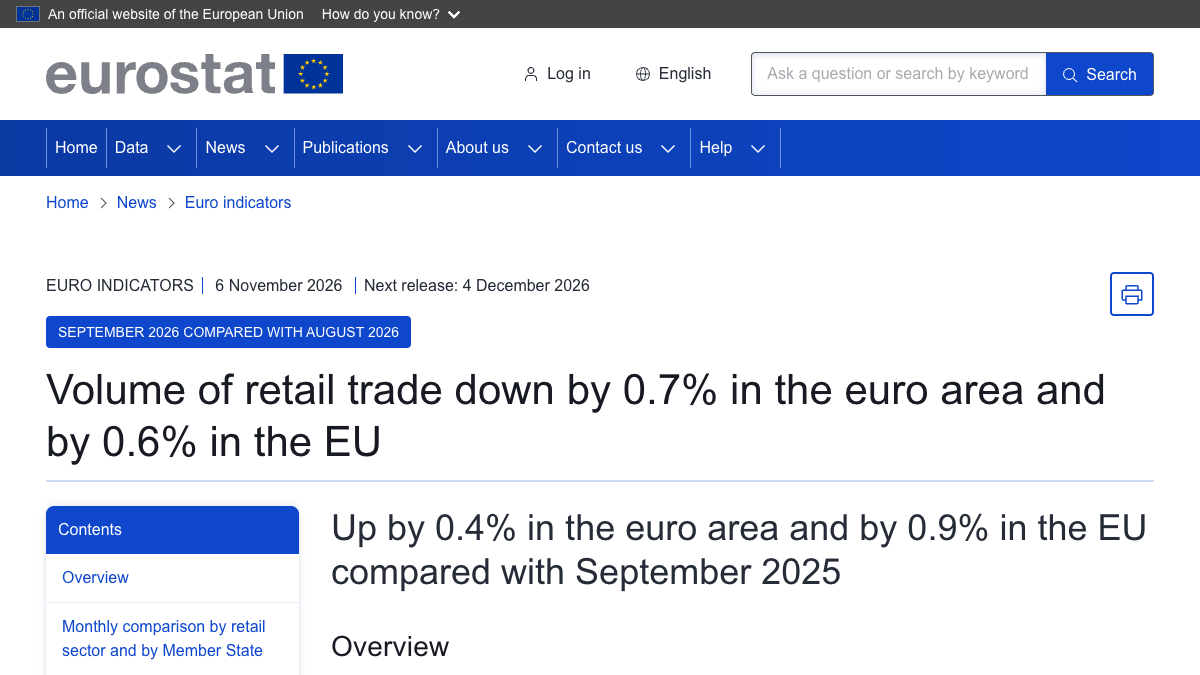


Preliminary figures released by the European Statistical Office on November 6 showed that retail trade volume in the eurozone decreased by 0.7% in September compared to August, and by 0.6% in the EU as a whole; however, compared to a year ago, the eurozone still saw a growth of 0.4%, while the EU grew by 0.9%. The presence of both "month-on-month decline" and "year-on-year increase" in the same set of data is not contradictory. These two comparisons answer different questions: the former looks at the trend of the most recent month, while the latter examines the level accumulated over the past year. What is truly worth analyzing is which goods and countries experienced this decline in September, and whether this trend will continue.
A month of decline interrupted the rebound in August.
In August, both retail trade volume in the eurozone and within the European Union increased by 0.4% month-on-month, but this growth declined in September. The 0.7% decrease in the eurozone not only wiped out the increase from the previous month but also brought the total volume back to a weaker level. Data over the past six months has shown fluctuations: the eurozone saw a 0.7% decline in July, a 0.4% increase in August, and another 0.7% decline in September. This pattern suggests a lack of sustained momentum in consumption, rather than a smooth growth curve.
Retail trade volume, after adjusting for price changes, is closer to the actual quantity of goods purchased and is not equal to the nominal sales amount received by merchants. During periods of high inflation, consumers may spend more money but end up buying fewer goods; the trade volume indicator is precisely designed to distinguish between price and quantity. Therefore, the decline in September indicates a weakening of actual purchasing activity, which cannot be explained solely by rising prices.
Non-food products are the main drag.
Itemized data shows that in the eurozone, food, beverages, and tobacco saw a month-on-month decline of 0.3%, while non-food goods declined by 1.2%. In professional stores, automobile fuel experienced a growth of 1.0%. The corresponding changes in the EU were a decline of 0.4%, a decline of 1.0%, and a growth of 0.1% respectively. The more significant decline in non-food goods indicates that households are more likely to postpone purchases of clothing, household items, and other discretionary expenses, whereas the demand for food remains relatively rigid.
The increase in fuel consumption also needs to be interpreted with caution. It may stem from changes in the number of trips, actual purchases after price adjustments, or monthly fluctuations, and cannot directly prove a overall strengthening of traffic activity. The opposite directions among the various components illustrate that one total figure cannot represent all consumption scenarios. For retail businesses, the category they operate in is more decisive than the European average in terms of their business experience.
Germany fell by 2%, with greater disparities among member states than the average.
Among the member countries with existing data, Germany saw a month-on-month decline of 2.0%, Romania a decline of 1.3%, and Portugal a decline of 0.9%; Luxembourg experienced growth of 5.3%, Slovakia of 2.2%, and Malta of 1.5%. The difference between the largest increase and the largest decrease exceeded 7 percentage points. European retail is not a synchronous market; factors such as population size, wages, tourism, taxation, and domestic inflation can all affect monthly results.
Germany is larger in size, and its decline will have a stronger impact on the eurozone average. However, single-month growth of more than 5% in smaller countries may also be influenced by base effects and one-time factors, and cannot be directly compared to Germany's economic scale. When analyzing data from member states, it is important to consider both weight and sustainability to avoid misinterpreting extreme percentages as the main trend for the entire Europe.
Year-on-year growth indicates that consumption has not returned to levels below last year.
Compared to September 2025, food, beverages, and tobacco in the eurozone saw a growth of 1.1%, non-food goods grew by 0.7%, while automotive fuel decreased by 3.0%; in the EU, these figures were 1.0% growth, 1.2% growth, and a 2.3% decrease, respectively. Year-on-year data indicates that, except for fuel, most retail categories are still higher than they were a year ago. The weaker month-on-month trend further suggests a recent loss of momentum, rather than a comprehensive decline below last year's levels overall.
This combination is commonly seen during periods of moderate economic growth but insufficient confidence. Household incomes may have improved compared to a year ago, yet people remain cautious about future expenditures; interest rates, housing costs, and energy bills still influence purchasing decisions. As long as there is positive year-over-year growth, it cannot be called a retail recession; however, several consecutive months of weak month-over-month growth can gradually erode that annual growth.
Monetary policy depends on whether consumption exhibits a continuous weak trend.
For the European Central Bank, a decline in retail sales may indicate reduced demand pressure, which could help inflation continue to cool down. However, monthly data is susceptible to the influence of holidays, weather, and seasonal adjustments, so policy decisions will not be based solely on a single drop in September. Service consumption is not fully included in retail trade, and households buying fewer goods does not necessarily mean that total consumption will contract accordingly.
The key next is whether recovery can occur in October and November, and whether wages, consumer confidence, and services sector activity will support spending. The data from September do not provide a simple conclusion; rather, they reflect two realities: European consumers spent less than in August, but overall it is still slightly higher than a year ago; non-food spending has significantly contracted, with varying performances among member countries. To determine whether consumption has truly weakened, we need to wait for this monthly decline to become a continuous trend.